Zhang Chuanfu, Qiu Shaofu, Wang Yong, Qi Lihua, Hao Rongzhang, Liu Xuelin, Shi Yun, Hu Xiaofeng, An Daizhi, Li Zhenjun, Li Peng, Wang Ligui, Cui Jiajun, Wang Pan, Huang Liuyu, Klena John D, Song Hongbin
Institute of Disease Control and Prevention, Academy of Military Medical Science, Beijing, People's Republic of China.
PLoS One. 2013 Jun 3;8(6):e64857. doi: 10.1371/journal.pone.0064857. Print 2014.
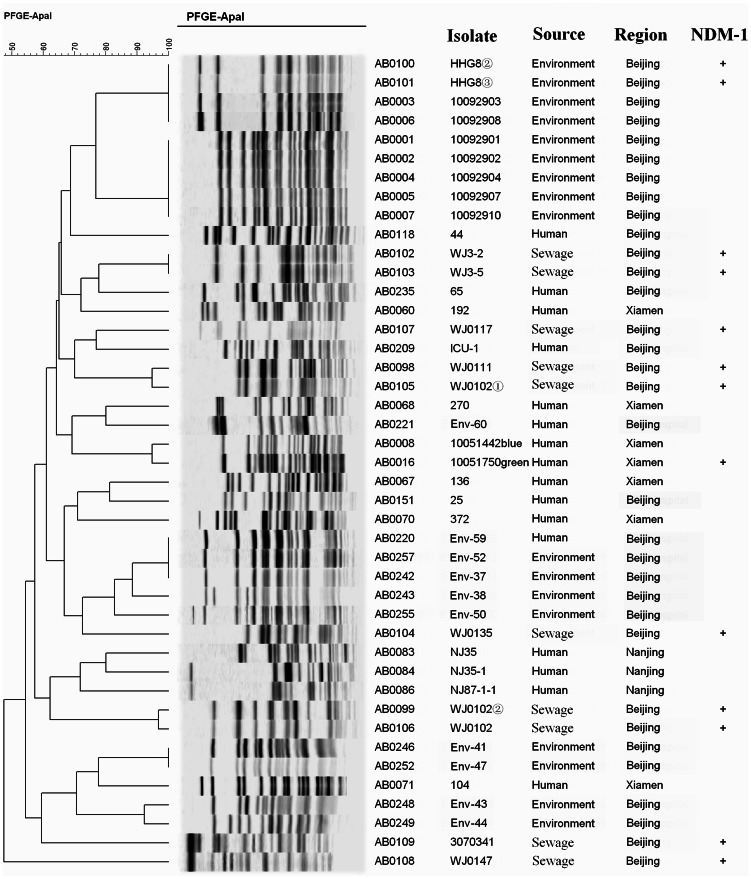
Multidrug resistant microbes present in the environment are a potential public health risk. In this study, we investigate the presence of New Delhi metallo-β-lactamase 1 (NDM-1) producing bacteria in the 99 water samples in Beijing City, including river water, treated drinking water, raw water samples from the pools and sewage from 4 comprehensive hospitals. For the bla NDM-1 positive isolate, antimicrobial susceptibility testing was further analyzed, and Pulsed Field Gel Electrophoresis (PFGE) was performed to determine the genetic relationship among the NDM-1 producing isolates from sewage and human, as well as the clinical strains without NDM-1. The results indicate that there was a higher isolation of NDM-1 producing Acinetobacter baumannii from the sewage of the hospitals, while no NDM-1 producing isolates were recovered from samples obtained from the river, drinking, or fishpond water. Surprisingly, these isolates were markedly different from the clinical isolates in drug resistance and pulsed field gel electrophoresis profiles, suggesting different evolutionary relationships. Our results showed that the hospital sewage may be one of the diffusion reservoirs of NDM-1 producing bacteria.
环境中存在的多重耐药微生物是一种潜在的公共卫生风险。在本研究中,我们调查了北京市99份水样中产生新德里金属β-内酰胺酶1(NDM-1)的细菌的存在情况,这些水样包括河水、处理后的饮用水、泳池原水样本以及4家综合医院的污水。对于bla NDM-1阳性分离株,进一步分析了抗菌药敏试验,并进行了脉冲场凝胶电泳(PFGE)以确定来自污水和人类的产NDM-1分离株之间以及无NDM-1的临床菌株之间的遗传关系。结果表明,医院污水中产NDM-1的鲍曼不动杆菌分离率较高,而从河流、饮用水或鱼塘水样中未分离出产NDM-1的菌株。令人惊讶的是,这些分离株在耐药性和脉冲场凝胶电泳图谱方面与临床分离株明显不同,表明存在不同的进化关系。我们的结果表明,医院污水可能是产NDM-1细菌的扩散储存库之一。