Department of Clinical Pharmacology & Therapeutics, University of the Ryukyus, Okinawa, Japan.
BMJ Open. 2013 May 28;3(5):e002934. doi: 10.1136/bmjopen-2013-002934.
To evaluate the effect of low-protein diet on kidney function in patients with diabetic nephropathy.
A systematic review and a meta-analysis of randomised controlled trials.
MEDLINE, EMBASE, Cochrane Library, ClinicalTrials.gov, International Standard Randomised Controlled Trial Number (ISRCTN) Register and University Hospital Medical Information Network-Clinical Trials Registry (UMIN-CTR) from inception to 10 December 2012. Internet searches were also carried out with general search engines (Google and Google Scholar).
Randomised controlled trials that compared low-protein diet versus control diet and assessed the effects on kidney function, proteinuria, glycaemic control or nutritional status.
The primary outcome was a change in the glomerular filtration rate (GFR). The secondary outcomes were changes in proteinuria, post-treatment value of glycated haemoglobin A1C (HbA1c) and post-treatment value of serum albumin. The results were summarised as the mean difference for continuous outcomes and pooled by the random effects model. Subgroup analyses and sensitivity analyses were conducted regarding patient characteristics, intervention period, methodological quality and assessment of diet compliance. The assessment of diet compliance was performed based on the actual protein intake ratio (APIR) of the low-protein diet group to the control group.
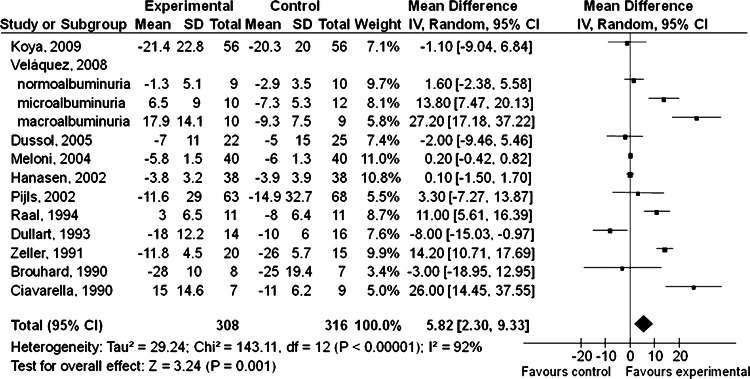
We identified 13 randomised controlled trials enrolling 779 patients. A low-protein diet was associated with a significant improvement in GFR (5.82 ml/min/1.73 m(2), 95% CI 2.30 to 9.33, I(2)=92%; n=624). This effect was consistent across the subgroups of type of diabetes, stages of nephropathy and intervention period. However, GFR was improved only when diet compliance was fair (8.92, 95% CI 2.75 to 15.09, I(2)=92% for APIR <0.9 and 0.03, 95% CI -1.49 to 1.56, I(2)=90% for APIR ≥0.9). Proteinuria and serum albumin were not differed between the groups. HbA1c was slightly but significantly decreased in the low-protein diet group (-0.26%, 95% CI -0.35 to -0.18, I(2)=0%; n=536).
Low-protein diet was significantly associated with improvement of diabetic nephropathy. The adverse effects of low-protein diet were not apparent such as worsening of glycaemic control and malnutrition.
评估低蛋白饮食对糖尿病肾病患者肾功能的影响。
系统评价和随机对照试验的荟萃分析。
MEDLINE、EMBASE、Cochrane 图书馆、ClinicalTrials.gov、国际标准随机对照试验编号(ISRCTN)登记处和大学医院医疗信息网-临床试验注册处(UMIN-CTR),从建立到 2012 年 12 月 10 日。还使用了通用搜索引擎(Google 和 Google Scholar)进行了互联网搜索。
比较低蛋白饮食与对照饮食并评估对肾功能、蛋白尿、血糖控制或营养状况影响的随机对照试验。
主要结果是肾小球滤过率(GFR)的变化。次要结果是蛋白尿、治疗后糖化血红蛋白 A1C(HbA1c)值和治疗后血清白蛋白值的变化。结果以连续结果的平均值差异表示,并采用随机效应模型进行汇总。根据患者特征、干预期、方法学质量和饮食依从性评估进行了亚组分析和敏感性分析。饮食依从性的评估是基于低蛋白饮食组与对照组的实际蛋白质摄入比(APIR)进行的。
我们确定了 13 项随机对照试验,共纳入 779 名患者。低蛋白饮食与 GFR 的显著改善相关(5.82ml/min/1.73m2,95%CI 2.30 至 9.33,I2=92%;n=624)。这种效果在糖尿病类型、肾病阶段和干预期的亚组中是一致的。然而,只有当饮食依从性良好时,GFR 才会改善(8.92,95%CI 2.75 至 15.09,I2=92%,APIR<0.9;0.03,95%CI-1.49 至 1.56,I2=90%,APIR≥0.9)。两组间蛋白尿和血清白蛋白无差异。低蛋白饮食组的 HbA1c 略有但显著降低(-0.26%,95%CI-0.35 至-0.18,I2=0%;n=536)。
低蛋白饮食与糖尿病肾病的改善显著相关。低蛋白饮食的不良影响并不明显,如血糖控制恶化和营养不良。