Karamifar Hamdollah, Habibian Narges, Amirhakimi Gholamhosein, Karamizadeh Zohre, Alipour Abbas
Department of Pediatrics, Shiraz University of Medical Sciences, Shiraz, Iran.
Iran J Pediatr. 2013 Jun;23(3):295-301.
Adiponectin is secreted from adipose tissue. This hormone has a fundamental role in pathogenesis of insulin resistance, and has anti-inflammatory and anti-atherogenic effects. The objectives of this study were to compare serum adiponectin level between type 1 diabetics and healthy people and to assess its related factors, and also to determine the relationship between adiponectin and metabolic state.
This was a case control study involving 60 diabetics (25 good and 35 poor metabolic controlled) and 28 healthy persons (younger than 18 years old). The data about demographic (age and sex), clinical and paraclinical characteristics [body mass index (BMI), duration of disease, puberty state, and glycosylated hemoglobin (HbA1c) and adiponectin level in serum] were collected. Determinants of adiponectin were assessed using univariate and multiple linear regression analyses.
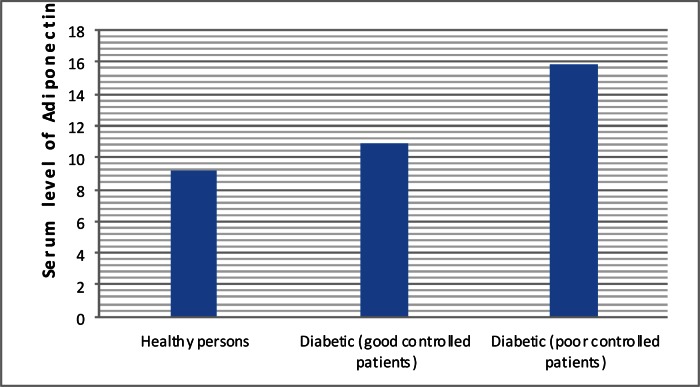
Mean (±SD) serum adiponectin level in healthy persons, good-controlled and poor-controlled type 1 diabetes mellitus patients were 9.16 (±4.2) µg/cc, 10.89 (±4.48)µg/cc, and 15.92 (±8.26)µg/cc, respectively. Post hoc analysis revealed that differences of adiponectin between poor- and good-controlled type 1 diabetes mellitus patients (P=0.01) and between healthy persons and poor controlled type 1 diabetes mellitus (P<0.0001) were statistically significant. Adiponectin level was associated with puberty state and BMI in healthy persons. It was associated with puberty state and HbA1c in type 1 diabetic persons.
Serum level of adiponectin was higher in type 1 diabetics than in healthy persons and it can be used as a good marker for metabolic control state among diabetics.
脂联素由脂肪组织分泌。这种激素在胰岛素抵抗的发病机制中起重要作用,具有抗炎和抗动脉粥样硬化作用。本研究的目的是比较1型糖尿病患者和健康人血清脂联素水平,评估其相关因素,并确定脂联素与代谢状态之间的关系。
这是一项病例对照研究,纳入60例糖尿病患者(25例代谢控制良好,35例代谢控制不佳)和28例健康人(年龄小于18岁)。收集有关人口统计学(年龄和性别)、临床和辅助临床特征[体重指数(BMI)、病程、青春期状态、糖化血红蛋白(HbA1c)以及血清脂联素水平]的数据。使用单因素和多元线性回归分析评估脂联素的决定因素。
健康人、代谢控制良好和代谢控制不佳的1型糖尿病患者的平均(±标准差)血清脂联素水平分别为9.16(±4.2)μg/cc、10.89(±4.48)μg/cc和15.92(±8.26)μg/cc。事后分析显示,代谢控制不佳和代谢控制良好的1型糖尿病患者之间(P=0.01)以及健康人和代谢控制不佳的1型糖尿病患者之间(P<0.0001)脂联素的差异具有统计学意义。脂联素水平与健康人的青春期状态和BMI相关。它与1型糖尿病患者的青春期状态和HbA1c相关。
1型糖尿病患者的血清脂联素水平高于健康人,它可作为糖尿病患者代谢控制状态的良好标志物。