Institute of Agricultural and Nutritional Sciences, Martin-Luther-University Halle-Wittenberg, Halle (Saale), Germany.
PLoS One. 2013 Jul 24;8(7):e69418. doi: 10.1371/journal.pone.0069418. Print 2013.
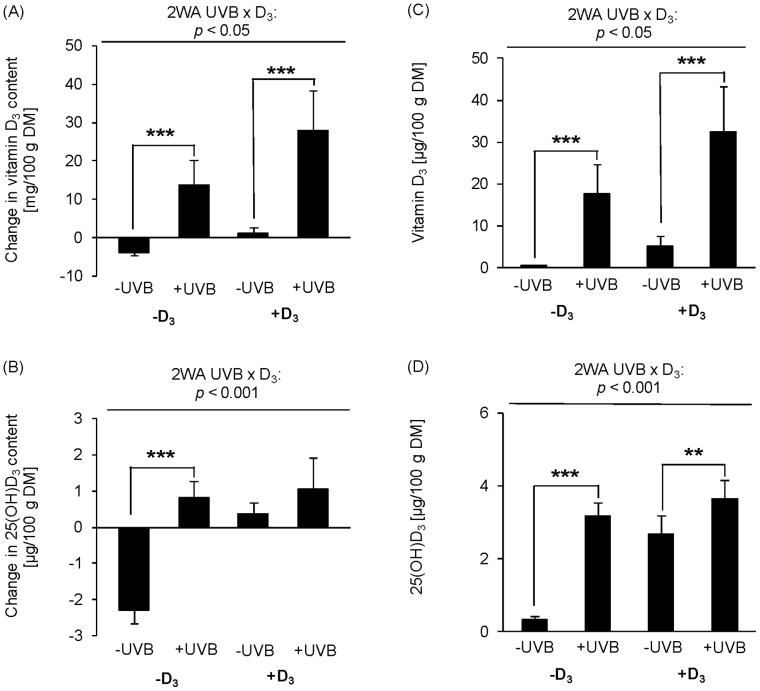
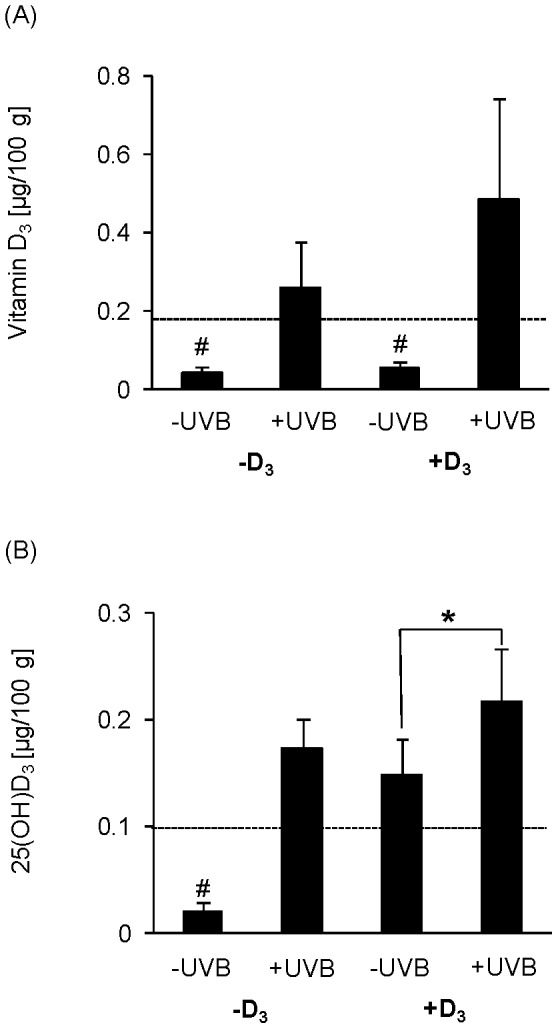
Vitamin D deficiency is a global health problem. This study aimed to investigate the efficacy of ultraviolet (UV) B radiation for improving vitamin D3 content of eggs and meat. In a two-factorial design hens that received diets with 0 (-D3) or 3,000 IU (+D3) vitamin D3/kg were non-exposed (-UVB) or exposed to UVB radiation (+UVB) for 3 h daily over 4 weeks. Data show that UVB radiation was very effective in raising the vitamin D3 content of egg yolk and meat. Egg yolk from +UVB/-D3 hens had a higher vitamin D3 content (17.5±7.2 µg/100 g dry matter (DM)) than those from the -UVB/+D3 group (5.2±2.4 µg/100 g DM, p<0.01). Vitamin D3 content in egg yolk of vitamin D3-supplemented hens could be further increased by UVB radiation (32.4±10.9 µg/100 g DM). The content of 25-hydroxyvitamin D3 (25(OH)D3) in the egg yolk also increased in response to UVB, although less pronounced than vitamin D3. Meat revealed about 4-fold higher vitamin D3 contents in response to UVB than to dietary vitamin D3 (p<0.001). In conclusion, exposure of hens to UVB is an efficient approach to provide consumers with vitamin D3-enriched foods from animal sources.
维生素 D 缺乏是一个全球性的健康问题。本研究旨在探讨紫外线(UV)B 辐射对提高鸡蛋和肉类中维生素 D3 含量的功效。在双因素设计中,摄入 0(-D3)或 3000 IU(+D3)维生素 D3/kg 日粮的母鸡分别接受或不接受(-UVB)或每天接受 3 小时的 UVB 辐射(+UVB),持续 4 周。结果表明,UVB 辐射非常有效地提高了蛋黄和肉中的维生素 D3 含量。来自 +UVB/-D3 母鸡的蛋黄中维生素 D3 含量更高(17.5±7.2 µg/100 g 干物质(DM)),高于 -UVB/+D3 组(5.2±2.4 µg/100 g DM,p<0.01)。补充维生素 D3 的母鸡的蛋黄中维生素 D3 含量可通过 UVB 辐射进一步增加(32.4±10.9 µg/100 g DM)。蛋黄中 25-羟维生素 D3(25(OH)D3)的含量也随着 UVB 而增加,尽管不如维生素 D3 明显。与饮食中维生素 D3 相比,肉类对 UVB 的反应维生素 D3 含量高出约 4 倍(p<0.001)。总之,让母鸡暴露于 UVB 是一种有效方法,可以为消费者提供富含维生素 D3 的动物源食品。