Department of Medical Sciences, Respiratory Medicine & Allergology, Uppsala University, Uppsala University Hospital, 751 85, Uppsala, Sweden.
BMC Geriatr. 2013 Aug 7;13:82. doi: 10.1186/1471-2318-13-82.
Low lung function is associated with increased morbidity and mortality. It is therefore of interest to identify biomarkers that are associated with impaired lung function. The aim of the study was to analyse associations of biomarkers and combinations of biomarkers with lung function in an elderly general population.
Lung function (FEV1 and FVC) and a panel of 15 inflammatory markers from blood samples were analysed in 888 subjects aged 70 years. Biomarkers included cytokines, chemokines, adhesion molecules, C-reactive protein (CRP) and leukocyte count.
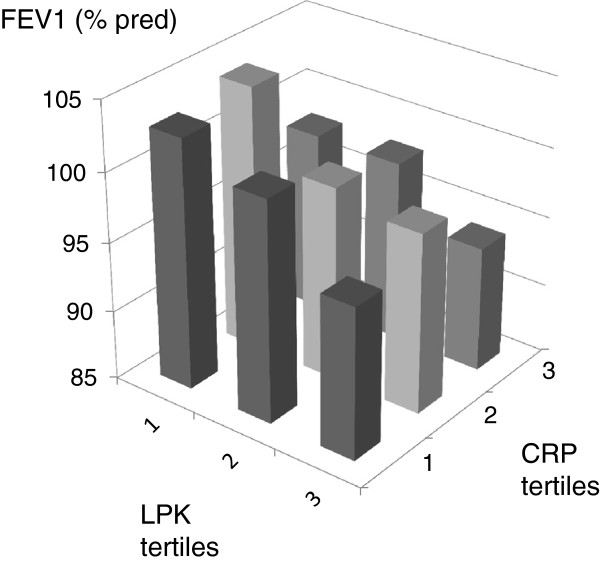
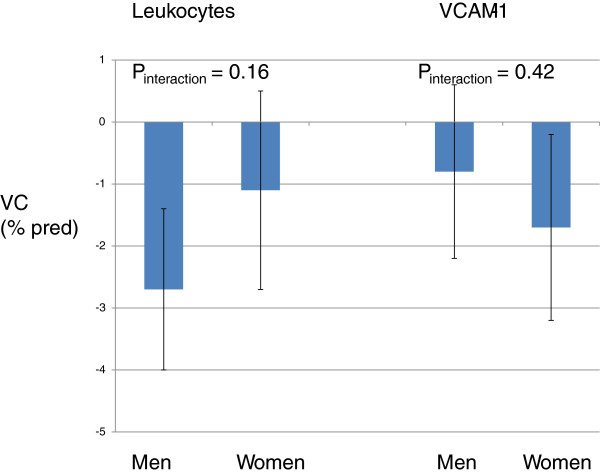
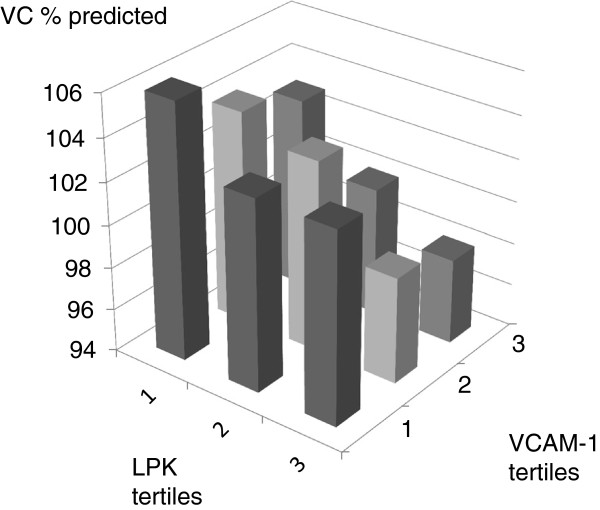
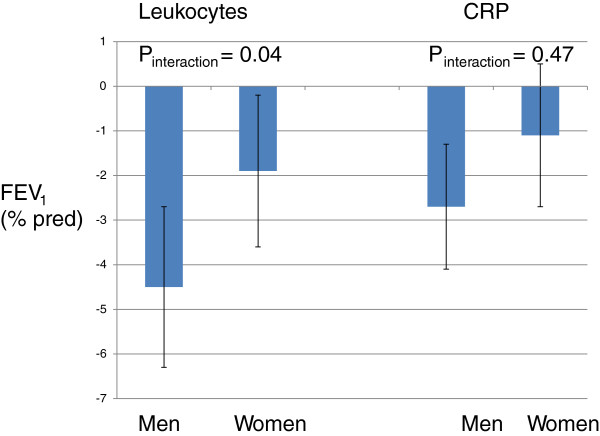
Leukocyte count and CRP were independently associated with FEV1 after adjustments for other inflammatory markers, sex, BMI, current smoking and pack-years of smoking. In a similar model, leukocyte count and vascular cell adhesion protein 1 (VCAM-1) were the biomarkers that were significantly associated with FVC. Subjects that had both leukocyte count and CRP in the lowest tertile had a FEV1 that was 9% of predicted higher than subjects with leukocyte count and CRP in the highest tertile (103±16 vs. 94±21% of predicted, p=0.0002) (mean±SD). A difference of 8% of predicted in FVC was found between subjects with leukocyte count and VCAM-1 in the lowest and highest tertiles, respectively (106±18 vs. 98±19% of predicted, p=0.002).
Leucocyte count, CRP and VCAM-1 were found to relate to poorer lung function. A dose related association was found for the combination leukocyte count and CRP towards FEV1 and leukocyte and VCAM-1 towards FVC. This indicates that combination of two biomarkers yielded more information than assessing them one by one when analysing the association between systemic inflammation and lung function.
肺功能降低与发病率和死亡率的增加有关。因此,寻找与肺功能受损相关的生物标志物是很有意义的。本研究的目的是分析生物标志物及其组合与老年人群肺功能的相关性。
对 888 名 70 岁的受试者的肺功能(FEV1 和 FVC)和血液样本中的 15 种炎症标志物进行了分析。生物标志物包括细胞因子、趋化因子、黏附分子、C 反应蛋白(CRP)和白细胞计数。
在校正其他炎症标志物、性别、BMI、当前吸烟和吸烟包年数后,白细胞计数和 CRP 与 FEV1 独立相关。在类似的模型中,白细胞计数和血管细胞黏附蛋白 1(VCAM-1)是与 FVC 显著相关的生物标志物。白细胞计数和 CRP 均处于最低三分位的受试者的 FEV1 比白细胞计数和 CRP 均处于最高三分位的受试者高 9%(103±16 对 94±21%预测值,p=0.0002)(均数±标准差)。白细胞计数和 VCAM-1 处于最低和最高三分位的受试者的 FVC 分别相差 8%(预测值,分别为 106±18 对 98±19%预测值,p=0.002)。
白细胞计数、CRP 和 VCAM-1 与肺功能降低相关。白细胞计数和 CRP 与 FEV1 呈剂量相关性,白细胞计数和 VCAM-1 与 FVC 呈剂量相关性。这表明在分析系统性炎症与肺功能之间的关系时,组合两种生物标志物比逐个评估它们提供了更多的信息。