Promotion Centre for Global Materials Research, Department of Material Science and Engineering, National Cheng Kung University, Tainan, Taiwan.
Sci Rep. 2013;3:2414. doi: 10.1038/srep02414.
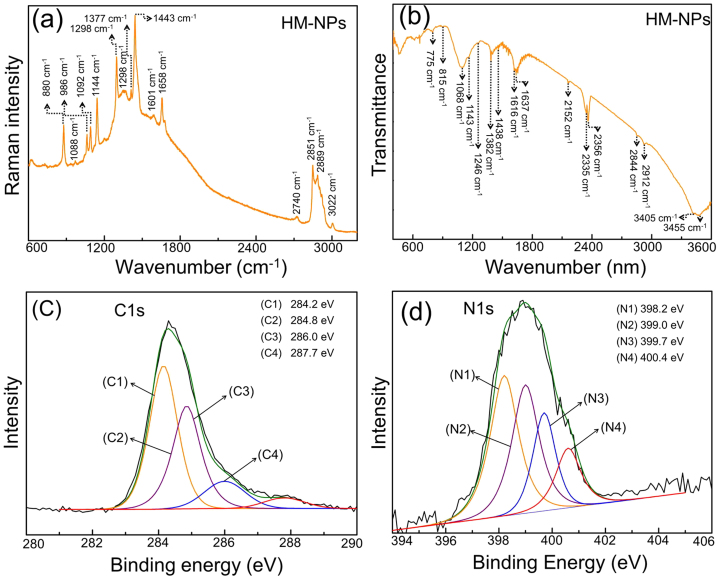
Glow discharge polymerization is not well understood due to the rapid/complex reaction at the plasma/gas precursor interface. Plasma reaction in a submerged condition allows post-plasma-polymerization, leading to further polymer growth and thus a stable structure. Electron collision with acetonitrile at the interface initiates the formation of radical monomers, which undergoes further rearrangement to form low-molecular (LM) nitrogen polymers (NPs). The radical-rich LM NPs go through further polymerization, forming stable high-molecular (HM) NPs (as determined using liquid chromatography/mass spectrometry). LM NPs absorb light at a wavelength of 270 nm (λ max) whereas HM NPs show absorption at 420 nm (λ max), as determined from ultraviolet-visible absorption spectra. The fluorescence spectra of HM NPs show characteristic emission at 430 nm, which indicates the presence of nitrogen functional groups with external conjugation. The proposed structure of HM NPs is verified with different analytical instruments.
辉光放电聚合由于等离子体/气体前体界面的快速/复杂反应而尚未被充分理解。在浸没条件下进行的等离子体反应允许进行后等离子体聚合,从而导致进一步的聚合物生长,进而形成稳定的结构。电子与界面处的乙腈发生碰撞,引发自由基单体的形成,这些单体进一步重排形成低分子量(LM)氮聚合物(NPs)。富含自由基的 LM NPs 进一步聚合,形成稳定的高分子量(HM)NPs(通过液相色谱/质谱法确定)。LM NPs 在 270nm 波长处(λmax)吸收光,而 HM NPs 在 420nm 波长处(λmax)显示吸收,这是从紫外-可见吸收光谱确定的。HM NPs 的荧光光谱在 430nm 处显示出特征发射,表明存在具有外部共轭的氮官能团。通过不同的分析仪器验证了 HM NPs 的结构。