Department of Psychology, Columbia University, New York, New York, USA.
PLoS One. 2013 Jul 31;8(7):e70285. doi: 10.1371/journal.pone.0070285. Print 2013.
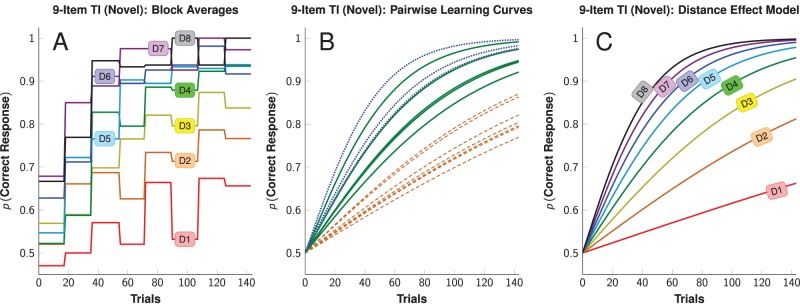
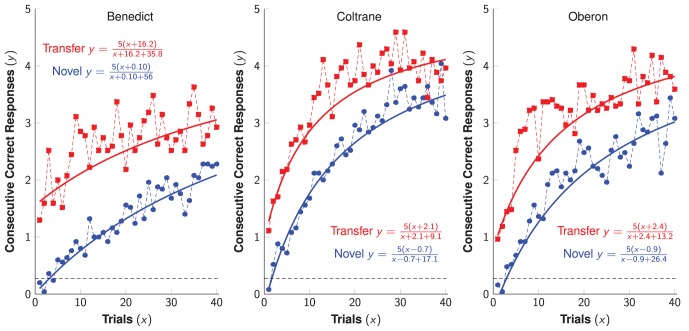
Do animals form task-specific representations, or do those representations take a general form that can be applied to qualitatively different tasks? Rhesus monkeys (Macaca mulatta) learned the ordering of stimulus lists using two different serial tasks, in order to test whether prior experience in each task could be transfered to the other, enhancing performance. The simultaneous chaining paradigm delivered rewards only after subjects responded in the correct order to all stimuli displayed on a touch sensitive video monitor. The transitive inference paradigm presented pairs of items and delivered rewards when subjects selected the item with the lower ordinal rank. After learning a list in one paradigm, subjects' knowledge of that list was tested using the other paradigm. Performance was enhanced from the very start of transfer training. Transitive inference performance was characterized by 'symbolic distance effects,' whereby the ordinal distance between stimuli in the implied list ordering was strongly predictive of the probability of a correct response. The patterns of error displayed by subjects in both tasks were best explained by a spatially coded representation of list items, regardless of which task was used to learn the list. Our analysis permits properties of this representation to be investigated without the confound of verbal reasoning.
动物是否形成特定于任务的表示形式,或者这些表示形式是否具有通用形式,可以应用于性质完全不同的任务?为了测试在每个任务中的先前经验是否可以转移到另一个任务,从而提高性能,恒河猴(Macaca mulatta)通过两种不同的序列任务学习了刺激列表的排序。同时连锁范式仅在受试者按触摸敏感视频监视器上显示的所有刺激的正确顺序响应后才提供奖励。传递推理范式呈现了一对物品,并在受试者选择了具有较低序数等级的物品时提供奖励。在一种范式中学习列表后,使用另一种范式测试对该列表的了解。从转移训练开始,性能就得到了提高。传递推理表现出“符号距离效应”,其中隐含列表排序中刺激之间的顺序距离强烈预测了正确响应的概率。在两个任务中,被试所显示的错误模式最好通过列表项目的空间编码表示来解释,无论使用哪个任务来学习列表。我们的分析允许在没有言语推理混淆的情况下研究这种表示的性质。