Kim Wan Gyu, Weon Hang Yeon, Seok Soon Ja, Lee Kang Hyo
Agricultural Microbiology Division, National Academy of Agricultural Science (NAAS), Rural Development Administration (RDA), Suwon 441-707, Korea.
Mycobiology. 2008 Dec;36(4):266-9. doi: 10.4489/MYCO.2008.36.4.266. Epub 2008 Dec 31.
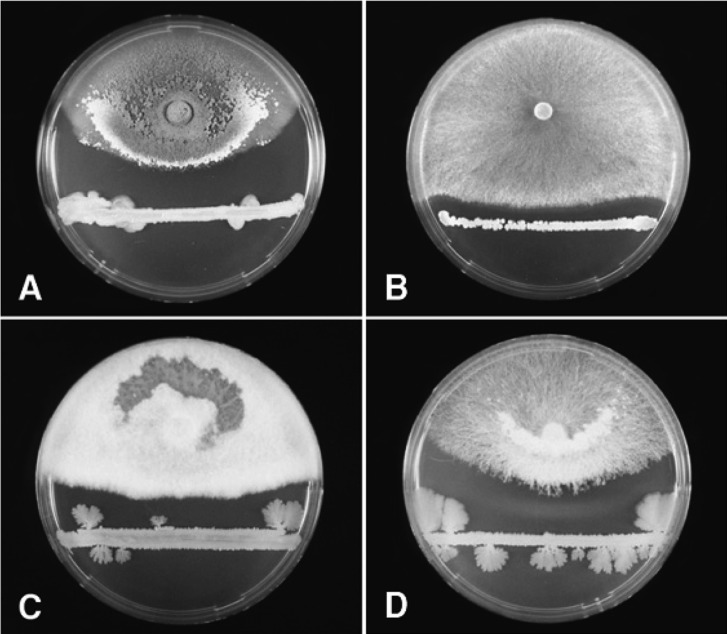
Twenty isolates of Bacillus species obtained from livestock manure composts and cotton-waste composts were tested for their antagonistic effects in vitro against three green mold pathogens of mushrooms (Trichoderma harzianum, T. koningii, and T. viridescens). However, there exists a possibility Bacillus species may have antagonistic effects against mushrooms themselves, and thus the same 20 isolates were tested in vitro against three species of mushrooms (Flammulina velutipes, Lentinus edodes, and Pleurotus ostreatus). Of the 20 Bacillus species isolates tested, two inhibited mycelial growth of T. harzianum, seven that of T. koningii, and eight that of T. viridescens. Importantly, the bacterial isolates M27 and RM29 strongly inhibited mycelial growth of all the Trichoderma spp. isolates tested. The isolate M27 was subsequently identified as the most effective in inhibiting mycelial growth of all the Trichoderma species. Interesting results of the effect Bacillus isolates had upon the mushroom species followed. It was found that most Bacillus isolates except 5T33 at least somewhat inhibited mycelial growth of the three mushroom species or some of the mushrooms. Furhermore, the antagonistic effects of the bacterial isolates against the three species of mushrooms varied depending on the mushroom species, suggesting a role for mushroom type in the mechanism of inhibition. The bacterial isolates M27 and RM29 were identified as having the most antagonistic activity, inhibiting mycelial growth of all the Trichoderma spp. as well as mycelial growth of the three species of mushrooms. These results suggest that the bacterial isolates and their antagonistic effects on green mold pathogens should be further studied for their practical use for biological control of green mold in the growing room of the mushrooms.
从家畜粪便堆肥和棉籽壳堆肥中分离得到的20株芽孢杆菌,针对蘑菇的三种绿霉病原体(哈茨木霉、康宁木霉和绿色木霉)进行了体外拮抗作用测试。然而,芽孢杆菌有可能对蘑菇本身产生拮抗作用,因此对同样的20个分离株针对三种蘑菇(金针菇、香菇和平菇)进行了体外测试。在测试的20株芽孢杆菌分离株中,有两株抑制了哈茨木霉的菌丝生长,七株抑制了康宁木霉的菌丝生长,八株抑制了绿色木霉的菌丝生长。重要的是,细菌分离株M27和RM29强烈抑制了所有测试的木霉属分离株的菌丝生长。分离株M27随后被确定为对所有木霉属物种的菌丝生长抑制效果最显著的菌株。接下来是芽孢杆菌分离株对蘑菇物种影响的有趣结果。发现除5T33外的大多数芽孢杆菌分离株至少在一定程度上抑制了三种蘑菇物种或部分蘑菇的菌丝生长。此外,细菌分离株对三种蘑菇物种的拮抗作用因蘑菇物种而异,这表明蘑菇类型在抑制机制中发挥了作用。细菌分离株M27和RM29被确定具有最强的拮抗活性,它们既抑制了所有木霉属物种的菌丝生长,也抑制了三种蘑菇物种的菌丝生长。这些结果表明,应进一步研究这些细菌分离株及其对绿霉病原体的拮抗作用,以便在蘑菇栽培室中实际用于绿霉的生物防治。