Khandaker Irona, Suzuki Akira, Kamigaki Taro, Tohma Kentaro, Odagiri Takashi, Okada Takashi, Ohno Ayumu, Otani Kanako, Sawayama Rumi, Kawamura Kazuhisa, Okamoto Michiko, Oshitani Hitoshi
Department of Virology, Tohoku University Graduate School of Medicine, 2-1 Seiryomachi, Aoba, Sendai, Miyagi, 9807585, Japan,
Virus Genes. 2013 Sep 29;47(3):456-66. doi: 10.1007/s11262-013-0980-5.
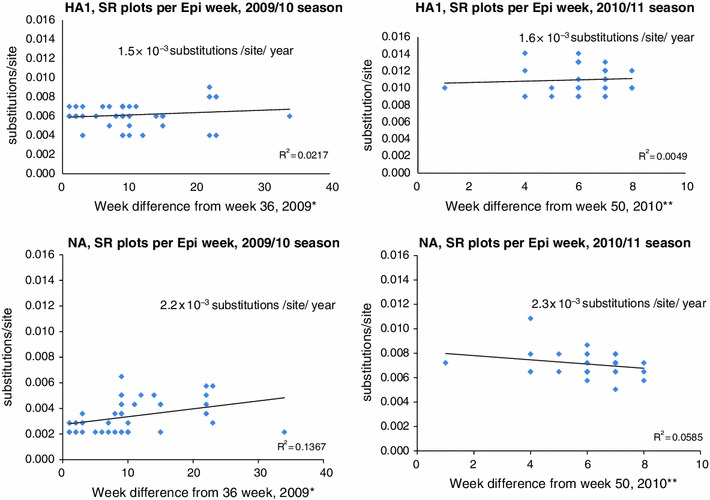
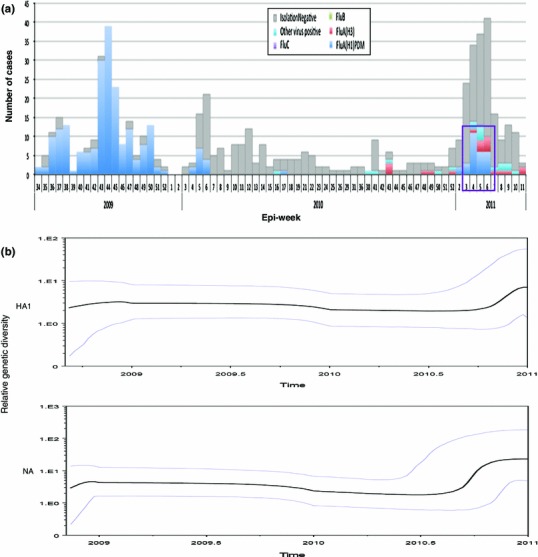
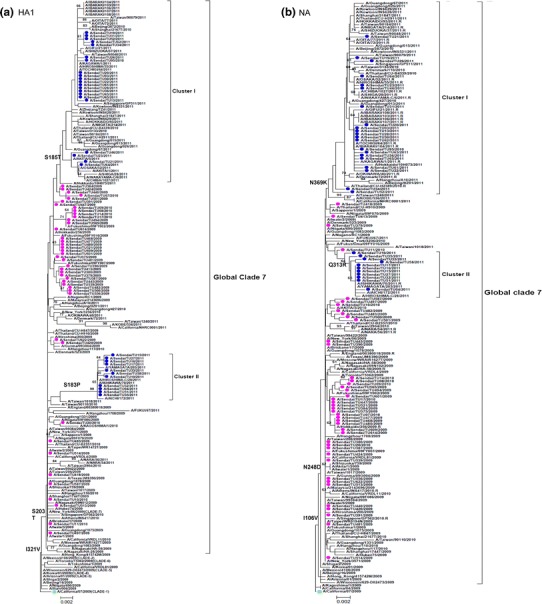
Analyzing the evolutionary pattern of the influenza A(H1N1)pdm09 strain in different regions is important for understanding its diversification. We therefore conducted this study to elucidate the genetic variability and molecular evolution of the influenza A(H1N1)pdm09 strains that circulated during the 2009-2010 and 2010-2011 influenza seasons in Sendai, Japan. Nasopharyngeal swab specimens were collected from patients with influenza-like illnesses who visited outpatient clinics in Sendai City, Japan, from September 2009 to April 2011. A total of 75 isolates were selected from September 2009 to April 2011 to analyze the genetic changes in the entire hemagglutinin 1 (HA1) segment of the HA gene and the neuraminidase (NA) gene based on sequence analysis. Bayesian coalescent Markov chain Monte Carlo analyses of HA1 and NA gene sequences were performed for further analysis. High sequence identities were observed for HA1 and NA in influenza A(H1N1)pdm09, displaying 99.06 and 99.33 % nucleotide identities, respectively, with the A(H1N1)pdm09 vaccine strain A/California/07/2009. The substitution rates of nucleotides for HA1 in the 2009-2010 and 2010-2011 were 1.5 × 10 and 1.6 × 10 substitutions per site per year, respectively. Phylogenetic tree analysis demonstrated that Sendai isolates were clustered into global clade 7, which is characterized by an S203T mutation in the HA1 gene. Moreover, two distinct circulation clusters were present in the 2010-2011 season. Mutations were present in antigenic or receptor-binding domains of the HA1 segment, including A141V, S143G, S183P, S185T, and S203T. The Bayesian skyline plot model illustrated a steady rate for the maintenance of genetic diversity, followed by a slight increase in the later part of the 2010-2011 season. Selection analysis revealed that the HA1 (position 197) and NA (position 46) sites were under positive selection; however, no known mutation conferring resistance to NA inhibitors such as H275Y was observed. The effect on control of the influenza A(H1N1)pdm09 virus, including vaccine strain selection, requires continuous monitoring of the strain by genetic surveillance.
分析甲型H1N1pdm09流感病毒株在不同地区的进化模式对于了解其多样性至关重要。因此,我们开展了这项研究,以阐明在日本仙台2009 - 2010年和2010 - 2011年流感季节流行的甲型H1N1pdm09流感病毒株的基因变异性和分子进化情况。从2009年9月至2011年4月,收集了日本仙台市门诊就诊的流感样疾病患者的鼻咽拭子标本。从2009年9月至2011年4月共挑选出75株分离株,基于序列分析来分析血凝素1(HA1)基因片段及整个HA基因和神经氨酸酶(NA)基因的遗传变化。对HA1和NA基因序列进行贝叶斯合并马尔可夫链蒙特卡洛分析以作进一步分析。在甲型H1N1pdm09流感病毒中观察到HA1和NA具有较高的序列同一性,与甲型H1N1pdm09疫苗株A/California/07/2009相比,核苷酸同一性分别为99.06%和99.33%。2009 - 2010年和2010 - 2011年HA1的核苷酸替换率分别为每年每个位点1.5×10和1.6×10个替换。系统发育树分析表明,仙台分离株聚类到全球进化枝7,其特征是HA1基因中有S203T突变。此外,在2010 - 2011年季节存在两个不同的传播簇。在HA1片段的抗原或受体结合域存在突变,包括A141V、S143G、S183P、S185T和S203T。贝叶斯天际线图模型显示遗传多样性维持速率稳定,随后在2010 - 2011年季节后期略有增加。选择分析显示HA1(第197位)和NA(第46位)位点处于正选择;然而,未观察到已知的对诸如H275Y等NA抑制剂产生抗性的突变。对于甲型H1N1pdm09流感病毒控制的影响,包括疫苗株选择,需要通过基因监测对该病毒株进行持续监测。