Department of Agricultural Biotechnology, WCU Biomodulation Major, Seoul National University, Seoul 151-921, Republic of Korea.
BMC Complement Altern Med. 2013 Oct 1;13:245. doi: 10.1186/1472-6882-13-245.
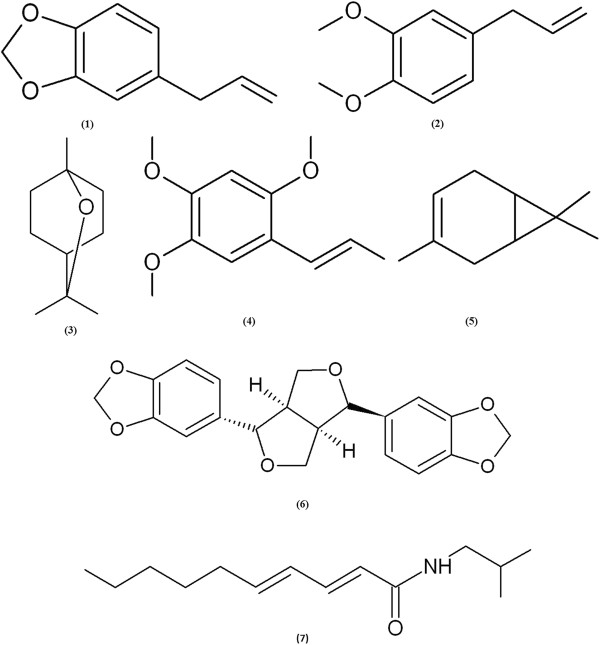
The growth-inhibiting and morphostructural effects of seven constituents identified in Asarum heterotropoides root on 14 intestinal bacteria were compared with those of the fluoroquinolone antibiotic ciprofloxacin.
A microtiter plate-based bioassay in sterile 96-well plates was used to evaluate the minimal inhibitory concentrations (MICs) of the test materials against the organisms.
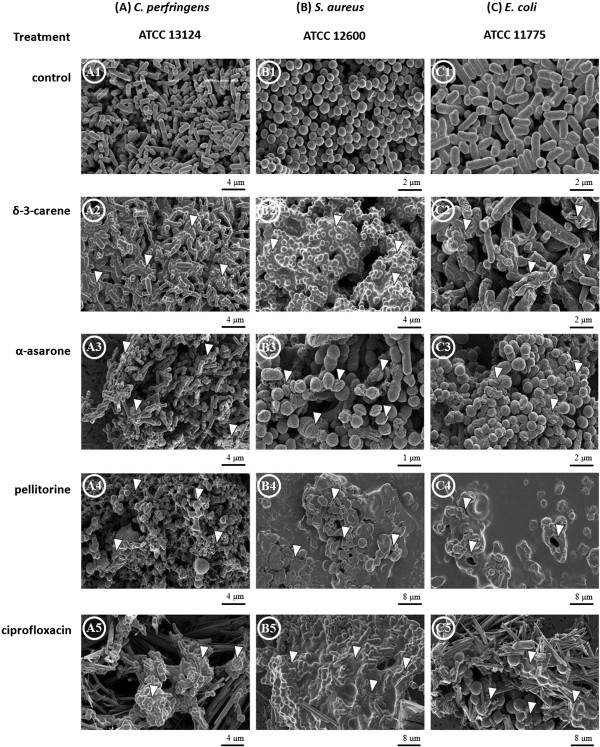
δ-3-Carene (5) exhibited the most potent growth inhibition of Gram-positive bacteria (Clostridium difficile ATCC 9689, Clostridium paraputrificum ATCC 25780, Clostridium perfringens ATCC 13124, and Staphylococcus aureus ATCC 12600) and Gram-negative bacteria (Escherichia coli ATCC 11775 and Bacteroides fragilis ATCC 25285) (minimal inhibitory concentrations (MIC), 0.18-0.70 mg/mL) except for Salmonella enterica serovar Typhimurium ATCC 13311 (MIC, 2.94 mg/mL). The MIC of methyleugenol (2), 1,8-cineole (3), α-asarone (4), (-)-asarinin (6), and pellitorine (7) was between 1.47 and 2.94 mg/mL against all test bacteria (except for compound 2 against C. difficile (0.70 mg/mL); compounds 1 (23.50 mg/mL) and 4 (5.80 mg/mL) against C. paraputricum; compounds 2 (5.80 mg/mL), 4 (12.0 mg/mL), and 7 (0.70 mg/mL) against C. perfringens); compound 1 against E. coli (7.20 mg/mL) and S. enterica serovar Typhimurium (12.0 mg/mL). Overall, all of the constituents were less potent at inhibiting microbial growth than ciprofloxacin (MIC, 0.063-0.25 mg/ mL). The lactic acid-producing bacteria (four bifidobacteria and two lactobacilli) and one acidulating bacterium Clostridium butyricum ATCC 25779 were less sensitive and more susceptible than the five harmful bacteria and two nonpathogenic bacteria (B. fragilis and E. coli) to the constituents and to ciprofloxacin, respectively. Beneficial Gram-positive bacteria and harmful and nonpathogenic Gram-negative bacteria were observed to have different degrees of antimicrobial susceptibility to the constituents, although the antimicrobial susceptibility of the harmful Gram-positive bacteria and the harmful and nonpathogenic Gram-negative bacteria was not observed. Scanning electron microscopy observations showed different degrees of physical damage and morphological alteration to both Gram-positive and Gram-negative bacteria treated with α-asarone, δ-3-carene, pellitorine, or ciprofloxacin, indicating that they do not share a common mode of action.
A. heterotropoides root-derived materials described merit further study as potential antibacterial products or lead molecules for the prevention or eradication from humans from diseases caused by harmful intestinal bacteria.
比较了从细辛中分离得到的七种成分对 14 种肠道细菌的生长抑制和形态结构作用与氟喹诺酮类抗生素环丙沙星的作用。
采用无菌 96 孔板微量滴定板法,评价试验材料对各菌的最小抑菌浓度(MIC)。
δ-3-蒈烯(5)对革兰氏阳性菌(艰难梭菌 ATCC 9689、类腐败梭菌 ATCC 25780、产气荚膜梭菌 ATCC 13124 和金黄色葡萄球菌 ATCC 12600)和革兰氏阴性菌(大肠杆菌 ATCC 11775 和脆弱拟杆菌 ATCC 25285)的生长抑制作用最为明显(MIC,0.18-0.70mg/mL),除肠炎沙门氏菌血清型 Typhimurium ATCC 13311(MIC,2.94mg/mL)外。甲基丁香酚(2)、1,8-桉叶素(3)、α-细辛脑(4)、(-)-细辛脑(6)和白屈菜红碱(7)的 MIC 均在 1.47-2.94mg/mL 之间,对所有试验菌均有作用(化合物 2 对艰难梭菌的 MIC 为 0.70mg/mL;化合物 1(23.50mg/mL)和 4(5.80mg/mL)对类腐败梭菌;化合物 2(5.80mg/mL)、4(12.0mg/mL)和 7(0.70mg/mL)对产气荚膜梭菌;化合物 1 对大肠杆菌(7.20mg/mL)和肠炎沙门氏菌血清型 Typhimurium(12.0mg/mL))。总的来说,所有成分对微生物生长的抑制作用均不如环丙沙星(MIC,0.063-0.25mg/mL)。产乳酸细菌(四种双歧杆菌和两种乳杆菌)和一种产酸菌丁酸梭菌 ATCC 25779 比五种有害菌和两种非致病菌(脆弱拟杆菌和大肠杆菌)对成分和环丙沙星的敏感性更低,易感性更高。有益的革兰氏阳性菌和有害及非致病性革兰氏阴性菌对成分的抗菌敏感性不同,尽管尚未观察到有害革兰氏阳性菌和有害及非致病性革兰氏阴性菌的抗菌敏感性。扫描电子显微镜观察显示,α-细辛脑、δ-3-蒈烯、白屈菜红碱或环丙沙星处理的革兰氏阳性菌和革兰氏阴性菌均有不同程度的物理损伤和形态改变,表明它们不具有共同的作用模式。
值得进一步研究从细辛根中分离得到的物质,作为预防或消除有害肠道细菌引起的人类疾病的潜在抗菌产品或先导分子。