Chromatin and Disease Group, Cancer Epigenetics and Biology Programme (PEBC), Bellvitge Biomedical Research Institute (IDIBELL), Avda. Gran Via 199-203, 08908 L'Hospitalet de Llobregat, Barcelona, Spain, Department of Experimental and Health Sciences, Barcelona Biomedical Research Park, Universitat Pompeu Fabra (UPF), 08003 Barcelona, Spain, Department of Genetic Engineering and Biotechnology, University of Dhaka, Dhaka 1000, Bangladesh, Center for Integrated Protein Science and Adolf-Butenandt Institute, Ludwig Maximilians University of Munich, 80336 Munich, Germany and CR-UK Institute for Cancer Studies, University of Birmingham, Birmingham B15 2TT, UK.
Nucleic Acids Res. 2014 Jan;42(1):249-63. doi: 10.1093/nar/gkt886. Epub 2013 Oct 3.
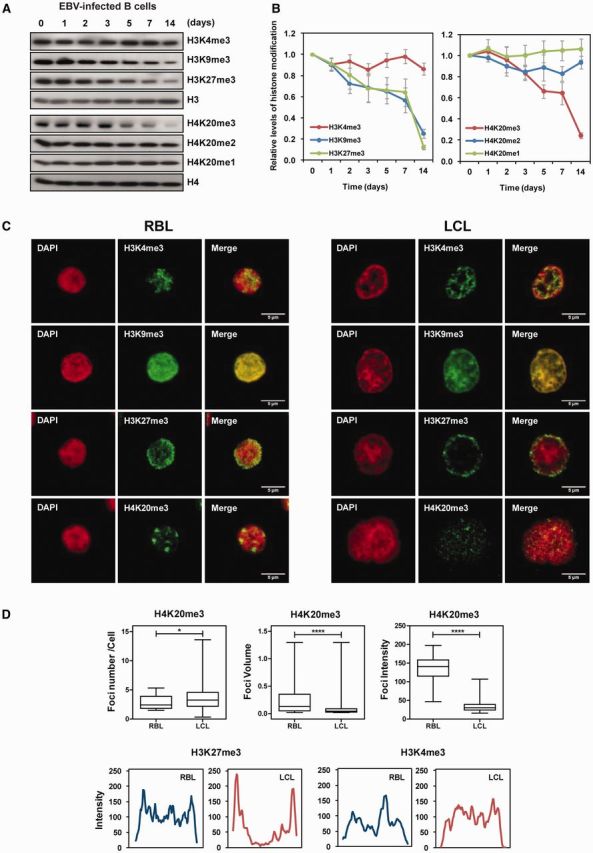
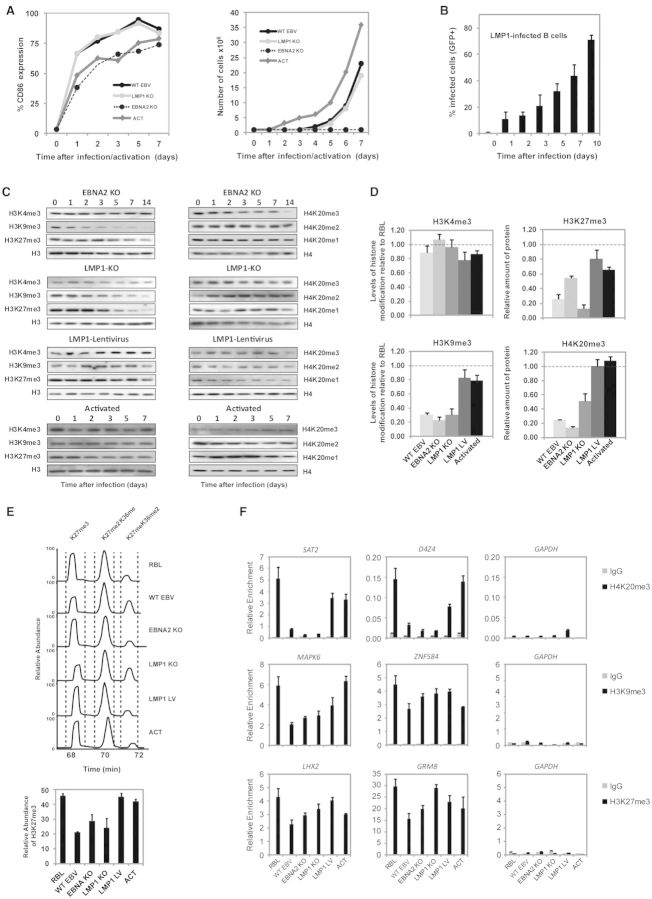
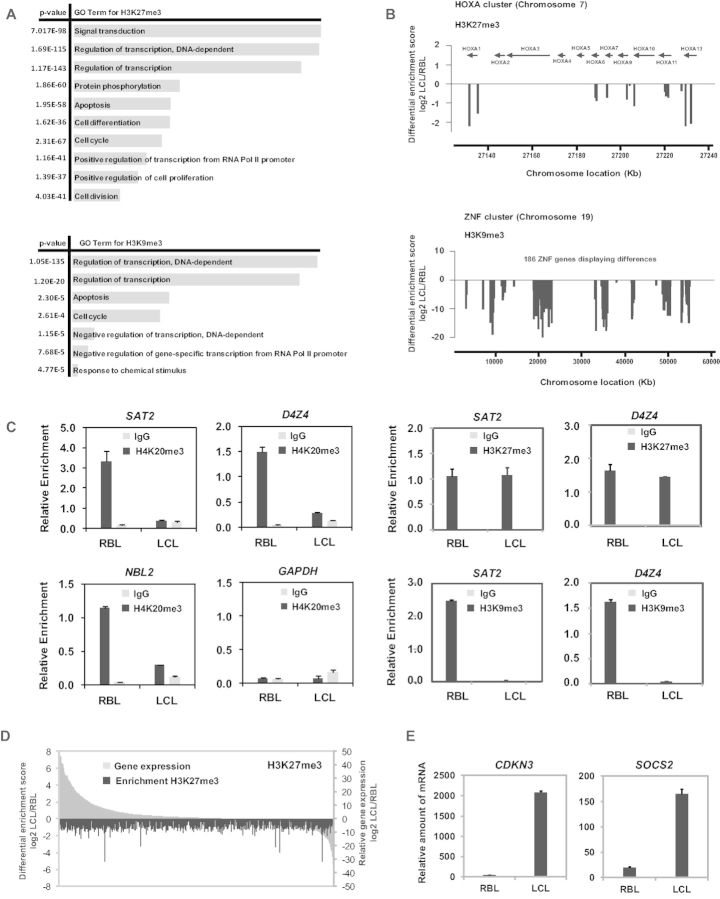
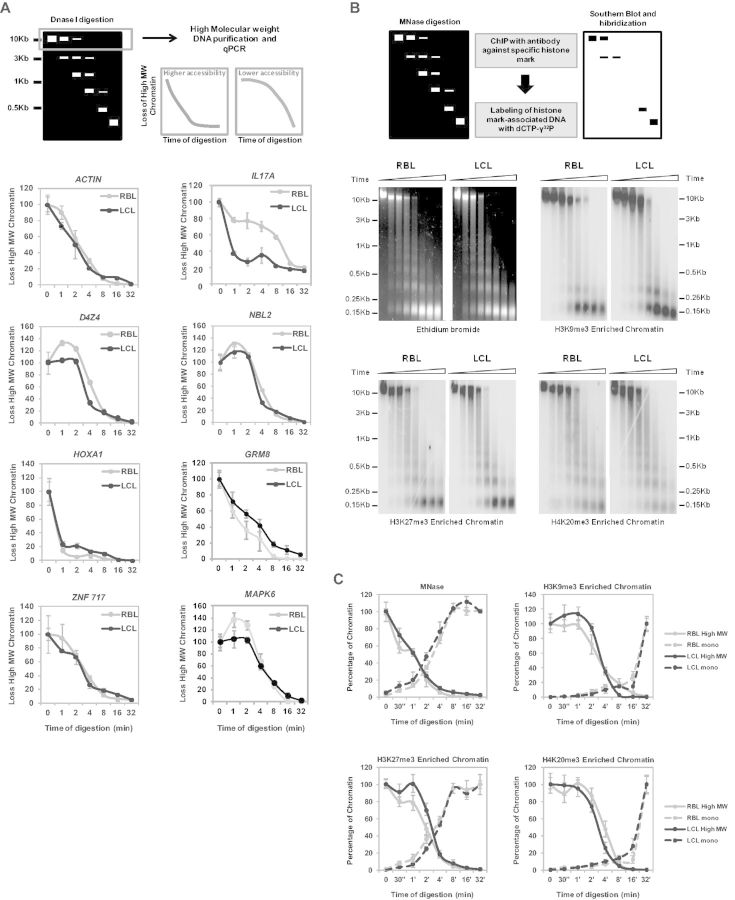
Epstein-Barr virus (EBV) infects and transforms human primary B cells inducing indefinite proliferation. To investigate the potential participation of chromatin mechanisms during the EBV-mediated transformation of resting B cells we performed an analysis of global changes in histone modifications. We observed a remarkable decrease and redistribution of heterochromatin marks including H4K20me3, H3K27me3 and H3K9me3. Loss of H4K20me3 and H3K9me3 occurred at constitutive heterochromatin repeats. For H3K27me3 and H3K9me3, comparison of ChIP-seq data revealed a decrease in these marks in thousands of genes, including clusters of HOX and ZNF genes, respectively. Moreover, DNase-seq data comparison between resting and EBV-transformed B cells revealed increased endonuclease accessibility in thousands of genomic sites. We observed that both loss of H3K27me3 and increased accessibility are associated with transcriptional activation. These changes only occurred in B cells transformed with EBV and not in those stimulated to proliferate with CD40L/IL-4, despite their similarities in the cell pathways involved and proliferation rates. In fact, B cells infected with EBNA-2 deficient EBV, which have much lower proliferation rates, displayed similar decreases for heterochromatic histone marks. Our study describes a novel phenomenon related to transformation of B cells, and highlights its independence of the pure acquisition of proliferation.
爱泼斯坦-巴尔病毒(EBV)感染并转化人类原代 B 细胞,诱导无限增殖。为了研究染色质机制在 EBV 介导的静止 B 细胞转化中的潜在参与,我们对组蛋白修饰的全局变化进行了分析。我们观察到异染色质标记(包括 H4K20me3、H3K27me3 和 H3K9me3)显著减少和重新分布。H4K20me3 和 H3K9me3 的丢失发生在组成型异染色质重复序列中。对于 H3K27me3 和 H3K9me3,ChIP-seq 数据的比较显示,在数千个基因中,这两种标记都减少了,包括 HOX 和 ZNF 基因簇。此外,在静止和 EBV 转化的 B 细胞之间的 DNase-seq 数据比较显示,数千个基因组位点的内切酶可及性增加。我们观察到 H3K27me3 的丢失和可及性的增加都与转录激活有关。这些变化仅发生在 EBV 转化的 B 细胞中,而不是在那些用 CD40L/IL-4 刺激增殖的 B 细胞中,尽管它们在涉及的细胞途径和增殖率方面存在相似性。事实上,感染了 EBNA-2 缺陷型 EBV 的 B 细胞,增殖率低得多,也显示出异染色质组蛋白标记的相似减少。我们的研究描述了一种与 B 细胞转化相关的新现象,并强调了其与增殖的单纯获得无关。