Center for Biotechnology and Genomic Medicine, Georgia Health Sciences University, Augusta, Georgia, United States of America ; Sino-American Cancer Research Institute at Nanjing University of Technology and Jiangsu Cancer Hospital, Nanjing, Jiangsu province, China ; Jiangsu Cancer Hospital, Nanjing Medical University, Nanjing, Jiangsu, China ; Institute of Translational Medicine, School of Pharmaceutical Sciences, Nanjing University of Technology, Nanjing, Jiangsu province, China.
PLoS One. 2013 Nov 11;8(11):e78393. doi: 10.1371/journal.pone.0078393. eCollection 2013.
Biomarkers play critical roles in early detection, diagnosis and monitoring of therapeutic outcome and recurrence of cancer. Previous biomarker research on ovarian cancer (OC) has mostly focused on the discovery and validation of diagnostic biomarkers. The primary purpose of this study is to identify serum biomarkers for prognosis and therapeutic outcomes of ovarian cancer.
Forty serum proteins were analyzed in 70 serum samples from healthy controls (HC) and 101 serum samples from serous OC patients at three different disease phases: post diagnosis (PD), remission (RM) and recurrence (RC). The utility of serum proteins as OC biomarkers was evaluated using a variety of statistical methods including survival analysis.
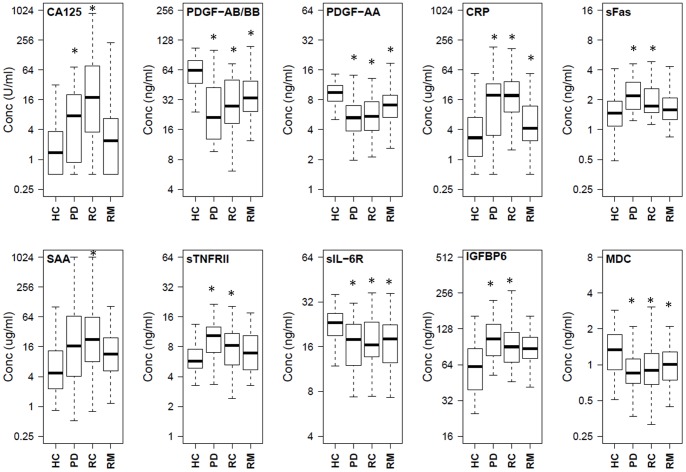
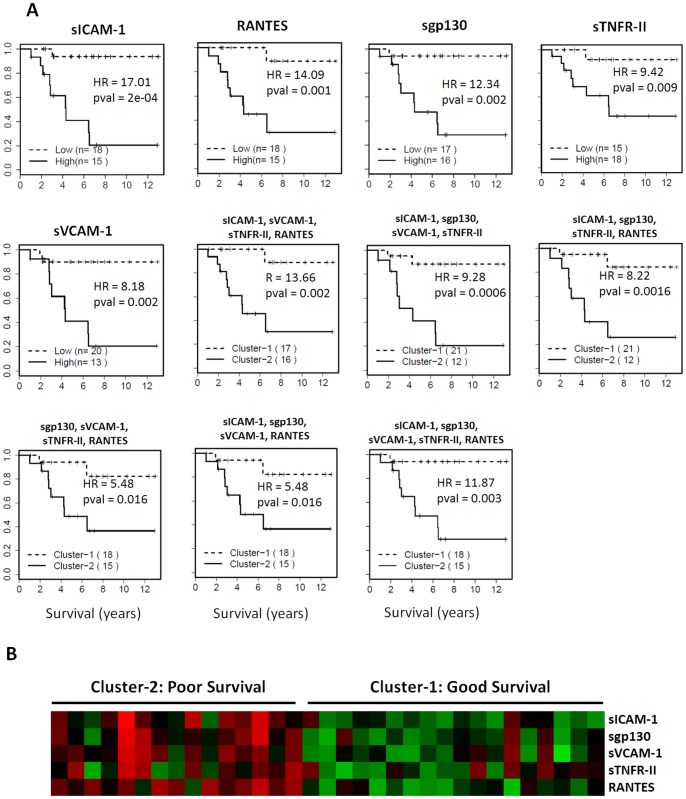
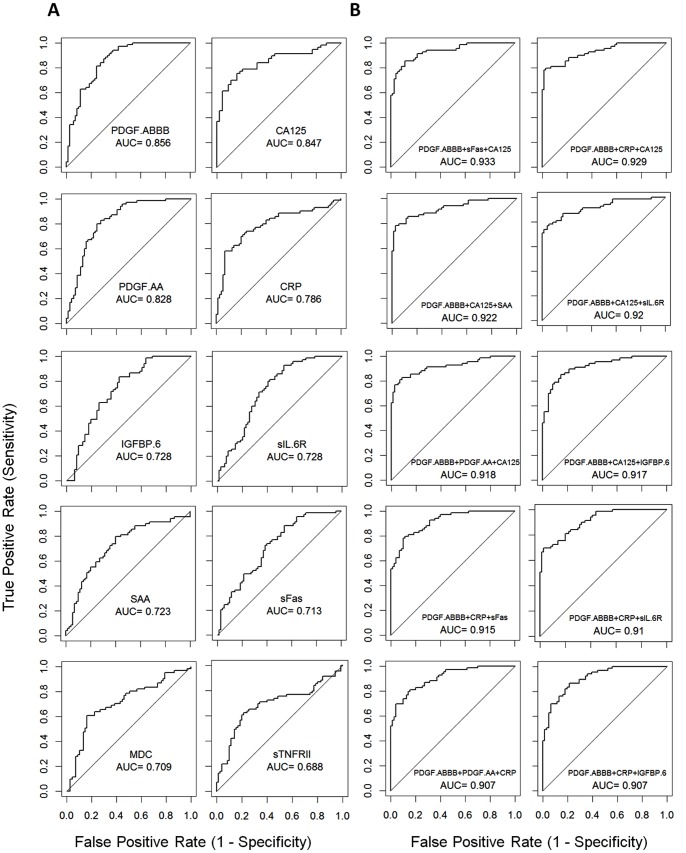
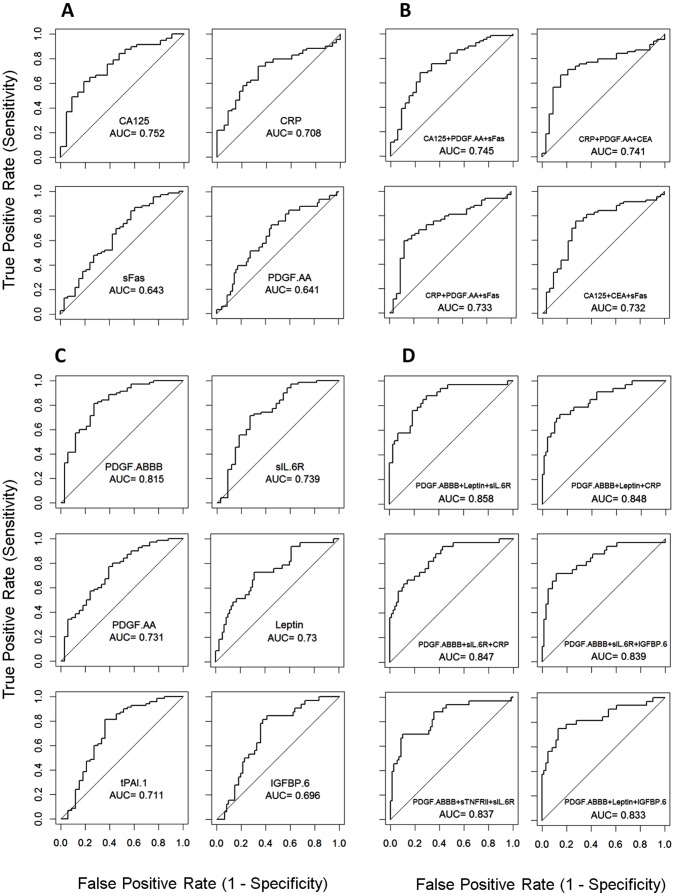
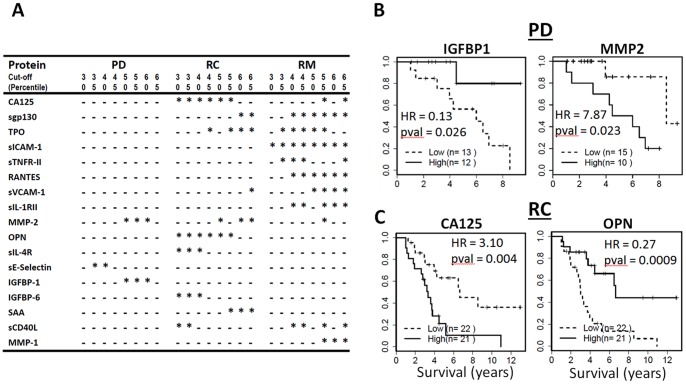
Ten serum proteins (PDGF-AB/BB, PDGF-AA, CRP, sFas, CA125, SAA, sTNFRII, sIL-6R, IGFBP6 and MDC) have individually good area-under-the-curve (AUC) values (AUC = 0.69-0.86) and more than 10 three-marker combinations have excellent AUC values (0.91-0.93) in distinguishing active cancer samples (PD & RC) from HC. The mean serum protein levels for RM samples are usually intermediate between HC and OC patients with active cancer (PD & RC). Most importantly, five proteins (sICAM1, RANTES, sgp130, sTNFR-II and sVCAM1) measured at remission can classify, individually and in combination, serous OC patients into two subsets with significantly different overall survival (best HR = 17, p<10(-3)).
We identified five serum proteins which, when measured at remission, can accurately predict the overall survival of serous OC patients, suggesting that they may be useful for monitoring the therapeutic outcomes for ovarian cancer.
生物标志物在癌症的早期检测、诊断和治疗效果监测及复发方面发挥着关键作用。既往卵巢癌(OC)的生物标志物研究主要集中在诊断生物标志物的发现和验证。本研究的主要目的是鉴定用于预测卵巢癌预后和治疗效果的血清生物标志物。
在三种不同的疾病阶段(诊断后、缓解期和复发期),分析了 70 例健康对照(HC)和 101 例浆液性 OC 患者的 70 份血清样本中的 40 种血清蛋白。使用多种统计方法(包括生存分析)评估血清蛋白作为 OC 生物标志物的效用。
十种血清蛋白(PDGF-AB/BB、PDGF-AA、CRP、sFas、CA125、SAA、sTNFRII、sIL-6R、IGFBP6 和 MDC)在区分活动期癌症样本(PD 和 RC)与 HC 时,单独具有良好的曲线下面积(AUC)值(AUC=0.69-0.86),超过 10 种三种标志物组合具有极好的 AUC 值(0.91-0.93)。RM 样本的平均血清蛋白水平通常介于 HC 和活动期 OC 患者之间(PD 和 RC)。最重要的是,在缓解期测量的五种蛋白(sICAM1、RANTES、sgp130、sTNFR-II 和 sVCAM1),单独或联合使用时,可以将浆液性 OC 患者分为两个亚组,其总生存情况存在显著差异(最佳 HR=17,p<10(-3))。
我们鉴定了五种血清蛋白,当在缓解期测量时,它们可以准确预测浆液性 OC 患者的总生存情况,表明它们可能对监测卵巢癌的治疗效果有用。