Epidemiology and Public Health Department, IV-UFRRJ, Seropédica, Rio de Janeiro, Brazil.
Parasit Vectors. 2013 Dec 11;6:348. doi: 10.1186/1756-3305-6-348.
Anaplasma phagocytophilum is an emerging pathogen of humans, dogs and other animals, and it is transmitted by ixodid ticks. The objective of the current study was a) detect A. phagocytophilum in dogs and ixodid ticks using real-time Polymerase Chain Reaction (qPCR); and b) Determine important variables associated to host, environment and potential tick vectors that are related to the presence of A. phagocytophilum in dogs domiciled in Rio de Janeiro, Brazil.
We tested blood samples from 398 dogs and samples from 235 ticks, including 194 Rhipicephalus sanguineus sensu lato, 15 Amblyomma cajennense, 8 Amblyomma ovale and 18 pools of Amblyomma sp. nymphs. A semi-structured questionnaire was applied by interviewing each dog owner. Deoxyribonucleic acid obtained from ticks and dog buffy coat samples were amplified by qPCR (msp2 gene). The sequencing of 16S rRNA and groESL heat shock operon genes and a phylogenetic analysis was performed. The multiple logistic regression model was created as a function of testing positive dogs for A. phagocytophilum.
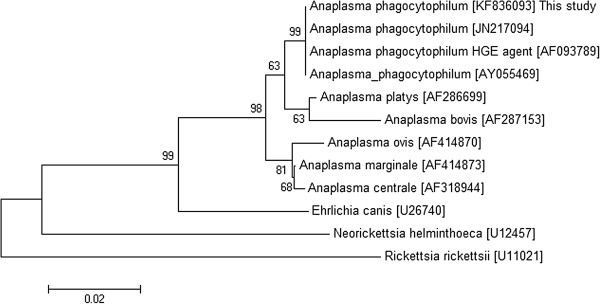
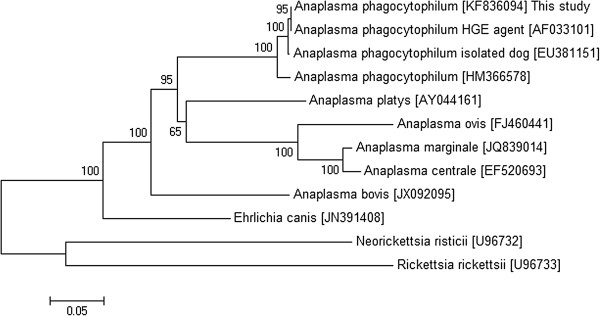
Among the 398 blood samples from dogs, 6.03% were positive for A. phagocytophilum. Anaplasma phagocytophilum was detected in one A. cajennense female tick and in five R. sanguineus sensu lato ticks (four males and one female). The partial sequences of the 16S rRNA, and groESL genes obtained were highly similar to strains of A. phagocytophilum isolated from wild birds from Brazil and human pathogenic strains. The tick species collected in positive dogs were R. sanguineus sensu lato and A. cajennense, with A.cajennense being predominant. Tick infestation history (OR = 2.86, CI = 1.98-14.87), dog size (OR = 2.41, IC: 1.51-12.67), the access to forest areas (OR = 3:51, CI: 1.52-16.32), hygiene conditions of the environment in which the dogs lived (OR = 4.35, CI: 1.86-18.63) and Amblyomma sp. infestation (OR = 6.12; CI: 2.11-28.15) were associated with A. phagocytophilum infection in dogs.
This is the first report of A. phagocytophilum in ixodid ticks from Brazil. The detection of A. phagocitophylum in A. cajennense, an aggressive feeder on a wide variety of hosts, including humans, is considered a public health concern.
嗜吞噬细胞无形体是一种新兴的人类、犬类和其他动物病原体,通过硬蜱传播。本研究的目的是:a)使用实时聚合酶链反应(qPCR)检测犬和硬蜱中的嗜吞噬细胞无形体;b)确定与宿主、环境和潜在蜱媒介相关的重要变量,这些变量与巴西里约热内卢犬中嗜吞噬细胞无形体的存在有关。
我们测试了 398 只犬的血液样本和 235 只蜱的样本,包括 194 只血厉螨、15 只镰形扇头蜱、8 只卵形扇头蜱和 18 只卵形扇头蜱若虫。通过采访每只犬主人,应用半结构问卷。从蜱和犬血涂片样本中提取脱氧核糖核酸,通过 qPCR(msp2 基因)进行扩增。对 16S rRNA 和 groESL 热休克操纵子基因进行测序和系统发育分析。创建了一个多变量逻辑回归模型,作为检测犬嗜吞噬细胞无形体阳性的函数。
在 398 份犬血样本中,有 6.03%的样本对嗜吞噬细胞无形体呈阳性。在 1 只镰形扇头蜱雌蜱和 5 只血厉螨(4 只雄蜱和 1 只雌蜱)中检测到嗜吞噬细胞无形体。获得的 16S rRNA 和 groESL 基因的部分序列与从巴西野生鸟类和人类致病性菌株分离的嗜吞噬细胞无形体菌株高度相似。在阳性犬中采集的蜱种为血厉螨和镰形扇头蜱,其中镰形扇头蜱占优势。蜱虫侵染史(OR=2.86,CI=1.98-14.87)、犬体型(OR=2.41,IC:1.51-12.67)、接触森林地区(OR=3:51,CI:1.52-16.32)、犬生活环境的卫生条件(OR=4.35,CI:1.86-18.63)和美洲钝缘蜱侵染(OR=6.12;CI:2.11-28.15)与犬嗜吞噬细胞无形体感染相关。
这是巴西首次报告在硬蜱中发现嗜吞噬细胞无形体。在镰形扇头蜱中检测到嗜吞噬细胞无形体,镰形扇头蜱是一种在包括人类在内的多种宿主上具有侵袭性的寄生虫,被认为是一个公共卫生问题。