Department of Biochemical Diagnostics, Medical University, Waszyngtona 15A, 15-269, Bialystok, Poland,
Rheumatol Int. 2014 Mar;34(3):393-9. doi: 10.1007/s00296-013-2921-y. Epub 2013 Dec 18.
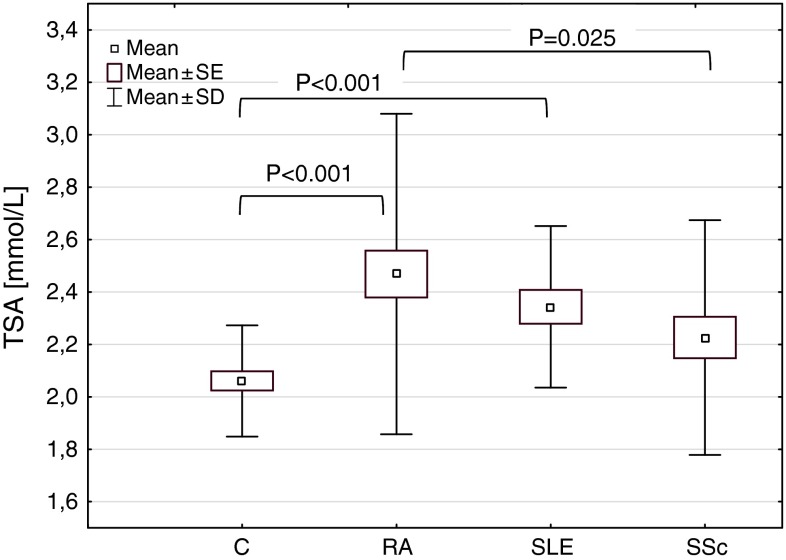
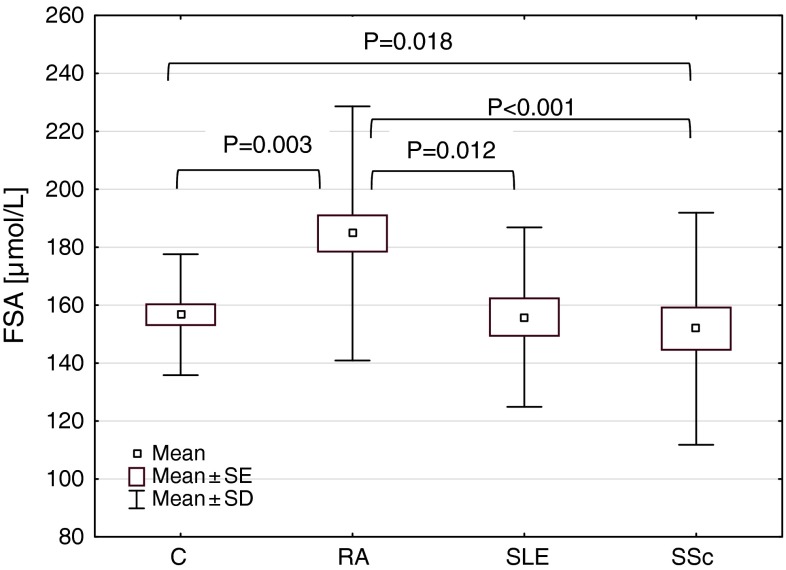
In the rheumatic diseases, the changes in the carbohydrate part of serum glycoproteins occur and these abnormalities can be monitored by serum level of total and free sialic acid. The aim of this study was to evaluate the total and free sialic acid level as a marker of inflammation activity (TSA) and the changes in glycosylation of blood glycoproteins (FSA) in rheumatoid arthritis (RA), systemic sclerosis (SSc) and systemic lupus erythematosus (SLE). Studies were carried out in 50 patients with RA, 24 with SLE and 32 with SSc. TSA concentration was measured with an enzymatic, colorimetric method and FSA with a thiobarbituric method. The serum levels of TSA in RA and SLE patients were significantly increased compared to controls and in RA patients were higher than that in SSc patients. The mean serum level of FSA in RA patients was significantly higher, but in SSc patients significantly lower than that in the controls, and in RA patients was significantly higher than in SLE and in SSc patients. All acute-phase proteins were changed: Positive acute-phase proteins were elevated, and the negative protein was decreased. The positive acute-phase proteins positively correlated with the levels of TSA and FSA in RA and SSc patients. In SLE patients, TSA positively correlated with haptoglobin and α1-antitrypsin. In RA patients, there was the positive correlation of TSA and FSA with DAS 28. The changes in the serum levels of TSA and FSA in the course of rheumatic diseases could reflect the abnormalities in glycosylation/sialylation patterns of glycoproteins induced by acute-phase response.
在风湿性疾病中,血清糖蛋白的碳水化合物部分发生变化,这些异常可以通过总唾液酸和游离唾液酸的血清水平来监测。本研究旨在评估类风湿关节炎 (RA)、系统性硬皮病 (SSc) 和系统性红斑狼疮 (SLE) 中作为炎症活动标志物的总唾液酸和游离唾液酸水平 (TSA) 以及血液糖蛋白糖基化的变化 (FSA)。研究共纳入 50 例 RA 患者、24 例 SLE 患者和 32 例 SSc 患者。采用酶比色法测定 TSA 浓度,采用硫代巴比妥酸法测定 FSA 浓度。与对照组相比,RA 和 SLE 患者的 TSA 血清水平显著升高,且 RA 患者的 TSA 血清水平高于 SSc 患者。RA 患者的平均 FSA 血清水平显著升高,但 SSc 患者的 FSA 血清水平显著降低,且 RA 患者的 FSA 血清水平明显高于 SLE 和 SSc 患者。所有急性期蛋白均发生变化:阳性急性期蛋白升高,阴性蛋白降低。RA 和 SSc 患者的 TSA 和 FSA 水平与阳性急性期蛋白呈正相关。在 SLE 患者中,TSA 与触珠蛋白和α1-抗胰蛋白酶呈正相关。在 RA 患者中,TSA 和 FSA 与 DAS28 呈正相关。风湿性疾病过程中 TSA 和 FSA 血清水平的变化可能反映了急性期反应诱导的糖蛋白糖基化/唾液酸化模式的异常。