Center for Devices and Radiological Health, U.S. Food and Drug Administration Silver Spring, MD, USA ; Department of Computer Science, University of Oxford Oxford, UK.
Center for Devices and Radiological Health, U.S. Food and Drug Administration Silver Spring, MD, USA.
Front Physiol. 2013 Dec 11;4:358. doi: 10.3389/fphys.2013.00358. eCollection 2013.
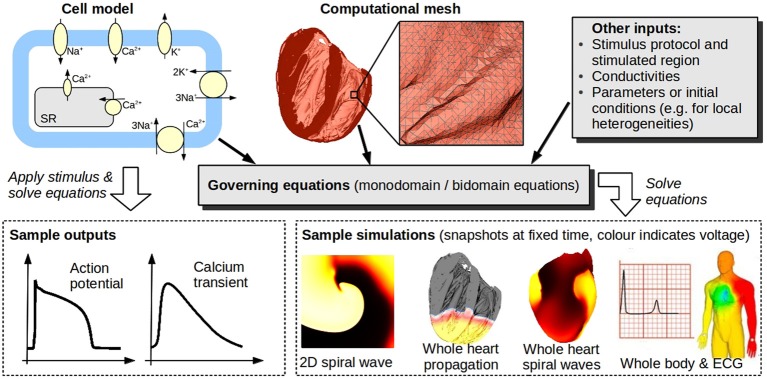
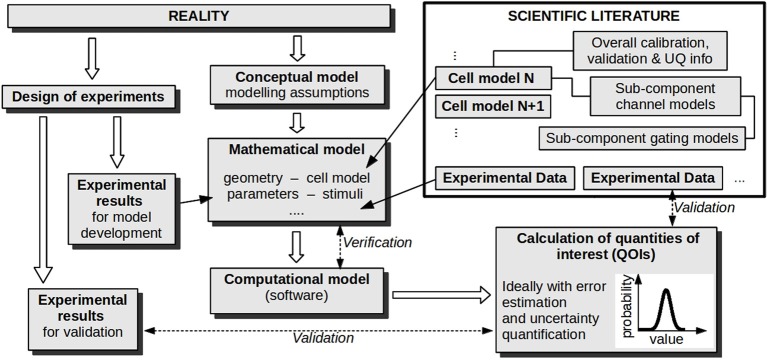
Computational models of cardiac electrophysiology have been used for over half a century to investigate physiological mechanisms and generate hypotheses for experimental testing, and are now starting to play a role in clinical applications. There is currently a great deal of interest in using models as diagnostic or therapeutic aids, for example using patient-specific whole-heart simulations to optimize cardiac resynchronization therapy, ablation therapy, and defibrillation. However, if models are to be used in safety-critical clinical decision making, the reliability of their predictions needs to be thoroughly investigated. In engineering and the physical sciences, the field of "verification, validation and uncertainty quantification" (VVUQ) [also known as "verification and validation" (V&V)] has been developed for rigorously evaluating the credibility of computational model predictions. In this article we first discuss why it is vital that cardiac models be developed and evaluated within a VVUQ framework, and then consider cardiac models in the context of each of the stages in VVUQ. We identify some of the major difficulties which may need to be overcome for cardiac models to be used in safely-critical clinical applications.
半个多世纪以来,心脏电生理学的计算模型一直被用于研究生理机制并提出实验测试的假设,现在它们开始在临床应用中发挥作用。目前,人们对使用模型作为诊断或治疗辅助工具非常感兴趣,例如使用患者特异性全心脏模拟来优化心脏再同步治疗、消融治疗和除颤。然而,如果要在安全关键的临床决策中使用模型,则需要彻底研究其预测的可靠性。在工程和物理科学领域,“验证、确认和不确定性量化”(VVUQ)[也称为“验证和确认”(V&V)]领域已经发展起来,用于严格评估计算模型预测的可信度。在本文中,我们首先讨论了为什么必须在 VVUQ 框架内开发和评估心脏模型,然后考虑了 VVUQ 各个阶段的心脏模型。我们确定了一些在安全关键的临床应用中使用心脏模型可能需要克服的主要困难。