Berge Jerica M, Wall Melanie, Larson Nicole, Forsyth Ann, Bauer Katherine W, Neumark-Sztainer Dianne
University of Minnesota Medical School, Department of Family Medicine and Community Health, Minneapolis, MN, USA.
Division of Biostatistics in the Department of Psychiatry and Department of Biostatistics in the Mailman School of Public Health, Columbia University, NY, USA.
Health Place. 2014 Mar;26:69-77. doi: 10.1016/j.healthplace.2013.11.007. Epub 2013 Dec 8.
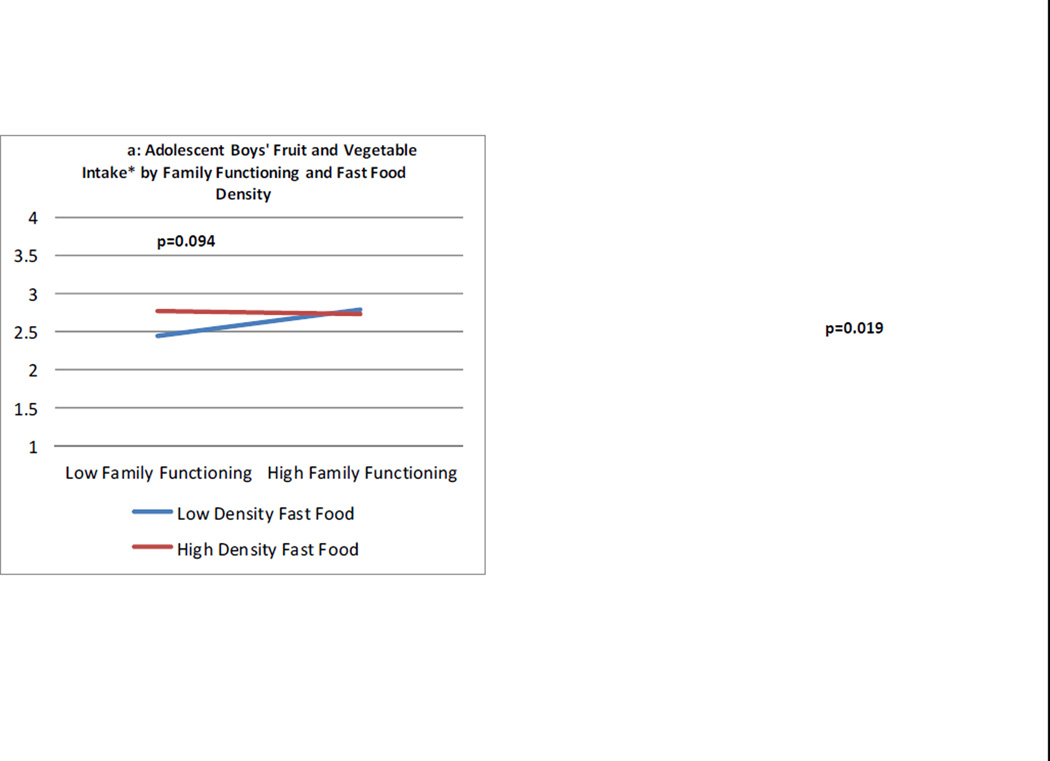
The aim of this study is to investigate individual and joint associations of the home environment and the neighborhood built environment with adolescent dietary patterns and body mass index (BMI) z-score. Racially/ethnically and socioeconomically diverse adolescents (n=2682; 53.2% girls; mean age14.4 years) participating in the EAT 2010 (Eating and Activity in Teens) study completed height and weight measurements and surveys in Minnesota middle and high schools. Neighborhood variables were measured using Geographic Information Systems data. Multiple regressions of BMI z-score, fruit and vegetable intake, and fast food consumption were fit including home and neighborhood environmental variables as predictors and also including their interactions to test for effect modification. Supportive family environments (i.e., higher family functioning, frequent family meals, and parent modeling of healthful eating) were associated with higher adolescent fruit and vegetable intake, lower fast food consumption, and lower BMI z-score. Associations between the built environment and adolescent outcomes were fewer. Interaction results, although not all consistent, indicated that the relationship between a supportive family environment and adolescent fruit and vegetable intake and BMI was enhanced when the neighborhood was supportive of healthful behavior. Public health interventions that simultaneously improve both the home environment and the neighborhood environment of adolescents may have a greater impact on adolescent obesity prevention than interventions that address one of these environments alone.
本研究旨在调查家庭环境和邻里建成环境与青少年饮食模式及体重指数(BMI)z评分之间的个体关联和联合关联。参与2010年青少年饮食与活动(EAT 2010)研究的种族/民族和社会经济背景各异的青少年(n = 2682;53.2%为女孩;平均年龄14.4岁)在明尼苏达州的初中和高中完成了身高和体重测量以及问卷调查。邻里变量使用地理信息系统数据进行测量。对BMI z评分、水果和蔬菜摄入量以及快餐消费进行多元回归分析,将家庭和邻里环境变量作为预测因素,同时纳入它们的相互作用以检验效应修正。支持性的家庭环境(即更高的家庭功能、频繁的家庭聚餐以及父母健康饮食的示范)与青少年更高的水果和蔬菜摄入量、更低的快餐消费以及更低的BMI z评分相关。建成环境与青少年健康指标之间的关联较少。交互作用结果虽然并非全部一致,但表明当邻里环境支持健康行为时,支持性家庭环境与青少年水果和蔬菜摄入量及BMI之间的关系会得到增强。与仅针对其中一种环境的干预措施相比,同时改善青少年家庭环境和邻里环境的公共卫生干预措施可能对预防青少年肥胖产生更大影响。