Murray Susan F, Hunter Benjamin M, Bisht Ramila, Ensor Tim, Bick Debra
King's International Development Institute, King's College London, London, UK.
BMC Pregnancy Childbirth. 2014 Jan 17;14:30. doi: 10.1186/1471-2393-14-30.
Demand-side financing, where funds for specific services are channelled through, or to, prospective users, is now employed in health and education sectors in many low- and middle-income countries. This systematic review aimed to critically examine the evidence on application of this approach to promote maternal health in these settings. Five modes were considered: unconditional cash transfers, conditional cash transfers, short-term payments to offset costs of accessing maternity services, vouchers for maternity services, and vouchers for merit goods. We sought to assess the effects of these interventions on utilisation of maternity services and on maternal health outcomes and infant health, the situation of underprivileged women and the healthcare system.
The protocol aimed for collection and synthesis of a broad range of evidence from quantitative, qualitative and economic studies. Nineteen health and social policy databases, seven unpublished research databases and 27 websites were searched; with additional searches of Indian journals and websites. Studies were included if they examined demand-side financing interventions to increase consumption of services or goods intended to impact on maternal health, and met relevant quality criteria. Quality assessment, data extraction and analysis used Joanna Briggs Institute standardised tools and software. Outcomes of interest included maternal and infant mortality and morbidity, service utilisation, factors required for successful implementation, recipient and provider experiences, ethical issues, and cost-effectiveness. Findings on Effectiveness, Feasibility, Appropriateness and Meaningfulness were presented by narrative synthesis.
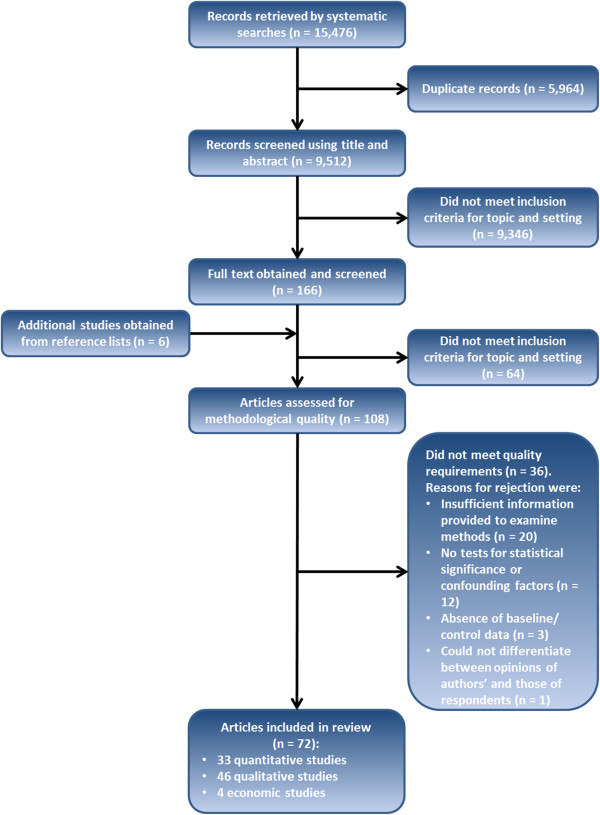
Thirty-three quantitative studies, 46 qualitative studies, and four economic studies from 17 countries met the inclusion criteria. Evidence on unconditional cash transfers was scanty. Other demand-side financing modes were found to increase utilisation of maternal healthcare in the index pregnancy or uptake of related merit goods. Evidence of effects on maternal and infant mortality and morbidity outcomes was insufficient. Important implementation aspects include targeting and eligibility criteria, monitoring, respectful treatment of beneficiaries, suitable incentives for providers, quality of care and affordable referral systems.
Demand-side financing schemes can increase utilisation of maternity services, but attention must be paid to supply-side conditions, the fine-grain of implementation and sustainability. Comparative studies and research on health impact and cost-effectiveness are required.
需求侧融资是指将特定服务的资金通过或直接提供给潜在用户,目前许多低收入和中等收入国家的卫生和教育部门都采用了这种方式。本系统评价旨在严格审查在这些环境中应用这种方法促进孕产妇健康的证据。考虑了五种模式:无条件现金转移、有条件现金转移、短期支付以抵消获得孕产妇服务的费用、孕产妇服务代金券以及优质商品代金券。我们试图评估这些干预措施对孕产妇服务利用、孕产妇健康结果和婴儿健康、弱势妇女状况以及医疗保健系统的影响。
该方案旨在收集和综合来自定量、定性和经济研究的广泛证据。检索了19个卫生和社会政策数据库、7个未发表研究数据库和27个网站;并额外检索了印度期刊和网站。如果研究考察了需求侧融资干预措施以增加旨在影响孕产妇健康的服务或商品的消费,并符合相关质量标准,则纳入研究。质量评估、数据提取和分析使用乔安娜·布里格斯研究所的标准化工具和软件。感兴趣的结果包括孕产妇和婴儿死亡率及发病率、服务利用情况、成功实施所需的因素、接受者和提供者的经验、伦理问题以及成本效益。通过叙述性综合呈现有效性、可行性、适宜性和意义方面的研究结果。
来自17个国家的33项定量研究、46项定性研究和4项经济研究符合纳入标准。关于无条件现金转移的证据很少。发现其他需求侧融资模式可增加指数妊娠期间孕产妇保健服务的利用或相关优质商品的获取。对孕产妇和婴儿死亡率及发病率结果的影响证据不足。重要的实施方面包括目标设定和资格标准、监测、对受益者的尊重对待、对提供者的适当激励、护理质量和负担得起的转诊系统。
需求侧融资计划可以增加孕产妇服务的利用,但必须关注供应侧条件、实施的细节和可持续性。需要进行比较研究以及关于健康影响和成本效益的研究。