MMWR Morb Mortal Wkly Rep. 2014 Jan 31;63(4):77-80.
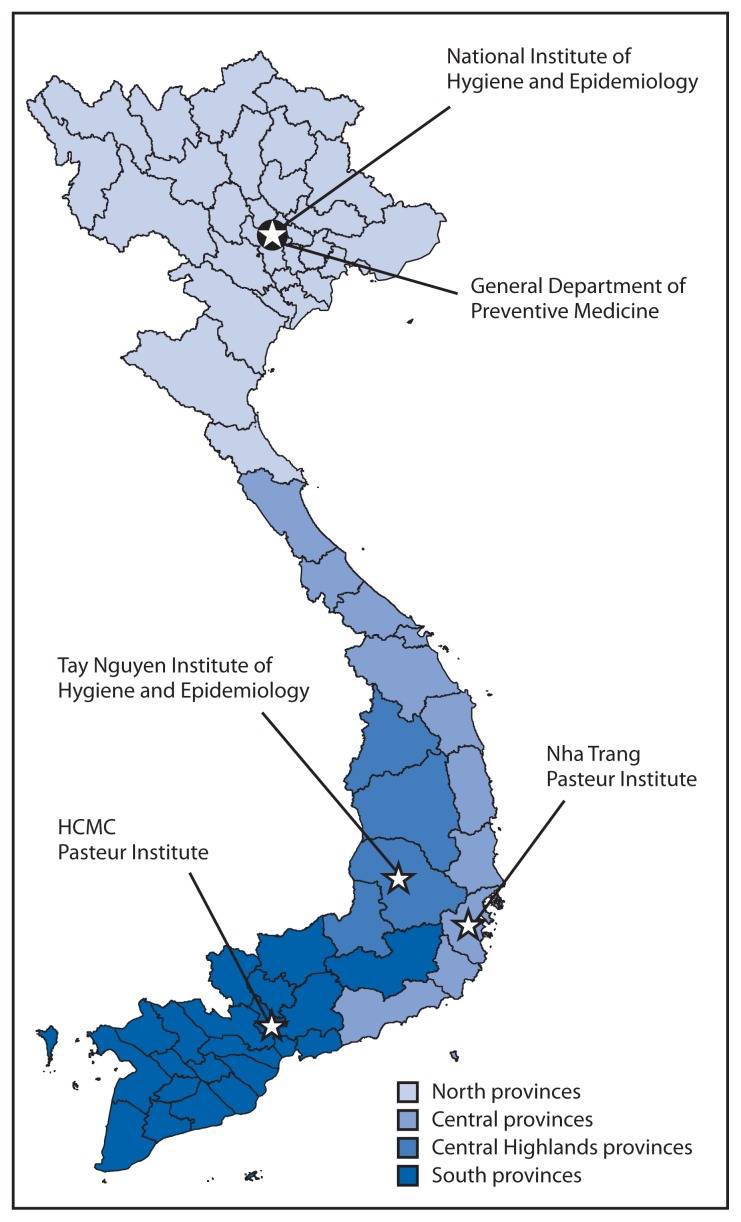
Over the past decade, Vietnam has successfully responded to global health security (GHS) challenges, including domestic elimination of severe acute respiratory syndrome (SARS) and rapid public health responses to human infections with influenza A(H5N1) virus. However, new threats such as Middle East respiratory syndrome coronavirus (MERS-CoV) and influenza A(H7N9) present continued challenges, reinforcing the need to improve the global capacity to prevent, detect, and respond to public health threats. In June 2012, Vietnam, along with many other nations, obtained a 2-year extension for meeting core surveillance and response requirements of the 2005 International Health Regulations (IHR). During March-September 2013, CDC and the Vietnamese Ministry of Health (MoH) collaborated on a GHS demonstration project to improve public health emergency detection and response capacity. The project aimed to demonstrate, in a short period, that enhancements to Vietnam's health system in surveillance and early detection of and response to diseases and outbreaks could contribute to meeting the IHR core capacities, consistent with the Asia Pacific Strategy for Emerging Diseases. Work focused on enhancements to three interrelated priority areas and included achievements in 1) establishing an emergency operations center (EOC) at the General Department of Preventive Medicine with training of personnel for public health emergency management; 2) improving the nationwide laboratory system, including enhanced testing capability for several priority pathogens (i.e., those in Vietnam most likely to contribute to public health emergencies of international concern); and 3) creating an emergency response information systems platform, including a demonstration of real-time reporting capability. Lessons learned included awareness that integrated functions within the health system for GHS require careful planning, stakeholder buy-in, and intradepartmental and interdepartmental coordination and communication.
在过去的十年中,越南成功应对了全球卫生安全(GHS)挑战,包括在国内消除严重急性呼吸综合征(SARS)和迅速应对人类感染甲型 H5N1 流感病毒的公共卫生反应。然而,中东呼吸综合征冠状病毒(MERS-CoV)和甲型 H7N9 流感等新威胁仍带来持续挑战,这加强了提高全球预防、检测和应对公共卫生威胁能力的必要性。2012 年 6 月,越南与许多其他国家一起获得了延长两年时间,以满足 2005 年《国际卫生条例》(IHR)核心监测和应对要求。2013 年 3 月至 9 月,美国疾病控制与预防中心(CDC)与越南卫生部(MoH)合作开展了一项 GHS 示范项目,以提高公共卫生突发事件的检测和应对能力。该项目旨在在短时间内证明,越南卫生系统在疾病和疫情监测、早期发现和应对方面的增强,有助于满足 IHR 的核心能力,符合亚太新兴疾病战略。工作重点是加强三个相互关联的优先领域,包括:1)在预防医学总局建立应急行动中心(EOC),并对公共卫生应急管理人员进行培训;2)改善全国实验室系统,包括增强对几种优先病原体(即越南最有可能导致国际关注的突发公共卫生事件的病原体)的检测能力;3)创建应急响应信息系统平台,包括实时报告能力的演示。经验教训包括认识到卫生系统内的综合功能需要精心规划、利益相关者的支持以及部门内和部门间的协调和沟通。