Ishidate Takao, Kim Soyoung, Mello Craig, Shirayama Masaki
RNA Therapeutics Institute; Program in Molecular Medicine; University of Massachusetts Medical School; Howard Hughes Medical Institute; Worcester, MA USA.
Worm. 2013 Oct 1;2(4):e26276. doi: 10.4161/worm.26276. Epub 2013 Sep 5.
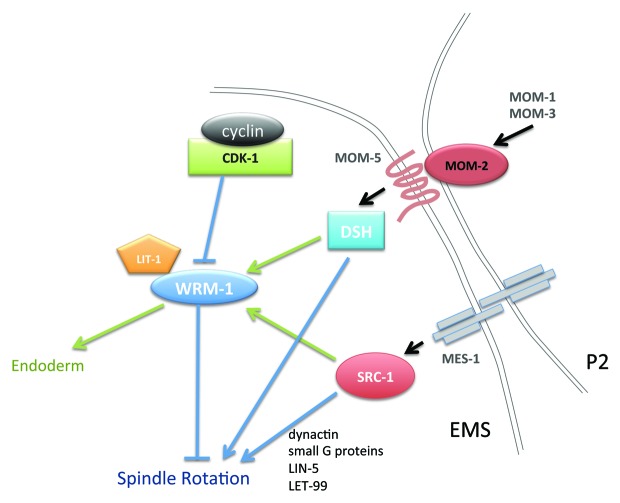
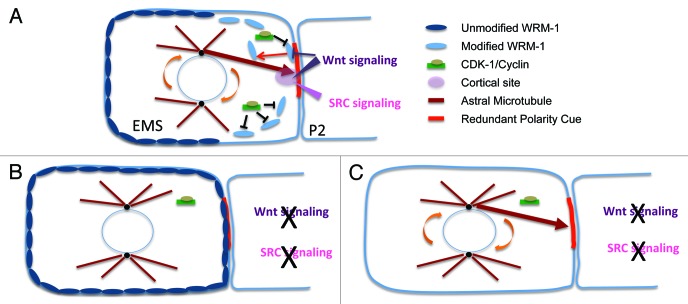
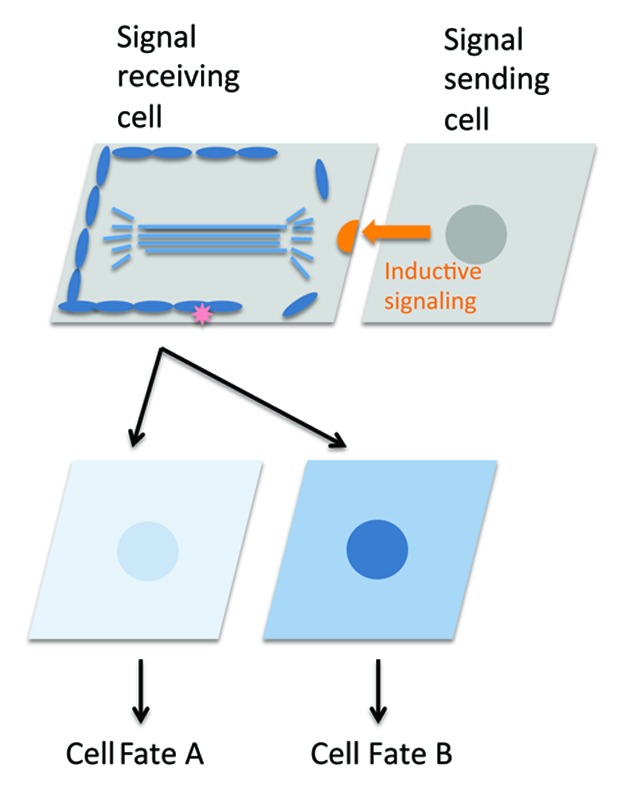
C. elegans, with its invariant cell lineage, provides a powerful model system in which to study signaling-dependent asymmetric cell division. The C. elegans β-catenin-related protein, WRM-1, specifies endoderm at the 4-cell stage during the first cell signaling-induced asymmetric cell division of embryogenesis. During this interaction, Wnt signaling and the cell cycle regulator CDK-1 act together to induce the asymmetric cortical release of WRM-1 at prophase of the EMS cell cycle. Genetic studies suggest that release of WRM-1 unmasks a cortical site that drives EMS spindle rotation onto the polarized axis of the cell, simultaneously making WRM-1 available for nuclear translocation, and downstream signaling to specify endoderm. These studies suggest a general paradigm for how cortical factors like WRM-1 can function at the cell cortex to mask potentially confounding polarity cues, and when released with appropriate cell cycle timing, can also function downstream to define cell fate.
秀丽隐杆线虫具有不变的细胞谱系,为研究信号依赖的不对称细胞分裂提供了一个强大的模型系统。秀丽隐杆线虫中与β-连环蛋白相关的蛋白质WRM-1,在胚胎发育的第一次细胞信号诱导的不对称细胞分裂过程中的4细胞阶段指定内胚层。在这种相互作用过程中,Wnt信号和细胞周期调节因子CDK-1共同作用,在EMS细胞周期的前期诱导WRM-1在皮质不对称释放。遗传学研究表明,WRM-1的释放揭示了一个皮质位点,该位点驱动EMS纺锤体旋转到细胞的极化轴上,同时使WRM-1可用于核转位,并进行下游信号传导以指定内胚层。这些研究提出了一个通用范式,即像WRM-1这样的皮质因子如何在细胞皮质发挥作用以掩盖潜在的混淆极性线索,以及在适当的细胞周期时间释放时,如何在下游发挥作用来定义细胞命运。