Laboratory of Microbiology, Department of Biochemistry and Microbiology, Faculty of Sciences, Ghent University, Ghent, Belgium.
BMC Microbiol. 2014 Feb 18;14:43. doi: 10.1186/1471-2180-14-43.
Imbalanced feeding regimes may initiate gastrointestinal and metabolic diseases in endangered felids kept in captivity such as cheetahs. Given the crucial role of the host's intestinal microbiota in feed fermentation and health maintenance, a better understanding of the cheetah's intestinal ecosystem is essential for improvement of current feeding strategies. We determined the phylogenetic diversity of the faecal microbiota of the only two cheetahs housed in an EAZA associated zoo in Flanders, Belgium, to gain first insights in the relative distribution, identity and potential role of the major community members.
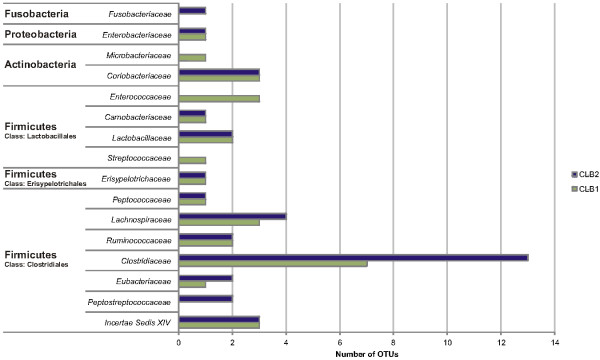
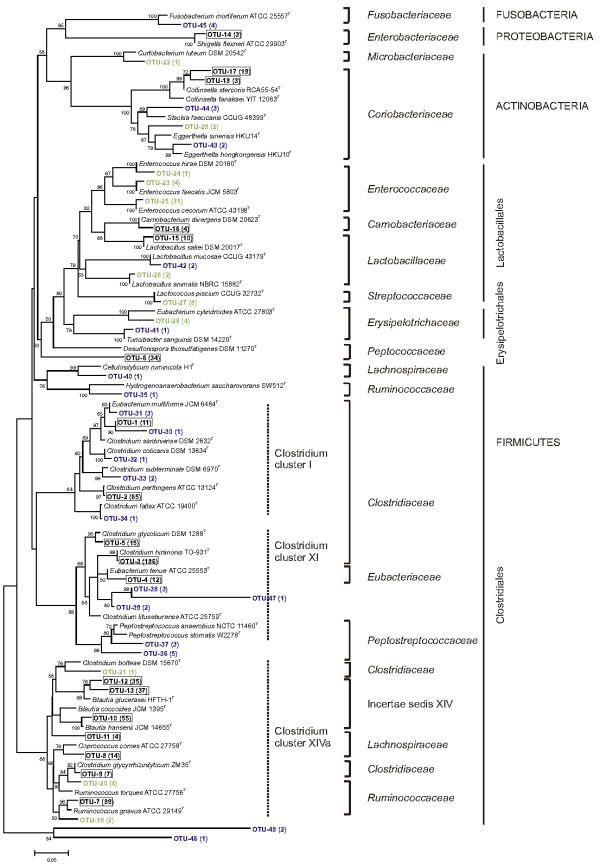
Taxonomic analysis of 16S rRNA gene clone libraries (702 clones) revealed a microbiota dominated by Firmicutes (94.7%), followed by a minority of Actinobacteria (4.3%), Proteobacteria (0.4%) and Fusobacteria (0.6%). In the Firmicutes, the majority of the phylotypes within the Clostridiales were assigned to Clostridium clusters XIVa (43%), XI (38%) and I (13%). Members of the Bacteroidetes phylum and Bifidobacteriaceae, two groups that can positively contribute in maintaining intestinal homeostasis, were absent in the clone libraries and detected in only marginal to low levels in real-time PCR analyses.
This marked underrepresentation is in contrast to data previously reported in domestic cats where Bacteroidetes and Bifidobacteriaceae are common residents of the faecal microbiota. Next to methodological differences, these findings may also reflect the apparent differences in dietary habits of both felid species. Thus, our results question the role of the domestic cat as the best available model for nutritional intervention studies in endangered exotic felids.
在圈养的濒危猫科动物(如猎豹)中,不平衡的饲养方式可能会引发胃肠道和代谢疾病。鉴于宿主肠道微生物群在饲料发酵和健康维持中的关键作用,更好地了解猎豹的肠道生态系统对于改进当前的饲养策略至关重要。我们确定了在比利时弗兰德斯的一个 EAZA 关联动物园中饲养的仅有的两只猎豹的粪便微生物群的系统发育多样性,以初步了解主要群落成员的相对分布、身份和潜在作用。
16S rRNA 基因克隆文库(702 个克隆)的分类分析显示,微生物群主要由厚壁菌门(94.7%)主导,其次是放线菌门(4.3%)、变形菌门(0.4%)和梭杆菌门(0.6%)。在厚壁菌门中,梭状芽胞杆菌目内的大多数分类群被分配到梭菌属 XIVa 簇(43%)、XI 簇(38%)和 I 簇(13%)。可以积极有助于维持肠道内稳态的拟杆菌门和双歧杆菌科的成员在克隆文库中不存在,在实时 PCR 分析中仅以边缘水平或低水平检测到。
与先前在家猫中报道的数据相比,这种明显的代表性不足表明,拟杆菌门和双歧杆菌科是粪便微生物群中常见的居民。除了方法学差异外,这些发现还可能反映出这两个猫科物种饮食习惯的明显差异。因此,我们的结果质疑了家猫作为濒危外来猫科动物营养干预研究中最佳可用模型的作用。