Avarguès-Weber Aurore, d'Amaro Daniele, Metzler Marita, Dyer Adrian G
Biological and Experimental Psychology, School of Biological and Chemical Sciences, Queen Mary University London London, UK.
Institut für Zoologie III (Neurobiologie), Johannes Gutenberg-Universität Mainz, Germany.
Front Behav Neurosci. 2014 Mar 14;8:80. doi: 10.3389/fnbeh.2014.00080. eCollection 2014.
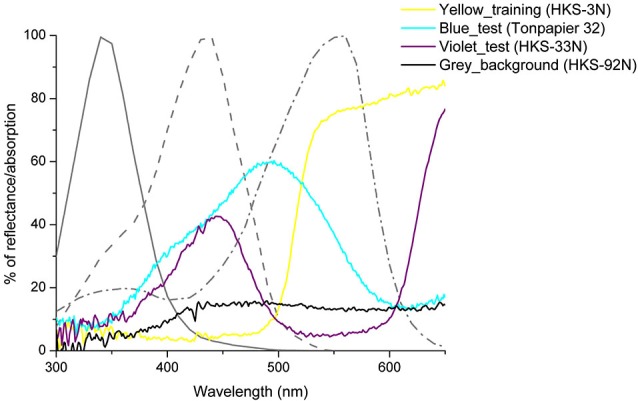
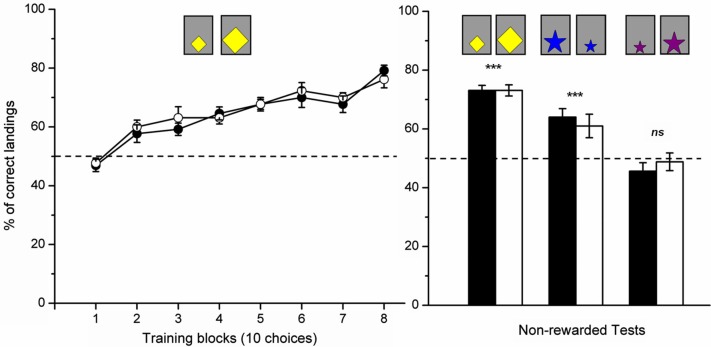
The ability to process visual information using relational rules allows for decisions independent of the specific physical attributes of individual stimuli. Until recently, the manipulation of relational concepts was considered as a prerogative of large mammalian brains. Here we show that individual free flying honeybees can learn to use size relationship rules to choose either the larger or smaller stimulus as the correct solution in a given context, and subsequently apply the learnt rule to novel colors and shapes providing that there is sufficient input to the long wavelength (green) photoreceptor channel. Our results add a novel, size-based conceptual rule to the set of relational concepts that honeybees have been shown to master and underline the value of bees as an animal model for studying the emergence of conceptualization abilities.
利用关系规则处理视觉信息的能力使得决策能够独立于单个刺激的特定物理属性。直到最近,关系概念的操纵还被认为是大型哺乳动物大脑的特权。在这里,我们表明,个体自由飞行的蜜蜂可以学会使用大小关系规则,在给定的情境中选择较大或较小的刺激作为正确答案,并且随后将学到的规则应用于新的颜色和形状,前提是有足够的输入到长波长(绿色)光感受器通道。我们的结果为蜜蜂已被证明能够掌握的关系概念集合增添了一条新的、基于大小的概念规则,并强调了蜜蜂作为研究概念化能力出现的动物模型的价值。