Greitemeyer Tobias
Department of Psychology, University of Innsbruck, Innsbruck, Austria.
PLoS One. 2014 Apr 10;9(4):e93440. doi: 10.1371/journal.pone.0093440. eCollection 2014.
Despite hundreds of studies, there is continuing debate about the extent to which violent video games increase aggression. Believers argue that playing violent video games increases aggression, but this stance is disputed by skeptics. The present study addressed believers' and skeptics' responses to summaries of scientific studies that do or do not present evidence for increased aggression after violent video game play.
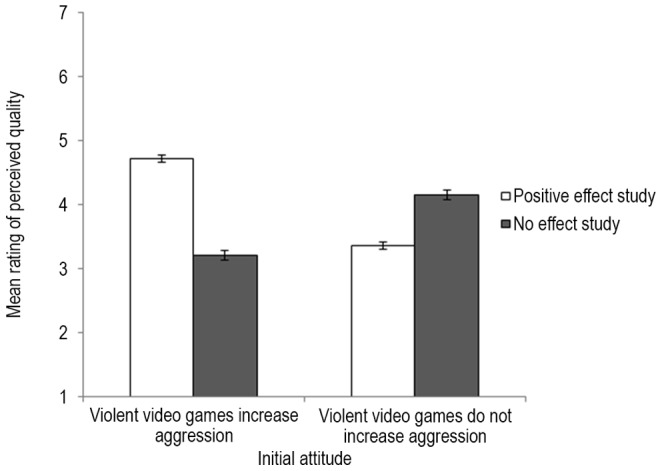
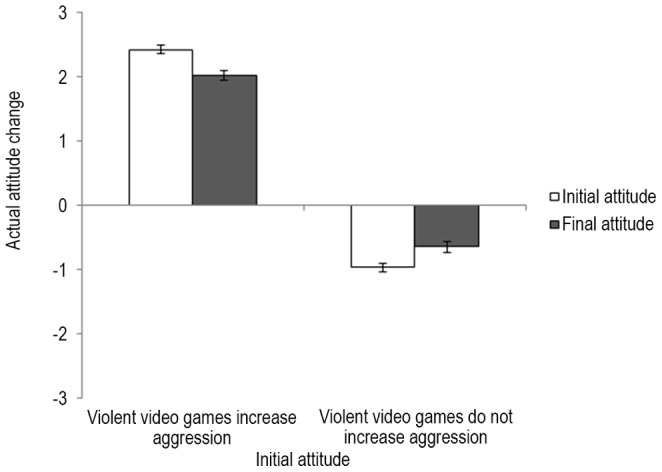
METHODS/PRINCIPAL FINDINGS: Participants (N = 662) indicated whether they believed that violent video games increase aggression. Afterwards, they evaluated two opposing summaries of fictitious studies on the effects of violent video play. They also reported whether their initial belief had changed after reading the two summaries and indicated again whether they believed that violent video games increase aggression. Results showed that believers evaluated the study showing an effect more favorably than a study showing no effect, whereas the opposite was observed for skeptics. Moreover, both believers and skeptics reported to become more convinced of their initial view. In contrast, for actual attitude change, a depolarization effect was found.
CONCLUSIONS/SIGNIFICANCE: These results suggest that biased assimilation of new information leads believers and skeptics to become more rather than less certain of their views. Hence, even when confronted with mixed and inconclusive evidence, the perceived gap between both sides of the argument increases.
尽管进行了数百项研究,但关于暴力电子游戏在多大程度上会增加攻击性仍存在持续的争论。支持者认为玩暴力电子游戏会增加攻击性,但这种立场受到了怀疑者的质疑。本研究探讨了支持者和怀疑者对科学研究总结的反应,这些总结呈现或未呈现暴力电子游戏后攻击性增加的证据。
方法/主要发现:参与者(N = 662)表明他们是否相信暴力电子游戏会增加攻击性。之后,他们评估了关于暴力电子游戏影响的两项虚构研究的对立总结。他们还报告了在阅读这两项总结后他们最初的信念是否发生了变化,并再次表明他们是否相信暴力电子游戏会增加攻击性。结果表明,支持者对显示有影响的研究评价比对显示无影响的研究更积极,而怀疑者则相反。此外,支持者和怀疑者都报告说对自己最初的观点更加确信。相比之下,对于实际的态度变化,发现了一种去极化效应。
结论/意义:这些结果表明,对新信息的有偏见的同化导致支持者和怀疑者对自己的观点更加确定,而不是不那么确定。因此,即使面对混合且无定论的证据,争论双方之间的感知差距也会加大。