Orphanidou-Vlachou Eleni, Vlachos Nikolaos, Davies Nigel P, Arvanitis Theodoros N, Grundy Richard G, Peet Andrew C
Birmingham Children's Hospital NHS Foundation Trust, Birmingham, UK; School of Cancer Sciences, College of Medical and Dental Sciences, University of Birmingham, Edgbaston, Birmingham, UK.
NMR Biomed. 2014 Jun;27(6):632-9. doi: 10.1002/nbm.3099. Epub 2014 Apr 13.
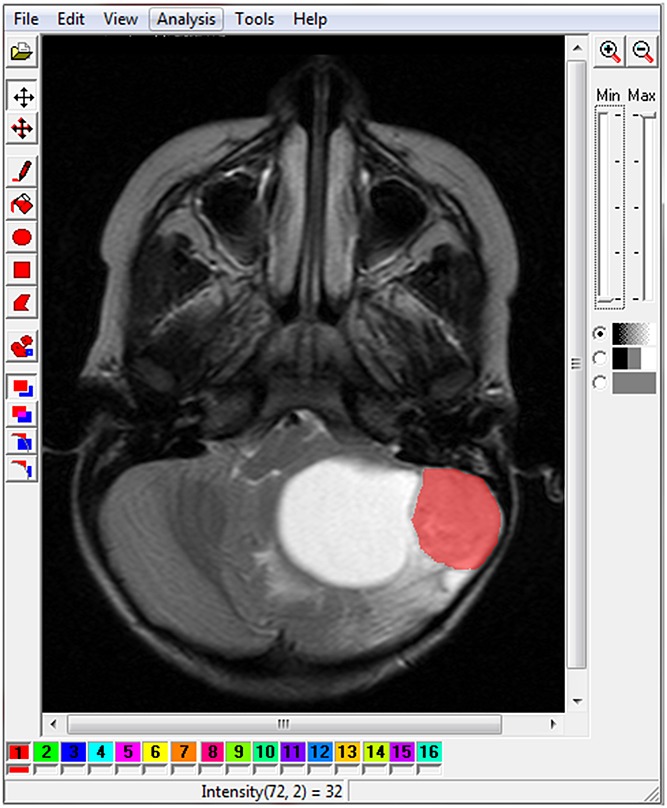
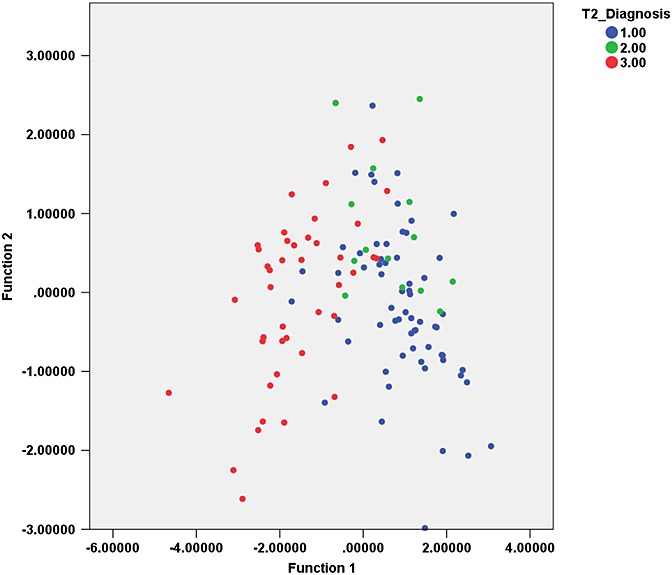
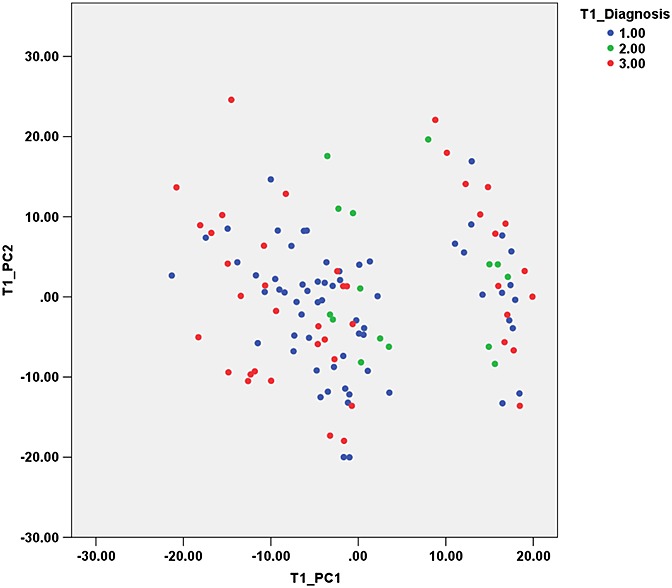
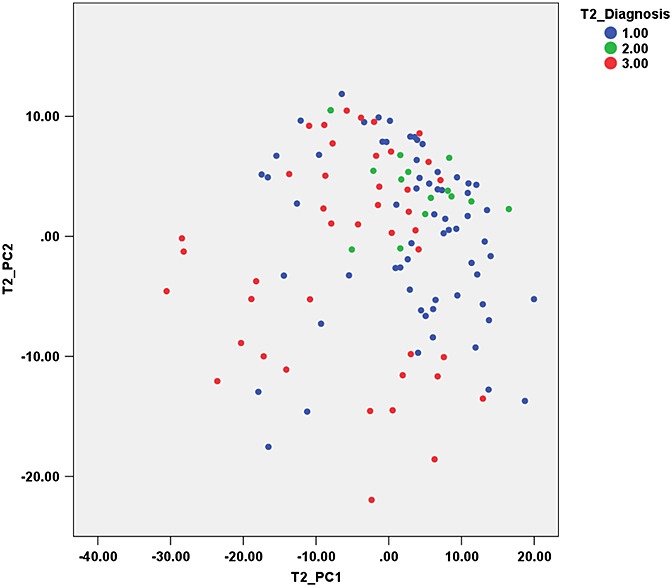
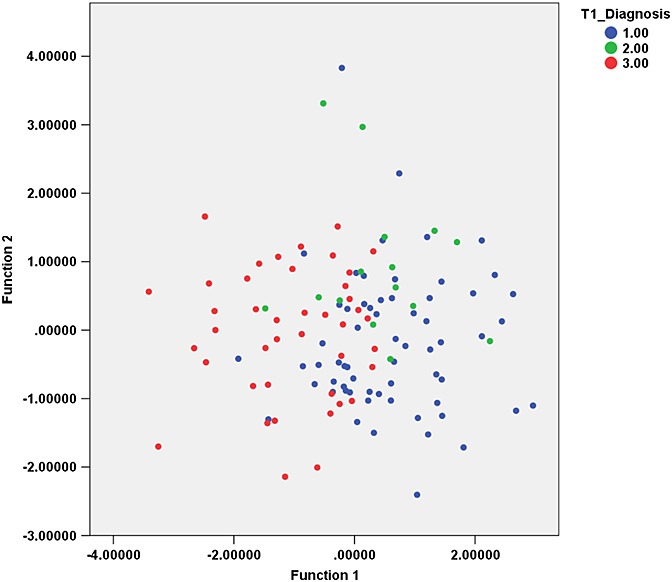
Brain tumours are the most common solid tumours in children, representing 20% of all cancers. The most frequent posterior fossa tumours are medulloblastomas, pilocytic astrocytomas and ependymomas. Texture analysis (TA) of MR images can be used to support the diagnosis of these tumours by providing additional quantitative information. MaZda software was used to perform TA on T1 - and T2 -weighted images of children with pilocytic astrocytomas, medulloblastomas and ependymomas of the posterior fossa, who had MRI at Birmingham Children's Hospital prior to treatment. The region of interest was selected on three slices per patient in Image J, using thresholding and manual outlining. TA produced 279 features, which were reduced using principal component analysis (PCA). The principal components (PCs) explaining 95% of the variance were used in a linear discriminant analysis (LDA) and a probabilistic neural network (PNN) to classify the cases, using DTREG statistics software. PCA of texture features from both T1 - and T2 -weighted images yielded 13 PCs to explain >95% of the variance. The PNN classifier for T1 -weighted images achieved 100% accuracy on training the data and 90% on leave-one-out cross-validation (LOOCV); for T2 -weighted images, the accuracy was 100% on training the data and 93.3% on LOOCV. A PNN classifier with T1 and T2 PCs achieved 100% accuracy on training the data and 85.8% on LOOCV. LDA classification accuracies were noticeably poorer. The features found to hold the highest discriminating potential were all co-occurrence matrix derived, where adjacent pixels had highly correlated intensities. This study shows that TA can be performed on standard T1 - and T2 -weighted images of childhood posterior fossa tumours using readily available software to provide high diagnostic accuracy. Discriminatory features do not correspond to those used in the clinical interpretation of the images and therefore provide novel tumour information.
脑肿瘤是儿童中最常见的实体肿瘤,占所有癌症的20%。最常见的后颅窝肿瘤是髓母细胞瘤、毛细胞型星形细胞瘤和室管膜瘤。磁共振成像(MR)图像的纹理分析(TA)可通过提供额外的定量信息来辅助这些肿瘤的诊断。使用MaZda软件对在伯明翰儿童医院治疗前进行过MRI检查的患有后颅窝毛细胞型星形细胞瘤、髓母细胞瘤和室管膜瘤的儿童的T1加权和T2加权图像进行TA。在Image J中,通过阈值处理和手动勾勒轮廓,为每位患者在三个切片上选择感兴趣区域。TA产生了279个特征,使用主成分分析(PCA)对这些特征进行了降维。使用DTREG统计软件,将解释95%方差的主成分(PC)用于线性判别分析(LDA)和概率神经网络(PNN)对病例进行分类。来自T1加权和T2加权图像的纹理特征的PCA产生了13个PC来解释>95%的方差。T1加权图像的PNN分类器在训练数据时准确率达到100%,在留一法交叉验证(LOOCV)时为90%;对于T2加权图像,训练数据时准确率为100%,LOOCV时为93.3%。结合T1和T2主成分的PNN分类器在训练数据时准确率达到100%,LOOCV时为85.8%。LDA分类准确率明显较低。发现具有最高鉴别潜力的特征均来自共生矩阵,其中相邻像素具有高度相关的强度。本研究表明,使用现成的软件可以对儿童后颅窝肿瘤的标准T1加权和T2加权图像进行TA,以提供高诊断准确性。鉴别特征与图像临床解读中使用的特征不同,因此提供了新的肿瘤信息。