Alfred Health, Commercial Road, Melbourne 3004, Victoria, Australia.
Respir Res. 2014 Apr 15;15(1):44. doi: 10.1186/1465-9921-15-44.
Exercise training is recommended for non-cystic fibrosis (CF) bronchiectasis, but the long-term effects are unclear. This randomised controlled trial aimed to determine the effects of exercise training and review of airway clearance therapy (ACT) on exercise capacity, health related quality of life (HRQOL) and the incidence of acute exacerbations in people with non-CF bronchiectasis.
Participants were randomly allocated to 8 weeks of supervised exercise training and review of ACT, or control. Primary outcomes of exercise capacity and HRQOL (Chronic respiratory disease questionnaire) and secondary outcomes of cough-related QOL (Leicester cough questionnaire) and psychological symptoms (Hospital anxiety and depression scale) were measured at baseline, following completion of the intervention period and at 6 and 12 months follow up. Secondary outcomes of the exacerbation rate and time to first exacerbation were analysed over 12 months.
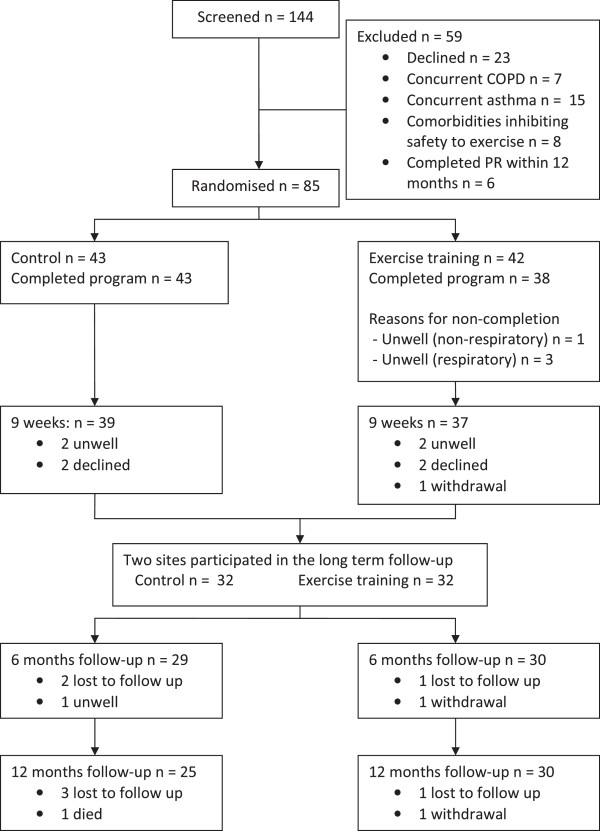
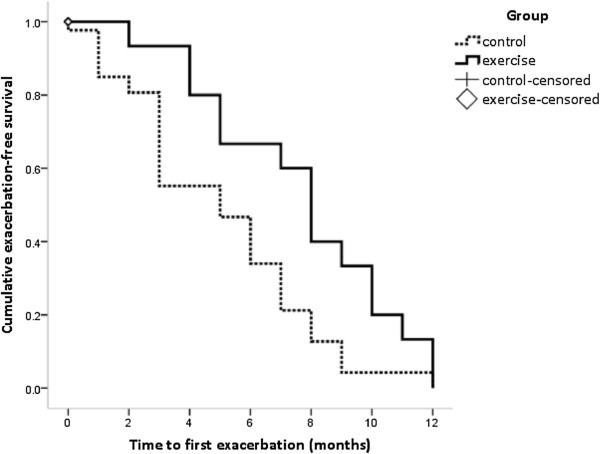
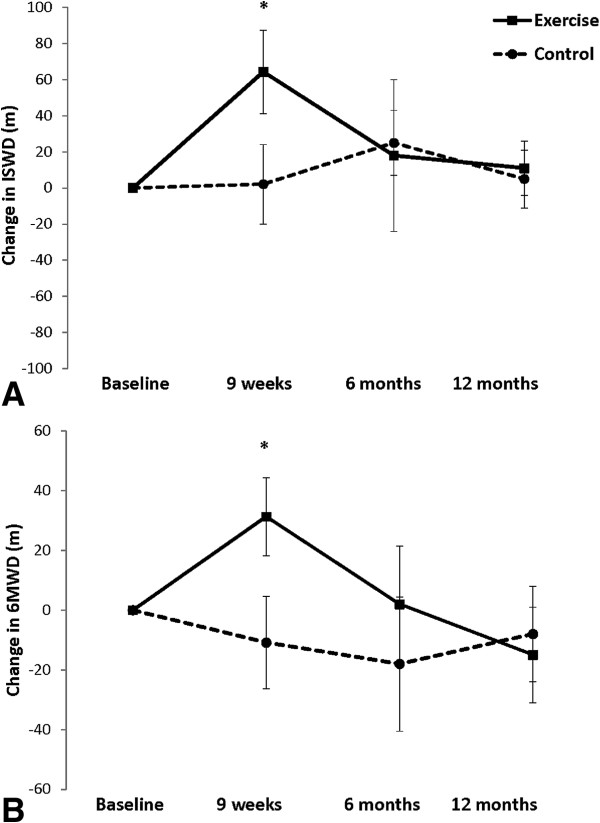
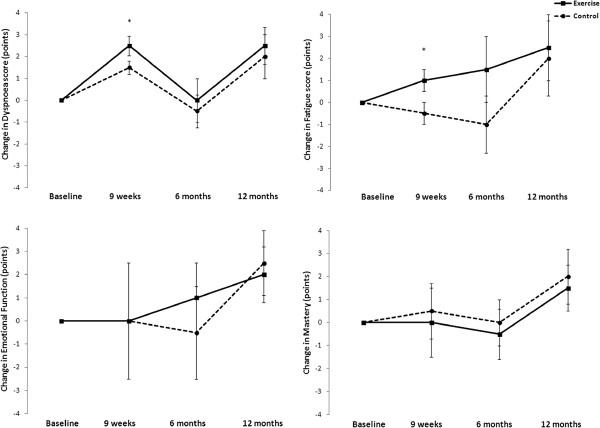
Eighty-five participants (mean FEV1 74% predicted; median Modified Medical Research Council Dyspnoea grade of 1 (IQR [1-3]) were included. Exercise training increased the incremental shuttle walk distance (mean difference to control 62 m, 95% CI 24 to 101 m) and the 6-minute walking distance (mean difference to control 41 m, 95% CI 19 to 63 m), but these improvements were not sustained at 6 or 12 months. Exercise training reduced dyspnoea (p = 0.009) and fatigue (p = 0.01) but did not impact on cough-related QOL or mood. Exercise training reduced the frequency of acute exacerbations (median 1[IQR 1-3]) compared to the control group (2[1-3]) over 12 months follow up (p = 0.012), with a longer time to first exacerbation with exercise training of 8 months (95% CI 7 to 9 months) compared to the control group (6 months [95% CI 5 to 7 months], p = 0.047).
Exercise training in bronchiectasis is associated with short term improvement in exercise capacity, dyspnoea and fatigue and fewer exacerbations over 12 months.
ClinicalTrials.gov (NCT00885521).
运动训练被推荐用于非囊性纤维化(CF)支气管扩张症,但长期效果尚不清楚。这项随机对照试验旨在确定运动训练和气道清除治疗(ACT)复习对非 CF 支气管扩张症患者的运动能力、健康相关生活质量(HRQOL)和急性加重发生率的影响。
参与者被随机分配到 8 周的监督运动训练和 ACT 复习,或对照组。主要结局是运动能力和 HRQOL(慢性呼吸系统疾病问卷),次要结局是咳嗽相关 QOL(莱斯特咳嗽问卷)和心理症状(医院焦虑和抑郁量表),在基线时、干预期结束时以及 6 和 12 个月随访时进行测量。次要结局是在 12 个月内的加重率和首次加重时间。
85 名参与者(平均 FEV1 为预计值的 74%;中位数改良医学研究委员会呼吸困难等级为 1(IQR [1-3]))被纳入研究。运动训练增加了递增穿梭步行距离(与对照组相比,平均差异为 62m,95%CI 24 至 101m)和 6 分钟步行距离(与对照组相比,平均差异为 41m,95%CI 19 至 63m),但这些改善在 6 或 12 个月时并未持续。运动训练减轻了呼吸困难(p=0.009)和疲劳(p=0.01),但对咳嗽相关 QOL 或情绪没有影响。与对照组相比,运动训练在 12 个月随访期间降低了急性加重的频率(中位数 1[IQR 1-3])(p=0.012),运动训练组首次加重的时间为 8 个月(95%CI 7 至 9 个月),而对照组为 6 个月(95%CI 5 至 7 个月)(p=0.047)。
支气管扩张症中的运动训练与短期运动能力、呼吸困难和疲劳的改善以及 12 个月内急性加重的减少有关。
ClinicalTrials.gov(NCT00885521)。