Goscé Lara, Barton David A W, Johansson Anders
Faculty of Engineering, University of Bristol, UK.
Sci Rep. 2014 May 6;4:4856. doi: 10.1038/srep04856.
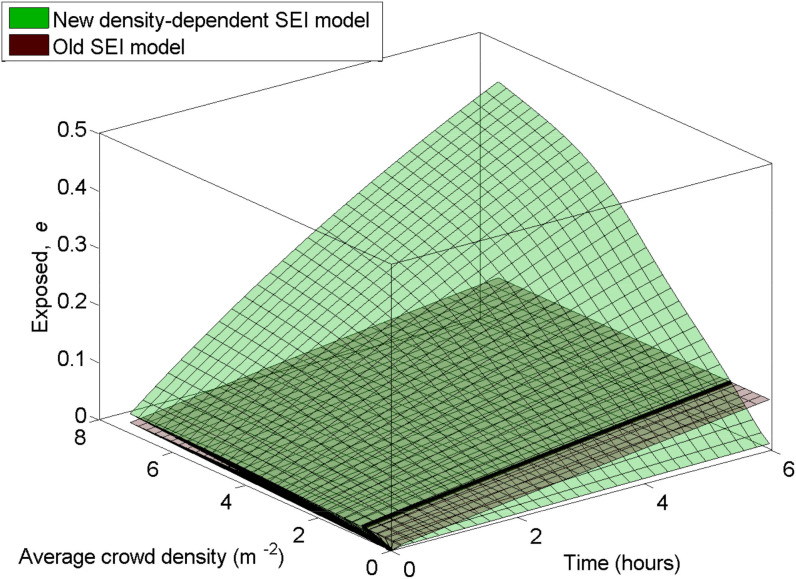
Since 1927 and until recently, most models describing the spread of disease have been of compartmental type, based on the assumption that populations are homogeneous and well-mixed. Recent models have utilised agent-based models and complex networks to explicitly study heterogeneous interaction patterns, but this leads to an increasing computational complexity. Compartmental models are appealing because of their simplicity, but their parameters, especially the transmission rate, are complex and depend on a number of factors, which makes it hard to predict how a change of a single environmental, demographic, or epidemiological factor will affect the population. Therefore, in this contribution we propose a middle ground, utilising crowd-behaviour research to improve compartmental models in crowded situations. We show how both the rate of infection as well as the walking speed depend on the local crowd density around an infected individual. The combined effect is that the rate of infection at a population scale has an analytically tractable non-linear dependency on crowd density. We model the spread of a hypothetical disease in a corridor and compare our new model with a typical compartmental model, which highlights the regime in which current models may not produce credible results.
自1927年以来直至最近,大多数描述疾病传播的模型都是基于人群是同质且充分混合的假设而建立的 compartmental 模型。最近的模型利用基于主体的模型和复杂网络来明确研究异质相互作用模式,但这导致计算复杂性不断增加。Compartmental 模型因其简单性而具有吸引力,但其参数,尤其是传播率,很复杂且取决于多种因素,这使得很难预测单一环境、人口统计学或流行病学因素的变化将如何影响人群。因此,在本论文中,我们提出了一种折中的方法,利用人群行为研究来改进拥挤情况下的 compartmental 模型。我们展示了感染率以及步行速度如何取决于感染个体周围的局部人群密度。综合效果是,在人群尺度上的感染率对人群密度具有解析上易于处理的非线性依赖性。我们对走廊中一种假设疾病的传播进行建模,并将我们的新模型与典型的 compartmental 模型进行比较,这突出了当前模型可能无法产生可信结果的情况。