Betrán Ana Pilar, Vindevoghel Nadia, Souza Joao Paulo, Gülmezoglu A Metin, Torloni Maria Regina
UNDP/UNFPA/UNICEF/WHO/World Bank Special Programme of Research, Development and Research Training in Human Reproduction, Department of Reproductive Health and Research, World Health Organization, Geneva, Switzerland.
Maternal Child Clinic, Calgary, Canada.
PLoS One. 2014 Jun 3;9(6):e97769. doi: 10.1371/journal.pone.0097769. eCollection 2014.
Caesarean sections (CS) rates continue to increase worldwide without a clear understanding of the main drivers and consequences. The lack of a standardized internationally-accepted classification system to monitor and compare CS rates is one of the barriers to a better understanding of this trend. The Robson's 10-group classification is based on simple obstetrical parameters (parity, previous CS, gestational age, onset of labour, fetal presentation and number of fetuses) and does not involve the indication for CS. This classification has become very popular over the last years in many countries. We conducted a systematic review to synthesize the experience of users on the implementation of this classification and proposed adaptations.
Four electronic databases were searched. A three-step thematic synthesis approach and a qualitative metasummary method were used.
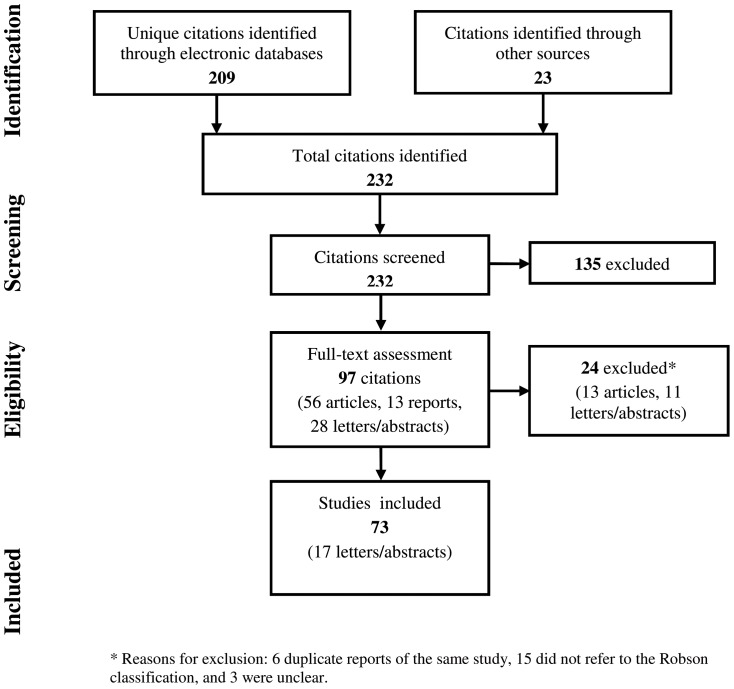
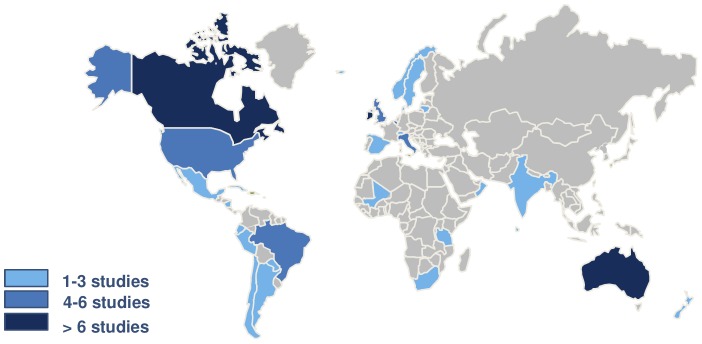
232 unique reports were identified, 97 were selected for full-text evaluation and 73 were included. These publications reported on the use of Robson's classification in over 33 million women from 31 countries. According to users, the main strengths of the classification are its simplicity, robustness, reliability and flexibility. However, missing data, misclassification of women and lack of definition or consensus on core variables of the classification are challenges. To improve the classification for local use and to decrease heterogeneity within groups, several subdivisions in each of the 10 groups have been proposed. Group 5 (women with previous CS) received the largest number of suggestions.
The use of the Robson classification is increasing rapidly and spontaneously worldwide. Despite some limitations, this classification is easy to implement and interpret. Several suggested modifications could be useful to help facilities and countries as they work towards its implementation.
剖宫产率在全球范围内持续上升,但其主要驱动因素和后果尚不清楚。缺乏标准化的国际认可分类系统来监测和比较剖宫产率是更好理解这一趋势的障碍之一。罗布森10组分类基于简单的产科参数(产次、既往剖宫产史、孕周、临产开始时间、胎儿先露和胎儿数量),不涉及剖宫产指征。在过去几年中,这种分类在许多国家非常流行。我们进行了一项系统评价,以综合用户在实施该分类方面的经验并提出改进建议。
检索了四个电子数据库。采用了三步主题综合法和定性元汇总法。
共识别出232篇独特报告,97篇被选作全文评估,73篇被纳入。这些出版物报道了来自31个国家的超过3300万妇女使用罗布森分类的情况。据用户反映,该分类的主要优点是简单、稳健、可靠和灵活。然而,数据缺失、妇女分类错误以及对分类核心变量缺乏定义或共识是面临的挑战。为改进该分类以供本地使用并减少组内异质性,已对10个组中的每个组提出了若干细分建议。第5组(有既往剖宫产史的妇女)收到的建议最多。
罗布森分类在全球范围内的使用正在迅速且自发地增加。尽管存在一些局限性,但这种分类易于实施和解释。一些建议的修改可能有助于各机构和各国在实施过程中提供帮助。