Wu Jing, Wang Dan-Dan, Li Xin-Lou, de Vlas Sake J, Yu Ya-Qin, Zhu Jian, Zhang Ying, Wang Bo, Yan Li, Fang Li-Qun, Liu Ya-Wen, Cao Wu-Chun
Department of Epidemiology and Statistics, Jilin University, Changchun, People's Republic of China.
BMC Infect Dis. 2014 Jun 3;14:301. doi: 10.1186/1471-2334-14-301.
Since the end of the 1990s, the incidence of hemorrhagic fever with renal syndrome (HFRS) has been increasing dramatically in Changchun, northeastern China. However, it is unknown which, and how, underlying risk factors have been involved in the reemergence of the disease.
Data on HFRS cases at the county scale were collected from 1998 to 2012. Data on livestock husbandry including the numbers of large animals (cattle, horses, donkeys and mules), sheep, and deer, and on climatic and land cover variables were also collected. Epidemiological features, including the spatial, temporal and human patterns of disease were characterized. The potential factors related to spatial heterogeneity and temporal trends were analyzed using standard and time-series Poisson regression analysis, respectively.
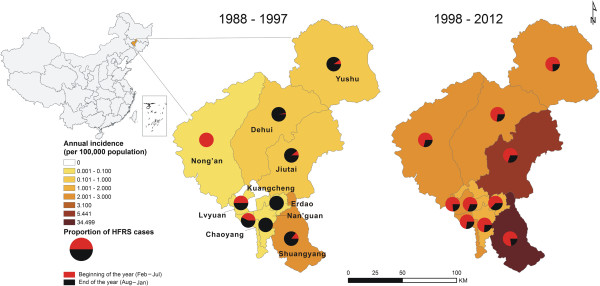
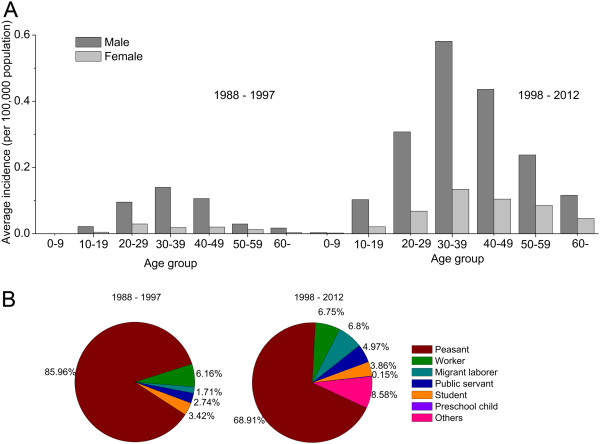
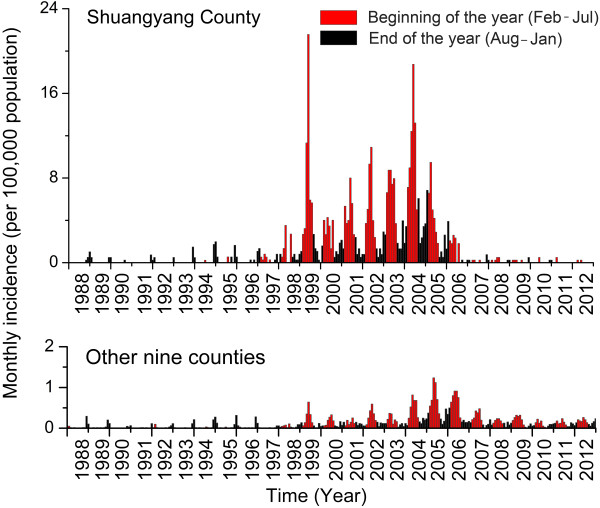
Annual incidence varied among the 10 counties. Shuangyang County in southeastern Changchun had the highest number of cases (1,525 cases; 35.9% of all cases), but its population only accounted for 5.6% of the total population. Based on seasonal pattern in HFRS incidence, two epidemic phases were identified. One was a single epidemic peak at the end of each year from 1988 to 1997 and the other consisted of dual epidemic peaks at both the end and the beginning of each year from 1998 to the end of the study period. HFRS incidence was higher in males compared to females, and most of the HFRS cases occurred in peasant populations. The results of the Poisson regression analysis indicated that the spatial distribution and the increasing incidence of HFRS were significantly associated with livestock husbandry and climate factors, particularly with deer cultivation.
Our results indicate that the re-emergence of HFRS in Changchun has been accompanied by changing seasonal patterns over the past 25 years. Integrated measures focusing on areas related to local livestock husbandry could be helpful for the prevention and control of HFRS.
自20世纪90年代末以来,中国东北长春市肾综合征出血热(HFRS)的发病率急剧上升。然而,尚不清楚哪些潜在风险因素以及这些因素如何导致了该疾病的再次出现。
收集了1998年至2012年县级尺度上的HFRS病例数据。还收集了包括大牲畜(牛、马、驴和骡)、羊和鹿数量在内的畜牧业数据以及气候和土地覆盖变量数据。对疾病的流行病学特征进行了描述,包括空间、时间和人群模式。分别使用标准泊松回归分析和时间序列泊松回归分析来分析与空间异质性和时间趋势相关的潜在因素。
10个县的年发病率各不相同。长春东南部的双阳县病例数最多(1525例;占所有病例的35.9%),但其人口仅占总人口的5.6%。根据HFRS发病率的季节模式,确定了两个流行阶段。一个是1988年至1997年每年年末的单一流行高峰,另一个是1998年至研究期末每年年末和年初的双流行高峰。男性的HFRS发病率高于女性,且大多数HFRS病例发生在农民群体中。泊松回归分析结果表明,HFRS的空间分布和发病率上升与畜牧业和气候因素显著相关,特别是与养鹿业相关。
我们的结果表明,在过去25年中,长春市HFRS的再次出现伴随着季节模式的变化。针对当地畜牧业相关领域采取综合措施可能有助于HFRS的预防和控制。