Key Laboratory of Vaccine, Prevention and Control of Infectious Disease of Zhejiang Province, Zhejiang Provincial Center for Disease Control and Prevention, Hangzhou, China.
MPH department, college of Veterinary Medicine, Cornell University, Ithaca, New York, United States of America.
PLoS Negl Trop Dis. 2021 Aug 6;15(8):e0009673. doi: 10.1371/journal.pntd.0009673. eCollection 2021 Aug.
Hemorrhagic fever with renal syndrome (HFRS) is a rodent-borne disease caused by hantavirus which was endemic Zhejiang Province, China. In this study, we aim to explore the changing epidemiology of HFRS in Zhejiang, identify high-risk areas and populations, and evaluate relevant policies and interventions to better improve HFRS control and prevention.
Surveillance data on HFRS during 1963-2020 in Zhejiang Province were extracted from Zhejiang Provincial Center for Disease Control and Prevention archives and the Chinese Notifiable Disease Reporting System. The changing epidemiological characteristics of HFRS including seasonal distribution, geographical distribution, and demographic features, were analyzed using joinpoint regression, autoregressive integrated moving average model, descriptive statistical methods, and Spatio-temporal cluster analysis.
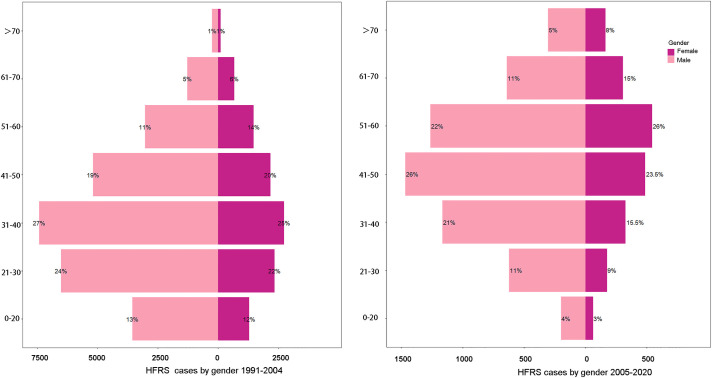
From 1963 to 2020, 114 071 HFRS cases and 1269 deaths were reported in Zhejiang Province. The incidence increased sharply from 1973 and peaked in 1986, then decreased steadily and maintained a stable incidence from 2004. HFRS cases were reported in all 11 prefecture-level cities of Zhejiang Province from 1963 to 2020. The joint region (Shengzhou, Xinchang, Tiantai, and surrounding areas), and Kaihua County are the most seriously affected regions throughout time. After 1990, the first HFRS incidence peak was in May-June, with another one from November to January. Most HFRS cases occurred in 21- (26.48%) and 30- years group (24.25%) from 1991 to 2004, but 41- (25.75%) and 51-years (23.30%) had the highest proportion from 2005 to 2020. Farmers accounted for most cases (78.10%), and cases are predominantly males with a male-to-female ratio of 2.6:1. It was found that the median time from onset to diagnosis was 6.5 days (IQR 3.75-10.42), and the time from diagnosis to disease report was significantly shortened after 2011.
We observed dynamic changes in the seasonal distribution, geographical distribution, and demographic features of HFRS, which should be well considered in the development of control and prevention strategies in future. Additional researches are warranted to elucidate the environmental, meteorological, and social factors associated with HFRS incidence in different decades.
肾综合征出血热(HFRS)是一种由汉坦病毒引起的啮齿动物传播疾病,在中国浙江省流行。本研究旨在探讨浙江省 HFRS 的流行特征变化,确定高危地区和人群,并评估相关政策和干预措施,以更好地改善 HFRS 的防控。
从浙江省疾病预防控制中心档案和中国法定传染病报告系统中提取 1963-2020 年浙江省 HFRS 监测数据。采用 joinpoint 回归、自回归移动平均模型、描述性统计方法和时空聚类分析,分析 HFRS 的季节性、地理和人口特征的变化趋势。
1963-2020 年,浙江省共报告 114071 例 HFRS 病例,1269 例死亡。发病率从 1973 年开始急剧上升,1986 年达到高峰,然后稳步下降,2004 年以来保持稳定。1963-2020 年,浙江省 11 个地级市均有 HFRS 报告。在 1990 年之前,主要的发病高峰在 5-6 月,其次在 11-1 月;而在 1990 年之后,主要的发病高峰在 5-6 月和 11-1 月。1991-2004 年,发病年龄主要集中在 21-(26.48%)和 30-(24.25%)岁年龄组,2005-2020 年,发病年龄主要集中在 41-(25.75%)和 51-(23.30%)岁年龄组。农民是 HFRS 最主要的发病人群(78.10%),且病例主要为男性,男女比为 2.6:1。从发病到诊断的中位数时间为 6.5 天(IQR 3.75-10.42),2011 年以后诊断到报告的时间明显缩短。
我们观察到 HFRS 的季节性分布、地理分布和人口特征的动态变化,在制定未来的防控策略时应充分考虑这些变化。需要进一步研究以阐明不同年代 HFRS 发病率与环境、气象和社会因素的关系。