Sequeira Ivana R, Lentle Roger G, Kruger Marlena C, Hurst Roger D
Institute of Food, Nutrition and Human Health, Massey University, Palmerston North, New Zealand.
The New Zealand Institute for Plant and Food Research Ltd, Palmerston North, New Zealand.
PLoS One. 2014 Jun 5;9(6):e99256. doi: 10.1371/journal.pone.0099256. eCollection 2014.
Lactulose mannitol ratio tests are clinically useful for assessing disorders characterised by changes in gut permeability and for assessing mixing in the intestinal lumen. Variations between currently used test protocols preclude meaningful comparisons between studies. We determined the optimal sampling period and related this to intestinal residence.
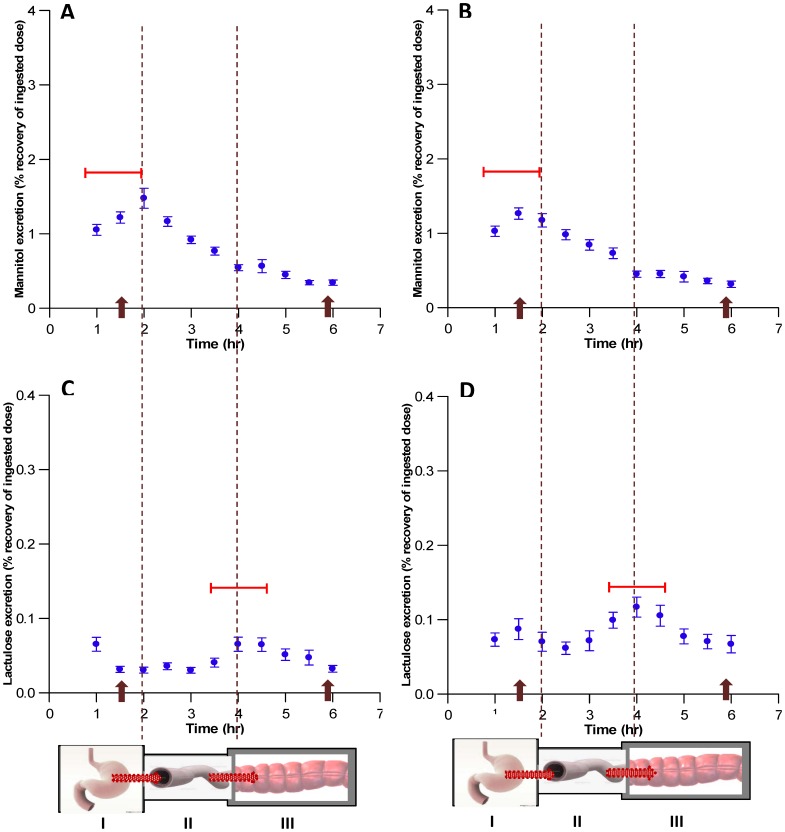
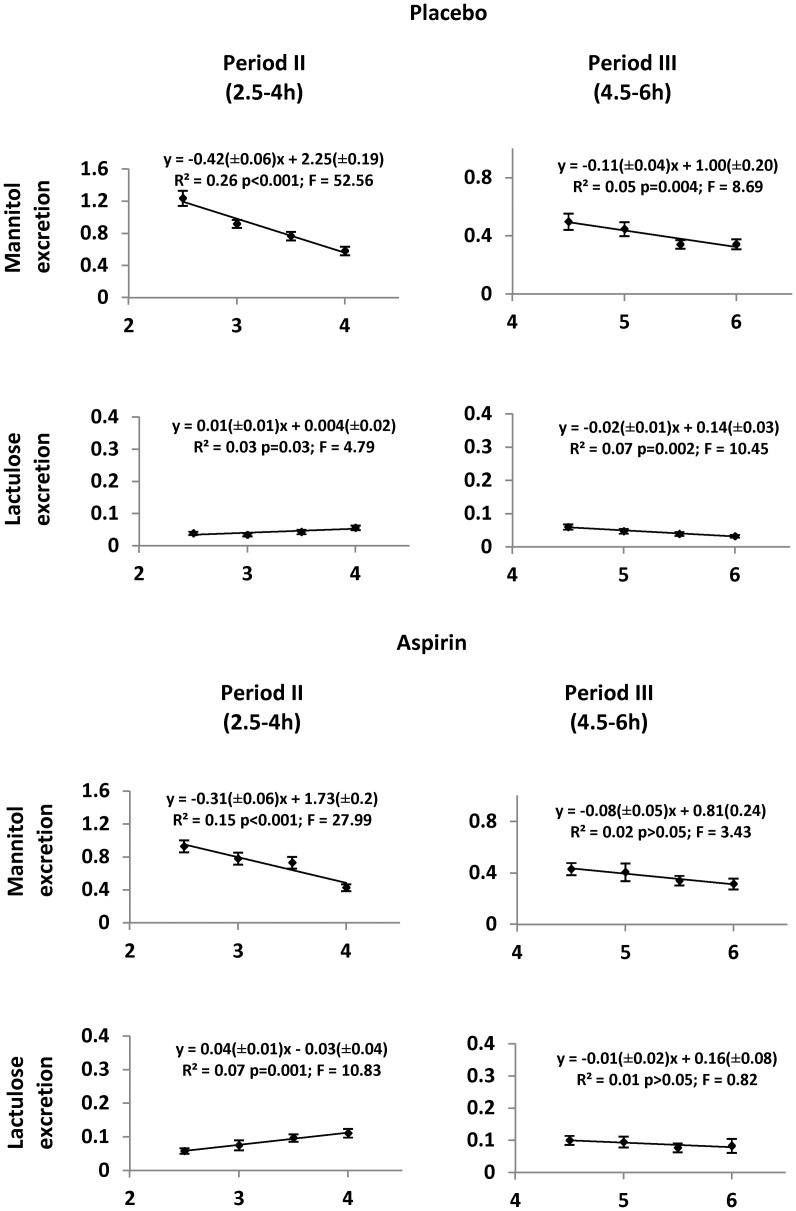
Half-hourly lactulose and mannitol urinary excretions were determined over 6 hours in 40 healthy female volunteers after administration of either 600 mg aspirin or placebo, in randomised order at weekly intervals. Gastric and small intestinal transit times were assessed by the SmartPill in 6 subjects from the same population. Half-hourly percentage recoveries of lactulose and mannitol were grouped on a basis of compartment transit time. The rate of increase or decrease of each sugar within each group was explored by simple linear regression to assess the optimal period of sampling.
The between subject standard errors for each half-hourly lactulose and mannitol excretion were lowest, the correlation of the quantity of each sugar excreted with time was optimal and the difference between the two sugars in this temporal relationship maximal during the period from 2½-4 h after ingestion. Half-hourly lactulose excretions were generally increased after dosage with aspirin whilst those of mannitol were unchanged as was the temporal pattern and period of lowest between subject standard error for both sugars.
The results indicate that between subject variation in the percentage excretion of the two sugars would be minimised and the differences in the temporal patterns of excretion would be maximised if the period of collection of urine used in clinical tests of small intestinal permeability were restricted to 2½-4 h post dosage. This period corresponds to a period when the column of digesta column containing the probes is passing from the small to the large intestine.
乳果糖-甘露醇比率测试在临床上对于评估以肠道通透性改变为特征的疾病以及评估肠腔内的混合情况很有用。目前使用的测试方案之间的差异使得各研究之间无法进行有意义的比较。我们确定了最佳采样期,并将其与肠道停留时间相关联。
40名健康女性志愿者随机依次服用600毫克阿司匹林或安慰剂,每周一次,在给药后6小时内每半小时测定一次乳果糖和甘露醇的尿排泄量。通过SmartPill评估了同一人群中6名受试者的胃和小肠转运时间。根据隔室转运时间对乳果糖和甘露醇的半小时回收率进行分组。通过简单线性回归探索每组中每种糖的增加或减少速率,以评估最佳采样期。
在摄入后2.5至4小时期间,每半小时乳果糖和甘露醇排泄量的受试者间标准误差最低,每种糖排泄量与时间的相关性最佳,且两种糖在这种时间关系上的差异最大。服用阿司匹林后,乳果糖的半小时排泄量通常会增加,而甘露醇的排泄量不变,两种糖的时间模式和受试者间标准误差最低的时期也不变。
结果表明,如果将小肠通透性临床试验中尿液收集时间限制在给药后2.5至4小时,两种糖排泄百分比的受试者间差异将最小化,排泄时间模式的差异将最大化。这个时期对应于含有探针的食糜柱从小肠进入大肠的时期。