Sree S Lakshmi, Sethupathy S
Department of Peridontics, RMDCH, Annamalai University, Chidambaram, Tamil Nadu, India.
Department of Biochemistry, RMMCH, Annamalai University, Chidambaram, Tamil Nadu, India.
Dent Res J (Isfahan). 2014 Mar;11(2):228-33.
In the recent years, various studies have shown a link between the free radicals, antioxidants and periodontal diseases. The purpose of the present study was to evaluate the oxidative stress and the antioxidant status present in the gingival tissue and plasma of patients with chronic periodontitis and to evaluate the antioxidant property of taurine.
Periodontal status in 10 chronic periodontitis patients was assessed in terms of gingival index, plaque index, probing pocket depth and clinical attachment level prior to and after oral administration of taurine (500 mg O.D.) for 15 days. The oxidative stress present in the gingival tissue and blood (by measuring thiobarbituric acid reactive substance [TBARS]) and the antioxidants namely glutathione peroxidase (GPX) and reduced glutathione (GSH) were estimated before and after administration of taurine. The changes in the clinical parameters were also reassessed following administration of taurine. Statistical comparisons were performed using the Student's t-test. A level of P < 0.05 was considered as statistically significant.
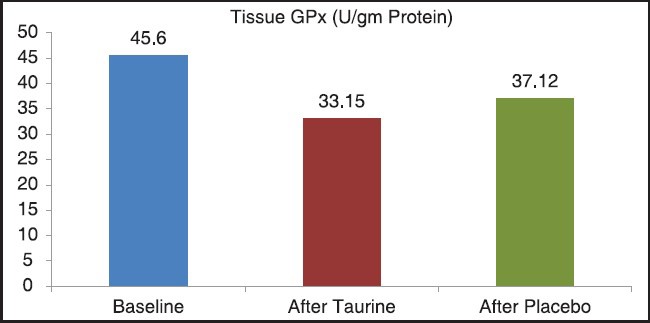
The levels of TBARS in plasma and gingival tissue showed a significant reduction (P < 0.001) following administration of taurine. The antioxidant enzyme GPX showed a significant reduction following administration of taurine (P < 0.001), whereas GSH increased significantly (P < 0.001) following administration of taurine. The improvement in the periodontal status following administration of taurine was also significant statistically.
Based on the biochemical and clinical assessments, taurine seems to exert a protective role against the oxidative stress in the management of patients with chronic periodontitis.
近年来,多项研究表明自由基、抗氧化剂与牙周疾病之间存在联系。本研究的目的是评估慢性牙周炎患者牙龈组织和血浆中的氧化应激及抗氧化状态,并评估牛磺酸的抗氧化特性。
在10例慢性牙周炎患者口服牛磺酸(每日500毫克)15天前后,根据牙龈指数、菌斑指数、探诊深度和临床附着水平评估牙周状况。在服用牛磺酸前后,分别测定牙龈组织和血液中的氧化应激(通过测量硫代巴比妥酸反应物质[TBARS])以及抗氧化剂谷胱甘肽过氧化物酶(GPX)和还原型谷胱甘肽(GSH)。服用牛磺酸后,还重新评估了临床参数的变化。采用学生t检验进行统计学比较。P < 0.05被认为具有统计学意义。
服用牛磺酸后,血浆和牙龈组织中的TBARS水平显著降低(P < 0.001)。服用牛磺酸后,抗氧化酶GPX显著降低(P < 0.001),而GSH显著增加(P < 0.001)。服用牛磺酸后牙周状况的改善在统计学上也具有显著性。
基于生化和临床评估,牛磺酸在慢性牙周炎患者的治疗中似乎对氧化应激发挥保护作用。