Kye Seunghee, Kwon Sung-Ok, Lee Soon-Young, Lee Jiyoon, Kim Bok Hee, Suh Hee-Jae, Moon Hyun-Kyung
Department of Preventive Medicine and Public Health, School of Medicine, Ajou University, Suwon, Korea.
Department of Food and Nutrition, Kyunghee University, Seoul, Korea.
Osong Public Health Res Perspect. 2014 Apr;5(2):85-91. doi: 10.1016/j.phrp.2014.02.002. Epub 2014 Feb 28.
Chronic degenerative diseases are closely related to daily eating habits, nutritional status, and, in particular, energy intake. In clarifying these relationships it is very important for dietary surveys to report accurate information about energy intake. This study attempted to identify the prevalence of the under-reporting of energy intake and its related characteristics based on the Korean National Health and Nutrition Examination Survey conducted in the years 2007-2009.
The present study analyzed dietary intake data from 15,133 adults aged ≥19 years using 24-hour dietary recalls. Basal metabolic rates were calculated from the age- and gender-specific equations of Schofield and under-reporting was defined as an energy intake <0.9, represented by the ratio of energy intake to estimated basal metabolic rate.
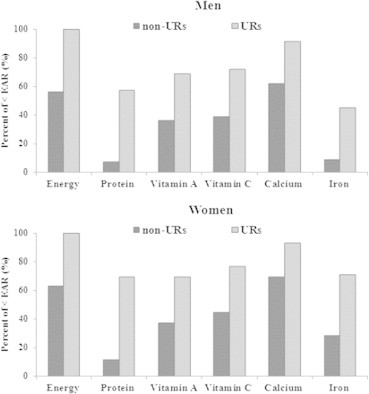
Under-reporters (URs) accounted for 14.4% of men and 23.0% of women and the under-reporting rate was higher in the age group 30-49 years for both men and women. The results from an analysis of the age-specific socioeconomic characteristics of participants classified as URs showed that under-reporting was high in women living alone and in women with only elementary school education or no education. The results from an analysis of the health-specific characteristics of URs showed that a large proportion of URs had poor self-rated health or were obese, or both, compared with non-URs. The proportion of participants who consumed less than the estimated average requirements for nutrients was significantly higher in URs compared with non-URs.
The under-reporting of energy intake was associated with age, gender, education level, income level, household status (single-person or multi-person), self-rated health, physical activity, and obesity.
慢性退行性疾病与日常饮食习惯、营养状况,尤其是能量摄入密切相关。在阐明这些关系时,饮食调查准确报告能量摄入信息非常重要。本研究试图根据2007 - 2009年韩国国家健康与营养检查调查,确定能量摄入报告不足的患病率及其相关特征。
本研究使用24小时饮食回顾法分析了15133名年龄≥19岁成年人的饮食摄入数据。根据Schofield的年龄和性别特异性方程计算基础代谢率,能量摄入报告不足定义为能量摄入<0.9,以能量摄入与估计基础代谢率的比值表示。
能量摄入报告不足者(URs)占男性的14.4%,女性的23.0%,30 - 49岁年龄组的男性和女性报告不足率均较高。对被归类为URs的参与者按年龄分类的社会经济特征分析结果表明,独居女性以及只有小学教育或未接受教育女性的报告不足率较高。对URs健康特异性特征的分析结果表明,与非URs相比,很大一部分URs自我健康评分较差或肥胖,或两者兼而有之。与非URs相比,URs中摄入营养素低于估计平均需求量的参与者比例显著更高。
能量摄入报告不足与年龄、性别、教育水平、收入水平、家庭状况(单人或多人)、自我健康评分、身体活动和肥胖有关。