Asgary Sedigheh, Keshvari Mahtab, Afshani Mohammad Reza, Amiri Masoud, Laher Ismail, Javanmard Shaghayegh Haghjooy
Isfahan Cardiovascular Research Center, Isfahan Cardiovascular Research Institute, Isfahan University of Medical Sciences, Isfahan 8187698191, Iran ; Physiology Research Center, Isfahan University of Medical Sciences, Isfahan 7346181746, Iran.
Isfahan Cardiovascular Research Center, Isfahan Cardiovascular Research Institute, Isfahan University of Medical Sciences, Isfahan 8187698191, Iran.
ISRN Nutr. 2014 Mar 4;2014:405867. doi: 10.1155/2014/405867. eCollection 2014.
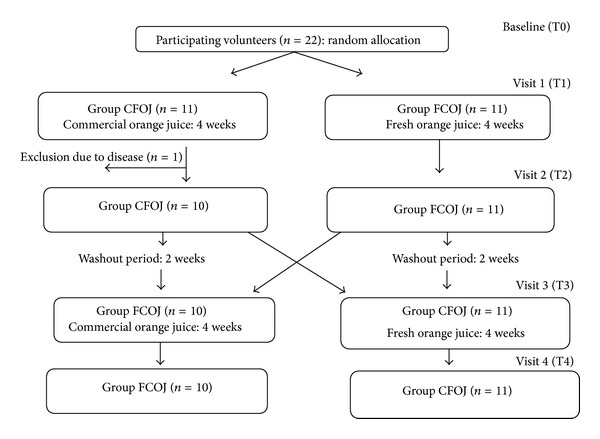
Background. Impaired endothelial function is a predictor of cardiovascular events. Orange juice (OJ) is rich in dietary flavonoids and could inhibit oxidative stress and inflammatory responses. We examined the effects of commercial (COJ) and fresh orange juice (FOJ) on endothelial function and physiological characteristics in healthy humans. Materials and Methods. Twenty-two healthy volunteers years were enrolled in a single blind randomized crossover controlled trial. The two groups consumed either COJ for the first 4 weeks and then FOJ (CFOJ, 4 weeks), or FOJ for the first 4 weeks and then COJ (FCOJ, 4 weeks). We assessed endothelial function by measuring flow-mediated dilation, serum concentrations of lipids, apolipoproteins A and B (apo A-1 and apo B), and inflammatory markers such as vascular endothelial adhesion molecule 1 (VCAM-1), E-selectin, high-sensitivity C-reactive protein (hs-CRP), and interleukin-6. Results. Consumption of both juices decreased VCAM, hs-CRP, and E-selectin but increased apo A-1. A decline in LDL occurred in the FOJ group. There were no differences between the characteristics of two groups, with the exception of apo A-1 levels that were increased with both forms of OJ. The largest variations occurred with hs-CRP, VCAM in both groups. Conclusion. Consumption of COJ and FOJ produced beneficial effects on the physiological characteristics of healthy volunteers. Although these results could encourage the consumption of OJ, intervention studies are needed to determine the long-term effects of these types of OJ on metabolic and cardiovascular endpoints.
背景。内皮功能受损是心血管事件的一个预测指标。橙汁富含膳食类黄酮,可抑制氧化应激和炎症反应。我们研究了市售橙汁(COJ)和鲜榨橙汁(FOJ)对健康人群内皮功能和生理特征的影响。材料与方法。22名健康志愿者参与了一项单盲随机交叉对照试验。两组在开始的4周内分别饮用COJ,然后饮用FOJ(CFOJ组,4周),或者在开始的4周内饮用FOJ,然后饮用COJ(FCOJ组,4周)。我们通过测量血流介导的血管舒张、血脂、载脂蛋白A和B(载脂蛋白A-1和载脂蛋白B)的血清浓度,以及炎症标志物如血管内皮黏附分子1(VCAM-1)、E-选择素、高敏C反应蛋白(hs-CRP)和白细胞介素-6来评估内皮功能。结果。饮用两种橙汁均降低了VCAM、hs-CRP和E-选择素,但增加了载脂蛋白A-1。FOJ组的低密度脂蛋白有所下降。两组的特征之间没有差异,但两种形式的橙汁均使载脂蛋白A-1水平升高。两组中变化最大的是hs-CRP和VCAM。结论。饮用COJ和FOJ对健康志愿者的生理特征产生了有益影响。尽管这些结果可能会鼓励人们饮用橙汁,但仍需要进行干预研究来确定这些类型的橙汁对代谢和心血管终点的长期影响。