Zhang Hai-Lin, Zhang Yu-Zhen, Yang Wei-Hong, Tao Xiao-Yan, Li Hao, Ding Ji-Chao, Feng Yun, Yang Du-Juan, Zhang Juan, He Jiang, Shen Xin-Xin, Wang Li-Hua, Zhang Yun-Zhi, Song Miao, Tang Qing
Emerg Infect Dis. 2014 Sep;20(9):1433-42. doi: 10.3201/eid2009.130440.
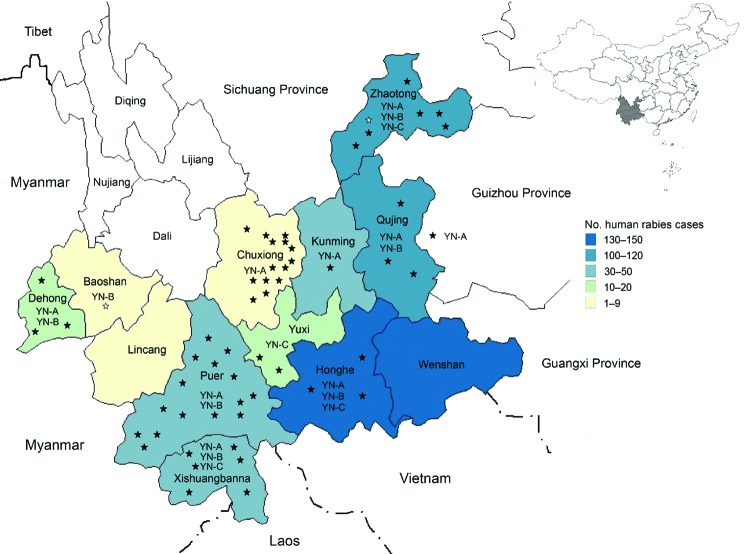
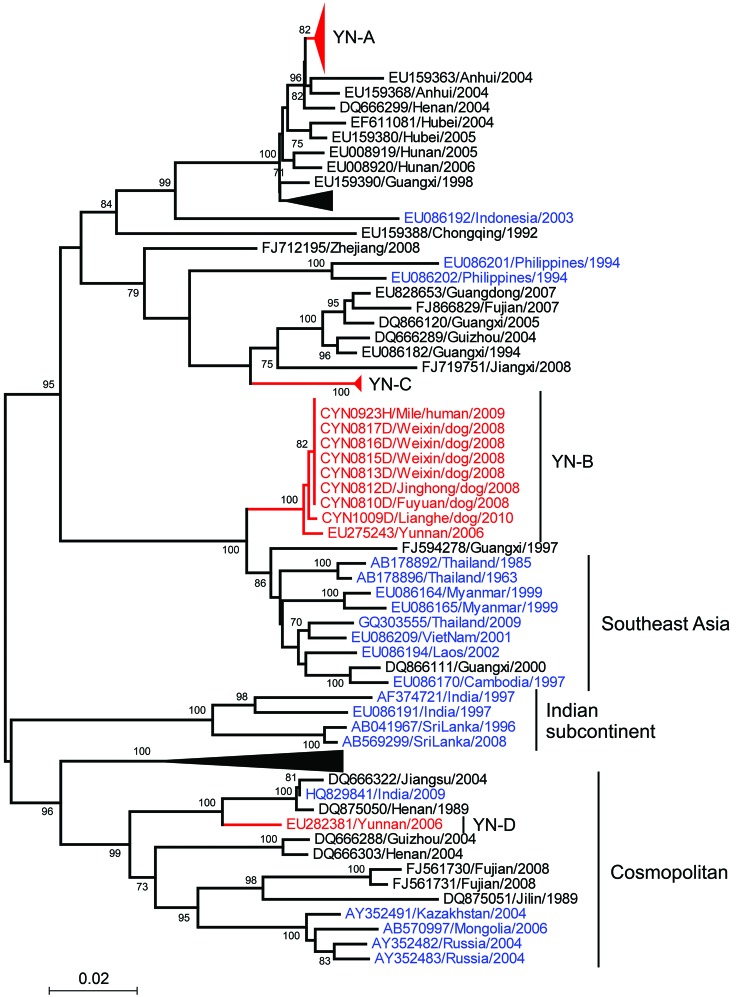
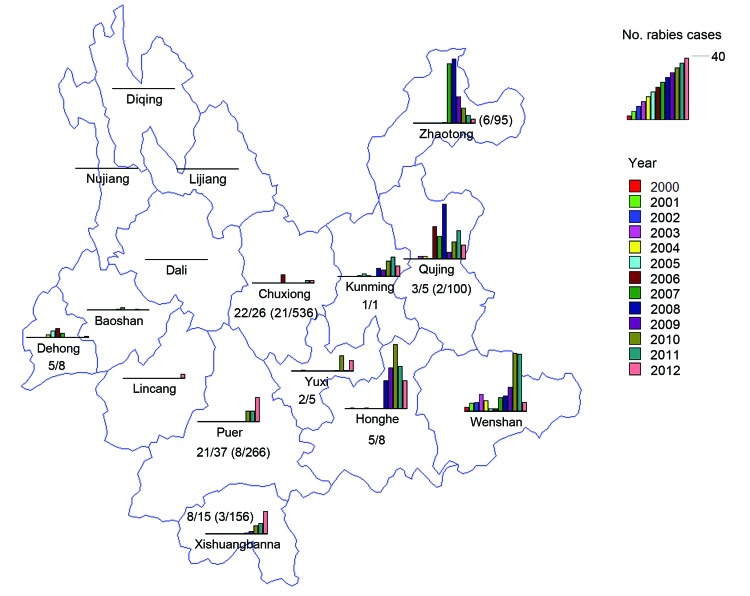
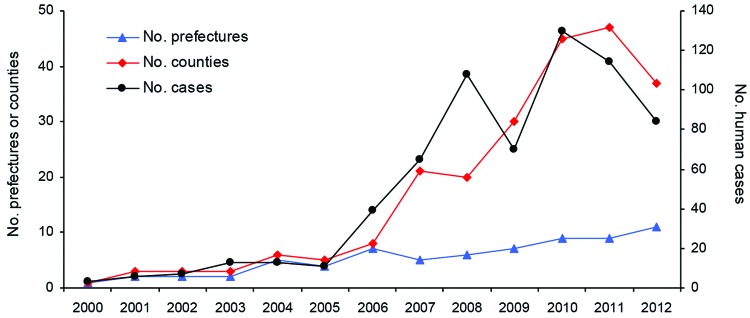
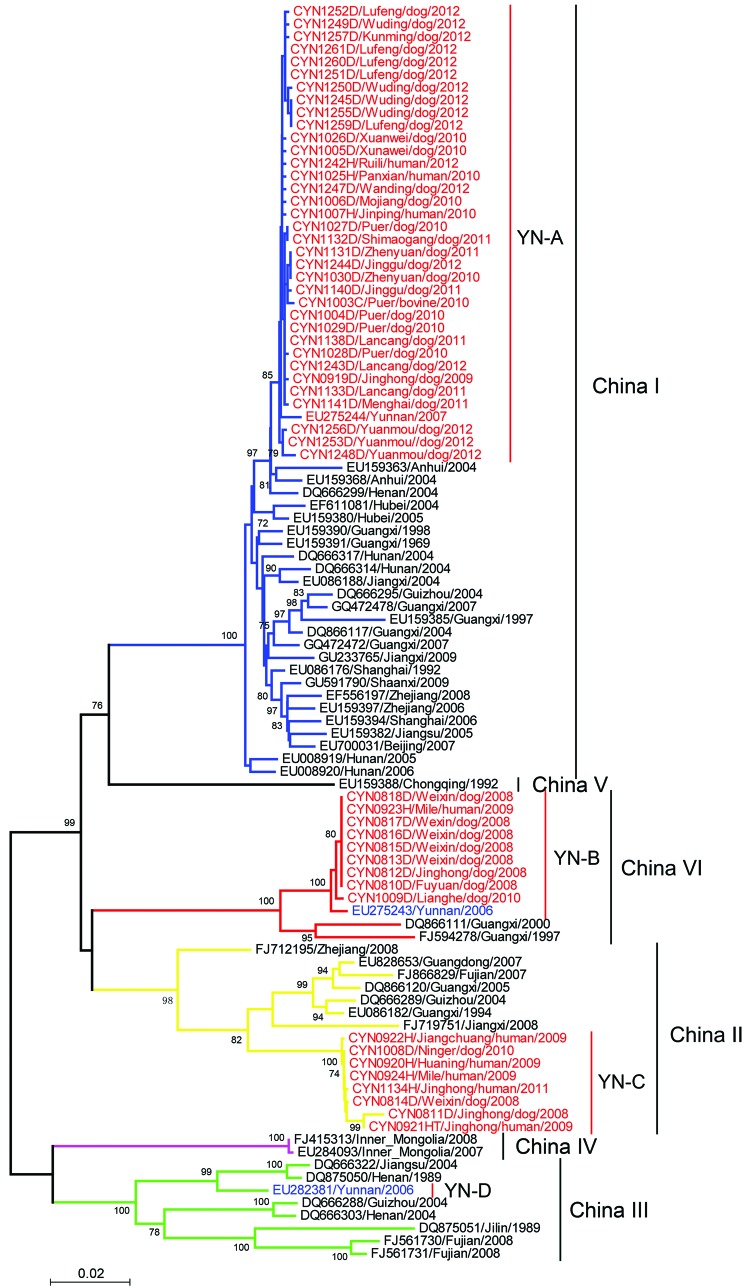
Yunnan Province in China borders 3 countries (Vietnam, Laos, and Myanmar) in Southeast Asia. In the 1980s, a large-scale rabies epidemic occurred in this province, which subsided by the late 1990s. However, 3 human cases of rabies in 2000 indicated reemergence of the disease in 1 county. In 2012, rabies was detected in 77 counties; 663 persons died of rabies during this new epidemic. Fifty two rabies virus strains obtained during 2008-2012 were identified and analyzed phylogenetically by sequencing the nucleoprotein gene. Of the 4 clades identified, clades YN-A and YN-C were closely related to strains from neighboring provinces, and clade YN-B was closely related to strains from Southeast Asia, but formed a distinct branch. Rabies virus diversity might be attributed to dog movements among counties, provinces, and neighboring countries. These findings suggest that Yunnan Province is a focal point for spread of rabies between Southeast Asia and China.
中国云南省与东南亚的3个国家(越南、老挝和缅甸)接壤。20世纪80年代,该省发生了大规模狂犬病疫情,到20世纪90年代后期疫情平息。然而,2000年出现了3例人间狂犬病病例,表明该病在1个县再度出现。2012年,在77个县检测到狂犬病;在这次新的疫情中,663人死于狂犬病。对2008 - 2012年期间获得的52株狂犬病病毒株进行核蛋白基因测序,鉴定并进行系统发育分析。在鉴定出的4个进化枝中,YN - A和YN - C进化枝与邻近省份的毒株密切相关,YN - B进化枝与东南亚的毒株密切相关,但形成一个独特的分支。狂犬病病毒的多样性可能归因于犬只在各县、各省和邻国之间的流动。这些发现表明,云南省是狂犬病在东南亚和中国之间传播的一个焦点地区。