Marine Genomics group, Faculty of Biosciences and Aquaculture, University of Nordland, Bodø, Norway.
BMC Evol Biol. 2014 Aug 22;14:182. doi: 10.1186/s12862-014-0182-3.
Vertebrate mitogenomes are economically organized and usually lack intergenic sequences other than the control region. Intergenic spacers located between the tRNA(Thr) and tRNA(Pro) genes ("T-P spacers") have been observed in several taxa, including gadiform species, but information about their biological roles and putative functions is still lacking.
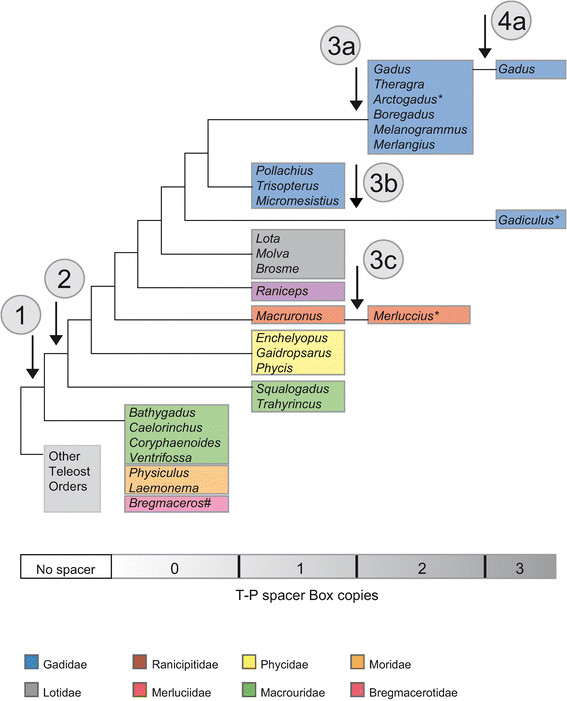
Sequence characterization of the complete European hake Merluccius merluccius mitogenome identified a complex T-P spacer ranging in size from 223-532 bp. Further analyses of 32 gadiform species, representing 8 families and 28 genera, revealed the evolutionary preserved presence of T-P spacers across all taxa. Molecular complexity of the T-P spacers was found to be coherent with the phylogenetic relationships, supporting a common ancestral origin and gain of function during codfish evolution. Intraspecific variation of T-P spacer sequences was assessed in 225 Atlantic cod specimens and revealed 26 haplotypes. Pyrosequencing data representing the mito-transcriptome poly (A) fraction in Atlantic cod identified an abundant H-strand specific long noncoding RNA of about 375 nt. The T-P spacer corresponded to the 5' part of this transcript, which terminated within the control region in a tail-to-tail configuration with the L-strand specific transcript (the 7S RNA).
The T-P spacer is inferred to be evolutionary preserved in gadiform mitogenomes due to gain of function through a long noncoding RNA. We suggest that the T-P spacer adds stability to the H-strand specific long noncoding RNA by forming stable hairpin structures and additional protein binding sites.
脊椎动物的线粒体基因组组织经济,通常除了调控区之外没有非基因序列。在几个分类群中,包括鳕形目物种,都观察到了位于 tRNA(Thr)和 tRNA(Pro)基因之间的基因间间隔区(“T-P 间隔区”),但其生物学作用和假定功能的信息仍然缺乏。
对完整的欧洲无须鳕 Merluccius merluccius 线粒体基因组的序列特征进行分析,确定了一个大小在 223-532bp 之间的复杂 T-P 间隔区。对代表 8 科 28 属的 32 种鳕鱼进行进一步分析,结果表明所有分类群中都存在 T-P 间隔区的进化保守性。T-P 间隔区的分子复杂性与系统发育关系一致,支持鳕鱼进化过程中共同的祖先起源和功能获得。对 225 个大西洋鳕鱼样本的 T-P 间隔区序列的种内变异进行了评估,发现了 26 个单倍型。在大西洋鳕鱼的线粒体转录组 poly(A)部分的焦磷酸测序数据中,鉴定出一种丰富的 H 链特异性长非编码 RNA,约 375nt。T-P 间隔区对应于该转录本的 5'部分,它在调控区以尾对尾的方式终止,与 L 链特异性转录本(7S RNA)形成终止结构。
由于通过长非编码 RNA 的功能获得,T-P 间隔区在鳕形目线粒体基因组中被推断为进化保守的。我们认为,T-P 间隔区通过形成稳定的发夹结构和额外的蛋白质结合位点,为 H 链特异性长非编码 RNA 增加稳定性。