Chiang Wei-Wei, Chuang Ching-Kai, Chao Mei, Chen Wei-June
Division of Microbiology, Graduate Institute of Biomedical Sciences, Chang Gung University, Kwei-San, Tao-Yuan 33332, Taiwan.
Division of Microbiology, Graduate Institute of Biomedical Sciences, Chang Gung University, Kwei-San, Tao-Yuan 33332, Taiwan ; Department of Plant Pathology, University of Kentucky, Lexington, KY 40546-0312, USA.
Biomed Res Int. 2014;2014:471323. doi: 10.1155/2014/471323. Epub 2014 Jul 22.
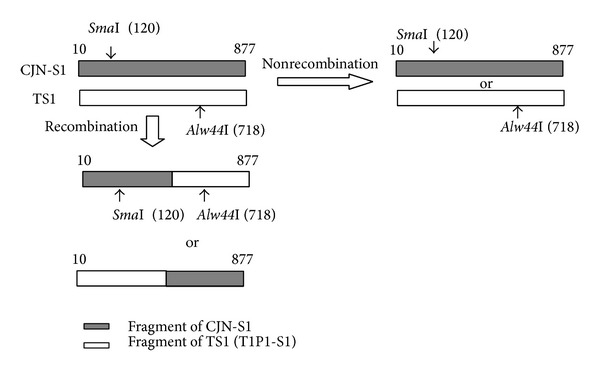
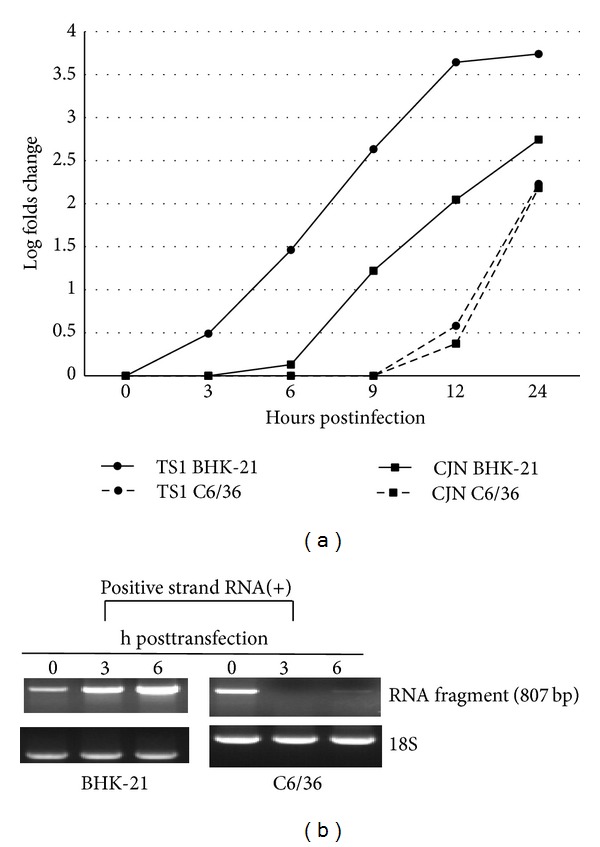
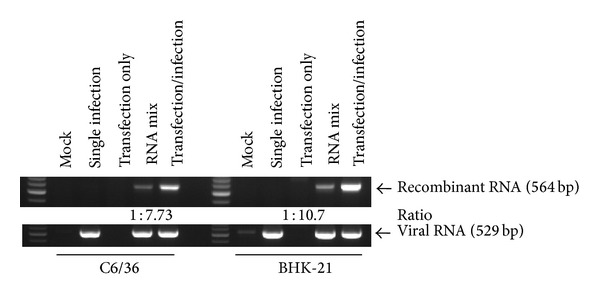
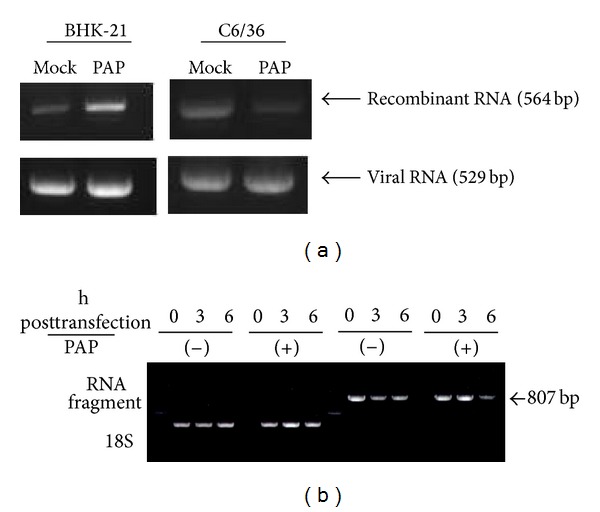
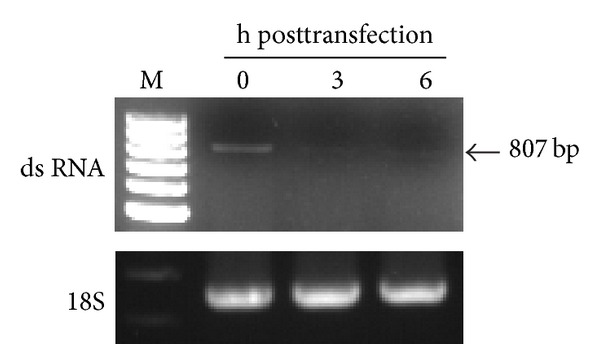
Japanese encephalitis virus (JEV) is one of approximately 70 flaviviruses, frequently causing symptoms involving the central nervous system. Mutations of its genomic RNA frequently occur during viral replication, which is believed to be a force contributing to viral evolution. Nevertheless, accumulating evidences show that some JEV strains may have actually arisen from RNA recombination between genetically different populations of the virus. We have demonstrated that RNA recombination in JEV occurs unequally in different cell types. In the present study, viral RNA fragments transfected into as well as viral RNAs synthesized in mosquito cells were shown not to be stable, especially in the early phase of infection possibly via cleavage by exoribonuclease. Such cleaved small RNA fragments may be further degraded through an RNA interference pathway triggered by viral double-stranded RNA during replication in mosquito cells, resulting in a lower frequency of RNA recombination in mosquito cells compared to that which occurs in mammalian cells. In fact, adjustment of viral RNA to an appropriately lower level in mosquito cells prevents overgrowth of the virus and is beneficial for cells to survive the infection. Our findings may also account for the slower evolution of arboviruses as reported previously.
日本脑炎病毒(JEV)是大约70种黄病毒之一,经常引起涉及中枢神经系统的症状。其基因组RNA在病毒复制过程中经常发生突变,这被认为是推动病毒进化的一个因素。然而,越来越多的证据表明,一些JEV毒株可能实际上是由该病毒基因不同群体之间的RNA重组产生的。我们已经证明,JEV中的RNA重组在不同细胞类型中发生的情况并不相同。在本研究中,转染到蚊子细胞中的病毒RNA片段以及在蚊子细胞中合成的病毒RNA显示不稳定,特别是在感染早期,可能是通过外切核糖核酸酶的切割作用。这种被切割的小RNA片段可能在蚊子细胞复制过程中通过由病毒双链RNA引发的RNA干扰途径进一步降解,导致与在哺乳动物细胞中相比,蚊子细胞中RNA重组的频率较低。事实上,将蚊子细胞中的病毒RNA水平适当降低可防止病毒过度生长,并有利于细胞在感染中存活。我们的发现也可能解释了先前报道的虫媒病毒进化较慢的现象。