Chakraborty Manodeep, Kamath Jagadish Vasudev, Bhattacharjee Ananya
Research Scholar, Department of Pharmacology, Bhagwant University, Ajmer, Rajasthan, India.
Department of Pharmacology, Shree Devi College of Pharmacy, Mangalore, Karnataka, India.
Toxicol Int. 2014 May;21(2):196-202. doi: 10.4103/0971-6580.139810.
Treatment of ischemic hypertensive patients with hydrochlorothiazide can precipitate cardiac arrhythmias. Green tea by virtue of its antioxidant potential is responsible for cardio-protective activity. The present study was undertaken to evaluate the pharmacodynamic interaction of green tea extract with hydrochlorothiazide against cyclophosphamide-induced myocardial toxicity.
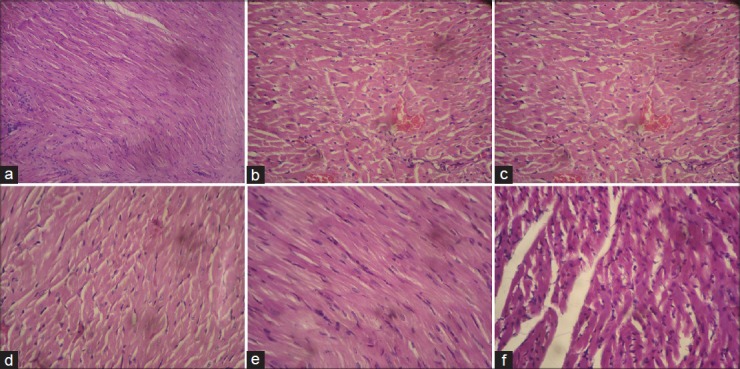
Rats were treated with high (500 mg/kg, p.o.) and low (100 mg/kg, p.o.) dose of green tea extract in alone and interactive groups for 10 days. Standard, high, and low dose of interactive groups received hydrochlorothiazide (10 mg/kg, p.o.) for last 7 days. Apart from normal control, all other groups were subjected to cyclophosphamide (200 mg/kg, i.p.) toxicity on day first and the effects of different treatments were evaluated by changes in electrocardiographic parameters, serum biomarkers, and tissue antioxidant levels. Apart from that, lipid profile and histological studies were also carried out.
Compared to cyclophosphamide control group, both high and low dose of green tea exhibited significant decrease in serum biomarkers and increase in tissue antioxidant levels. Green tea treatment was also responsible for significant improvement in echocardiography (ECG) parameter, lipid profile, and histological score. Incorporation of high and low dose of green tea with hydrochlorothiazide-exhibited significant protection compared to hydrochlorothiazide-alone-treated group.
The present findings clearly suggested that green tea extract dose dependently reduces cyclophosphamide-induced myocardial toxicity. Green tea when combined with hydrochlorothiazide can reduce the associated side effects and exhibits myocardial protection.
用氢氯噻嗪治疗缺血性高血压患者会引发心律失常。绿茶因其抗氧化潜力具有心脏保护活性。本研究旨在评估绿茶提取物与氢氯噻嗪联合使用对环磷酰胺诱导的心肌毒性的药效学相互作用。
将大鼠分为单独给药组和联合给药组,分别给予高剂量(500毫克/千克,口服)和低剂量(100毫克/千克,口服)绿茶提取物,持续10天。联合给药组的标准剂量、高剂量和低剂量组在最后7天给予氢氯噻嗪(10毫克/千克,口服)。除正常对照组外,所有其他组在第1天接受环磷酰胺(200毫克/千克,腹腔注射)毒性处理,并通过心电图参数、血清生物标志物和组织抗氧化水平的变化评估不同处理的效果。除此之外,还进行了血脂分析和组织学研究。
与环磷酰胺对照组相比,高剂量和低剂量的绿茶均使血清生物标志物显著降低,组织抗氧化水平升高。绿茶处理还使超声心动图(ECG)参数、血脂谱和组织学评分得到显著改善。与单独使用氢氯噻嗪治疗组相比,高剂量和低剂量绿茶与氢氯噻嗪联合使用表现出显著的保护作用。
本研究结果清楚地表明,绿茶提取物剂量依赖性地降低环磷酰胺诱导的心肌毒性。绿茶与氢氯噻嗪联合使用可减少相关副作用并具有心肌保护作用。