Rangel-Negrín Ariadna, Coyohua-Fuentes Alejandro, Chavira Roberto, Canales-Espinosa Domingo, Dias Pedro Américo D
Instituto de Neuroetología, Universidad Veracruzana, Xalapa, Veracruz, Mexico.
Instituto de Ciencias Médicas y Nutrición Salvador Zubirán, México D.F., Mexico.
PLoS One. 2014 Nov 6;9(11):e112329. doi: 10.1371/journal.pone.0112329. eCollection 2014.
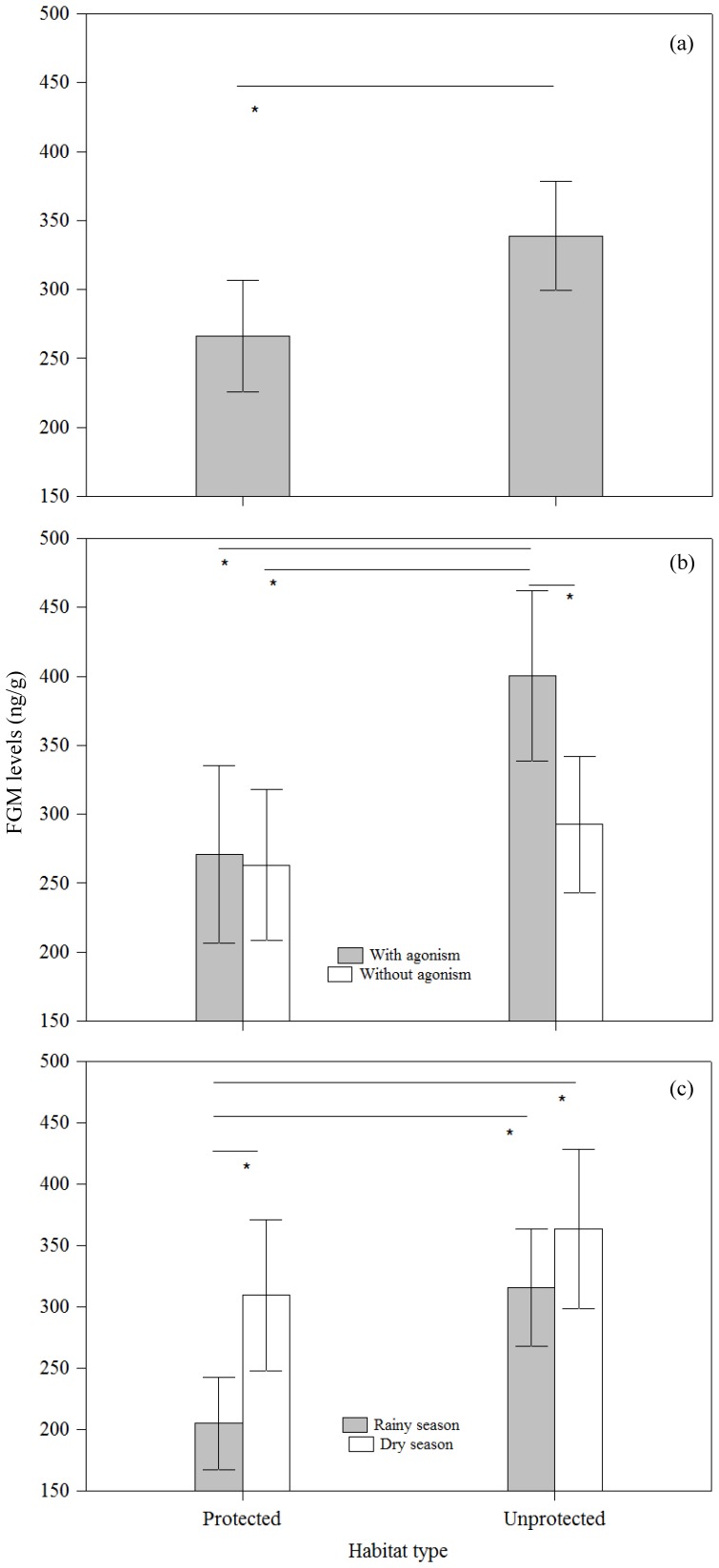
The non-invasive monitoring of glucocorticoid hormones allows for the assessment of the physiological effects of anthropogenic disturbances on wildlife. Variation in glucocorticoid levels of the same species between protected and unprotect areas seldom has been measured, and the available evidence suggests that this relationship may depend on species-specific habitat requirements and biology. In the present study we focused on black howler monkeys (Alouatta pigra), a canopy-dwelling primate species, as a case study to evaluate the physiological consequences of living in unprotected areas, and relate them with intragroup competition and competition with extragroup individuals. From February 2006 to September 2007 we collected 371 fecal samples from 21 adults belonging to five groups (two from protected and three from unprotected areas) in Campeche, Mexico. We recorded agonistic interactions within groups and encounters with other groups (1,200 h of behavioral observations), and determined fecal glucocorticoid metabolite (FGM) concentrations with radioimmunoassays. We used linear mixed models and Akaike's information criterion to choose the best model explaining variation in FGM concentrations between protected and unprotected areas calculated from five categorical variables: habitat type (protected vs. unprotected), participation in agonistic interactions, intergroup encounters, sex and female reproductive state, and season. The best model included habitat type, the interaction between habitat type and agonism, and the interaction between habitat type and season. FGM concentrations were higher in unprotected habitats, particularly when individuals were involved in agonistic interactions; seasonal variation in FGM concentrations was only detected in protected habitats. High FGM concentrations in black howler monkeys living in unprotected habitats are associated with increased within-group food competition and probably associated with exposure to anthropogenic stressors and overall food scarcity. Because persistent high GC levels can be detrimental to health and fitness, populations living in disturbed unprotected areas may not be viable in the long-term.
对糖皮质激素进行非侵入性监测有助于评估人为干扰对野生动物的生理影响。很少有研究测量过同一物种在保护区和非保护区糖皮质激素水平的差异,现有证据表明,这种关系可能取决于物种特定的栖息地需求和生物学特性。在本研究中,我们聚焦于一种树栖灵长类动物——黑吼猴(Alouatta pigra),以此作为案例研究,来评估生活在非保护区的生理后果,并将其与群体内竞争以及与群体外个体的竞争联系起来。2006年2月至2007年9月,我们从墨西哥坎佩切的21只成年黑吼猴身上采集了371份粪便样本,这些猴子分属于五个群体(两个来自保护区,三个来自非保护区)。我们记录了群体内的争斗互动以及与其他群体的相遇情况(1200小时的行为观察),并通过放射免疫分析法测定粪便糖皮质激素代谢物(FGM)的浓度。我们使用线性混合模型和赤池信息准则来选择最佳模型,该模型由五个分类变量计算得出,用于解释保护区和非保护区之间FGM浓度的差异:栖息地类型(保护区与非保护区)、参与争斗互动的情况、群体间相遇情况、性别和雌性生殖状态以及季节。最佳模型包括栖息地类型、栖息地类型与争斗之间的相互作用以及栖息地类型与季节之间的相互作用。非保护区的FGM浓度较高,尤其是当个体参与争斗互动时;FGM浓度的季节性变化仅在保护区被检测到。生活在非保护区的黑吼猴体内FGM浓度较高,这与群体内食物竞争加剧有关,可能也与接触人为应激源和整体食物短缺有关。由于持续的高糖皮质激素水平可能对健康和适应性有害,长期生活在受干扰的非保护区的种群可能无法长期存活。