Vester Jan Kjølhede, Glaring Mikkel Andreas, Stougaard Peter
Department of Plant and Environmental Sciences, University of Copenhagen, Thorvaldsensvej 40, 1871, Frederiksberg C, Denmark,
Extremophiles. 2015 Jan;19(1):17-29. doi: 10.1007/s00792-014-0704-3. Epub 2014 Nov 16.
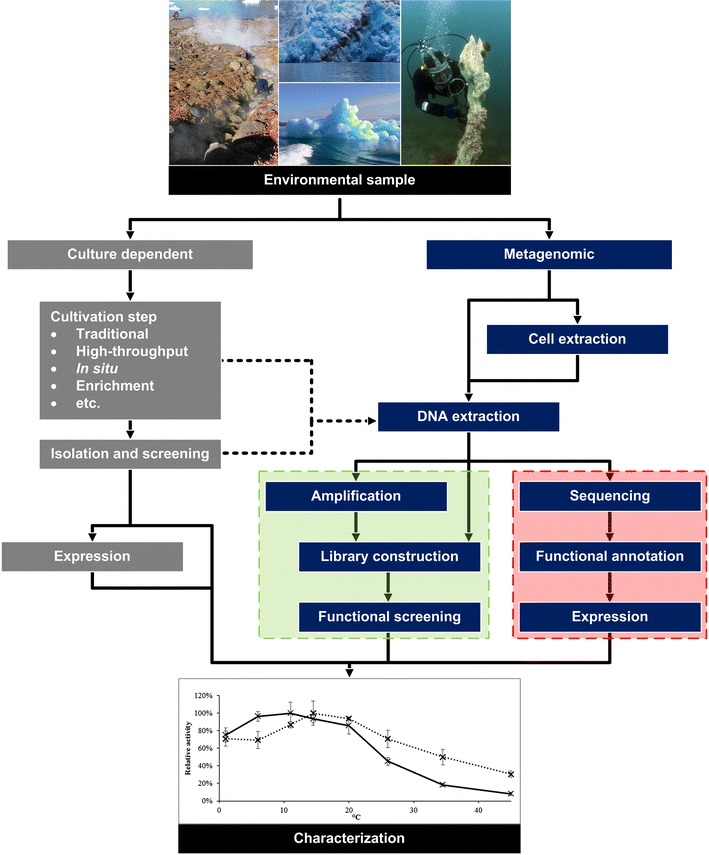
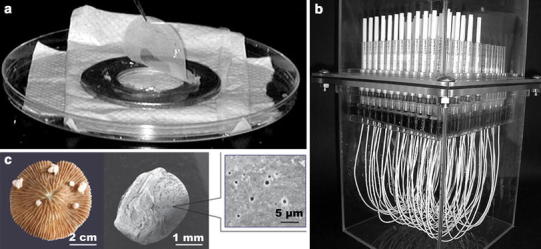
Only a small minority of microorganisms from an environmental sample can be cultured in the laboratory leaving the enormous bioprospecting potential of the uncultured diversity unexplored. This resource can be accessed by improved cultivation methods in which the natural environment is brought into the laboratory or through metagenomic approaches where culture-independent DNA sequence information can be combined with functional screening. The coupling of these two approaches circumvents the need for pure, cultured isolates and can be used to generate targeted information on communities enriched for specific activities or properties. Bioprospecting in extreme environments is often associated with additional challenges such as low biomass, slow cell growth, complex sample matrices, restricted access, and problematic in situ analyses. In addition, the choice of vector system and expression host may be limited as few hosts are available for expression of genes with extremophilic properties. This review summarizes the methods developed for improved cultivation as well as the metagenomic approaches for bioprospecting with focus on the challenges faced by bioprospecting in cold environments.
环境样本中只有一小部分微生物能够在实验室中培养,未培养微生物的巨大生物勘探潜力尚未得到开发。可以通过改进培养方法(即将自然环境引入实验室)或宏基因组学方法(即可以将不依赖培养的DNA序列信息与功能筛选相结合)来挖掘这一资源。这两种方法的结合避免了对纯培养分离物的需求,可用于生成关于富集特定活性或特性的群落的靶向信息。在极端环境中进行生物勘探通常还会面临其他挑战,如生物量低、细胞生长缓慢、样品基质复杂、获取受限以及原位分析存在问题。此外,载体系统和表达宿主的选择可能受到限制,因为能够表达具有嗜极端特性基因的宿主很少。本综述总结了为改进培养而开发的方法以及用于生物勘探的宏基因组学方法,重点关注寒冷环境中生物勘探面临的挑战。