Danielsson Marita, Nilsen Per, Ohrn Annica, Rutberg Hans, Fock Jenni, Carlfjord Siw
Department of Medical and Health Sciences, Division of Health Care Analysis, Linköping University, Linköping, SE- 581 83 Sweden ; Department of Health and Development, County Council of Östergötland, Linköping, SE- 581 91 Sweden.
Department of Medical and Health Sciences, Division of Health Care Analysis, Linköping University, Linköping, SE- 581 83 Sweden.
BMC Nurs. 2014 Nov 26;13(1):39. doi: 10.1186/s12912-014-0039-5. eCollection 2014.
Patient safety culture emerges from the shared assumptions, values and norms of members of a health care organization, unit, team or other group with regard to practices that directly or indirectly influence patient safety. It has been argued that organizational culture is an amalgamation of many cultures, and that subcultures should be studied to develop a deeper understanding of an organization's culture. The aim of this study was to explore subcultures among registered nurses and nurse assistants in Sweden in terms of their assumptions, values and norms with regard to practices associated with patient safety.
The study employed an exploratory design using a qualitative method, and was conducted at two hospitals in southeast Sweden. Seven focus group interviews and two individual interviews were conducted with registered nurses and seven focus group interviews and one individual interview were conducted with nurse assistants. Manifest content analysis was used for the analysis.
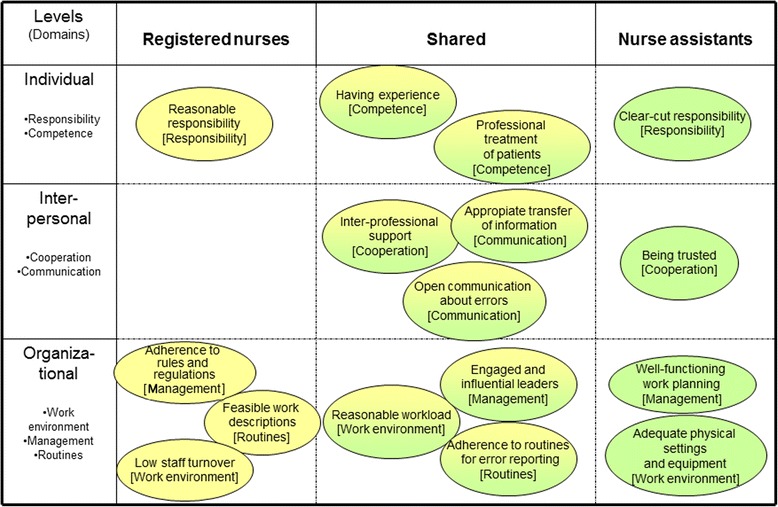
Seven patient safety culture domains (i.e. categories of assumptions, values and norms) that included practices associated with patient safety were found: responsibility, competence, cooperation, communication, work environment, management and routines. The domains corresponded with three system levels: individual, interpersonal and organizational levels. The seven domains consisted of 16 subcategories that expressed different aspects of the registered nurses and assistants nurses' patient safety culture. Half of these subcategories were shared.
Registered nurses and nurse assistants in Sweden differ considerably with regard to patient safety subcultures. The results imply that, in order to improve patient safety culture, efforts must be tailored to both registered nurses' and nurse assistants' patient safety-related assumptions, values and norms. Such efforts must also take into account different system levels. The results of the present study could be useful to facilitate discussions about patient safety within and between different professional groups.
患者安全文化源自医疗保健组织、科室、团队或其他群体成员对于直接或间接影响患者安全的实践所共有的假设、价值观和规范。有人认为组织文化是多种文化的融合,应该研究亚文化以更深入地理解组织文化。本研究的目的是从瑞典注册护士和护理助理对于与患者安全相关实践的假设、价值观和规范方面,探索其亚文化。
本研究采用探索性设计,运用定性方法,在瑞典东南部的两家医院进行。对注册护士进行了七次焦点小组访谈和两次个人访谈,对护理助理进行了七次焦点小组访谈和一次个人访谈。采用显性内容分析法进行分析。
发现了七个与患者安全相关实践的患者安全文化领域(即假设、价值观和规范的类别):责任、能力、合作、沟通、工作环境、管理和常规。这些领域对应三个系统层面:个人、人际和组织层面。这七个领域由16个子类别组成,这些子类别表达了注册护士和助理护士患者安全文化的不同方面。其中一半的子类别是共有的。
瑞典的注册护士和护理助理在患者安全亚文化方面存在很大差异。结果表明,为了改善患者安全文化,必须针对注册护士和护理助理与患者安全相关的假设、价值观和规范做出努力。这些努力还必须考虑不同的系统层面。本研究结果可能有助于促进不同专业群体内部和之间关于患者安全的讨论。