Department of Clinical Laboratory, First Affiliated Hospital of Guangxi Medical University, Nanning, Guangxi Zhuang Autonomous Region China.
Department of Occupational Health and Environmental Health, School of Public Health at Guangxi Medical University, Nanning, Guangxi Zhuang Autonomous Region China.
Cancer Cell Int. 2014 Nov 30;14(1):127. doi: 10.1186/s12935-014-0127-3. eCollection 2014.
The null genotype of GSTM1 have been implicated in gastric cancer risk, but numerous individual studies showed mixed, or even conflicting results. Thus, a meta-analysis was performed.
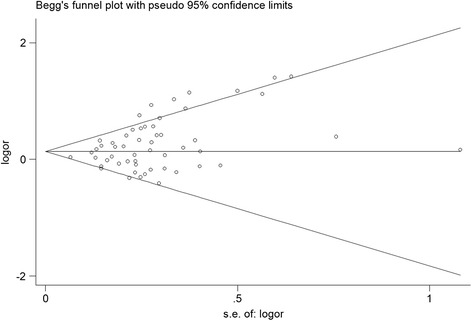
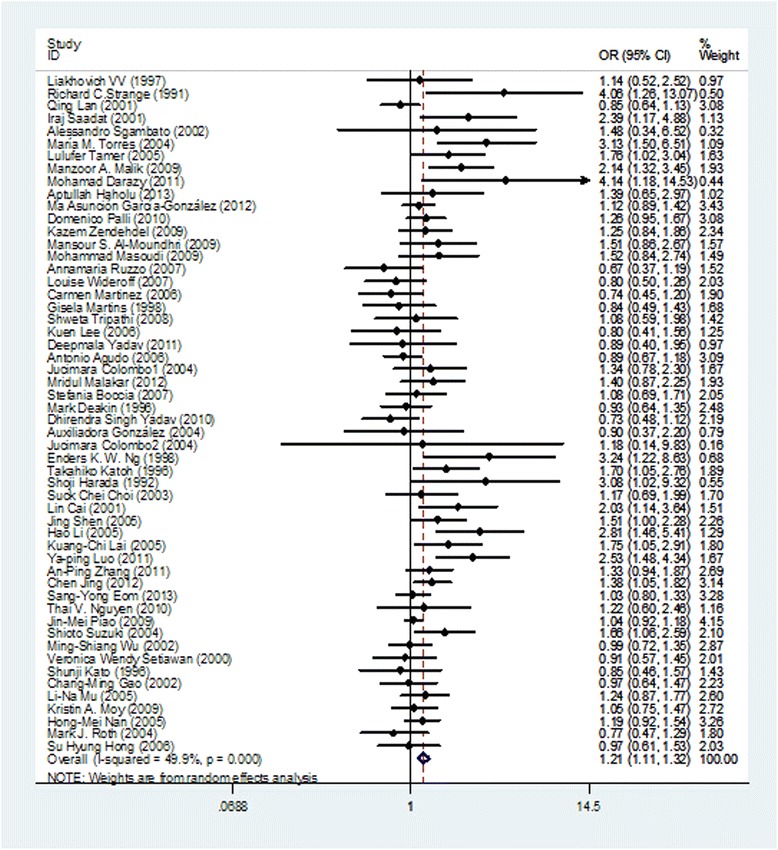
We identified 54 individual studies involving 9,322 cases and 15,118 controls through computer-based searches of PubMed, Embase, and Cochrane Library. It was found that the null genotype of GSTM1 was associated with an increased gastric cancer risk (OR = 1.207, 95% CI: 1.106-1.317, P < 0.001), under the random-effects model (I(2) : 49.9%, PQ <0.001). From stratification analyses for ethnicity, alcohol drinking, Helicobacter pylori infection, an effect modification of gastric cancer risk was found in the subgroups of ethnicity, smoking status, Helicobacter pylori infection, whereas null result was found in the subgroups of alcohol drinking. We also undertook gene-gene interaction analysis between GSTM1 and GSTT1 genes for gastric cancer risk, and the results indicated that the dual null genotypes of GSTM1 and GSTT1 might elevate the risk of gastric cancer (OR = 1.505, 95% CI: 1.165-1.944, P = 002).
This meta-analysis suggests that the null genotype of GSTM1 may be a important genetic risk factor for gastric cancer development.
GSTM1 的无效基因型与胃癌风险相关,但许多单独的研究结果显示存在混合甚至相互矛盾的结果。因此,进行了荟萃分析。
我们通过计算机检索 PubMed、Embase 和 Cochrane Library,共确定了 54 项涉及 9322 例病例和 15118 例对照的个体研究。结果发现,GSTM1 的无效基因型与胃癌风险增加相关(OR=1.207,95%CI:1.106-1.317,P<0.001),采用随机效应模型(I²:49.9%,PQ<0.001)。根据种族、饮酒、幽门螺杆菌感染的分层分析,发现种族、吸烟状况、幽门螺杆菌感染亚组中存在胃癌风险的效应修饰,但在饮酒亚组中则未发现无效结果。我们还对 GSTM1 和 GSTT1 基因之间的基因-基因相互作用进行了分析,结果表明 GSTM1 和 GSTT1 的双重无效基因型可能会增加胃癌的风险(OR=1.505,95%CI:1.165-1.944,P=0.02)。
本荟萃分析表明,GSTM1 的无效基因型可能是胃癌发生的重要遗传危险因素。