Tomar Poonam, Hongal Sudheer, Saxena Vrinda, Jain Manish, Rana Kuldeep, Ganavadiya Rahul
Department of Public Health Dentistry, People's Dental Academy, People's University, Bhopal, Madhya Pradesh, India.
Department of Conservative and Endodontics, People's Dental Academy, People's University, Bhopal, Madhya Pradesh, India.
J Basic Clin Pharm. 2014 Dec;6(1):12-8. doi: 10.4103/0976-0105.145769.
Toothbrushes may play a significant role in plaque control. Toothbrushes should be correctly stored, disinfected and changed at regular intervals.
The purpose of this study was to evaluate the efficacy of 0.2% chlorhexidine (CHX) gluconate solution and ultra violet (UV) toothbrush-sanitizer for toothbrush disinfection.
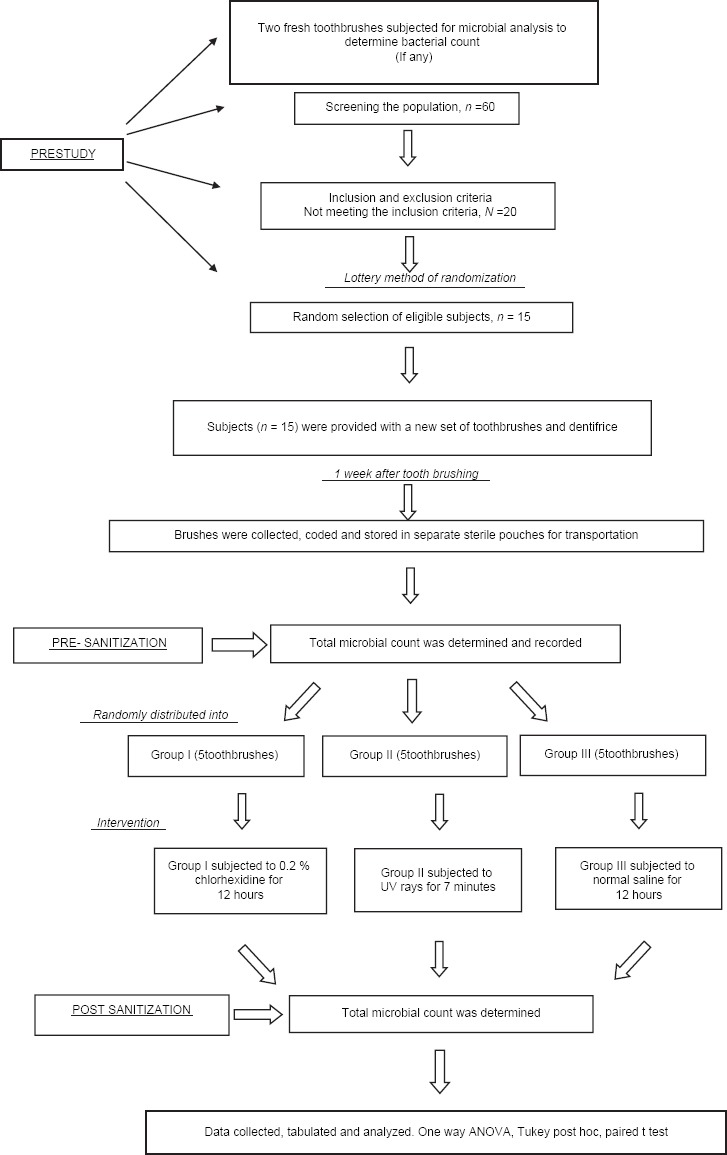
Fresh tooth brushes were distributed to fifteen study subjects, who were selected randomly and who met the study criteria. All the study participants were asked to brush their teeth with the tooth brush provided. No special instructions were given regarding the brushing techniques. Toothbrushes were collected after 7 days. All tooth brushes were randomly allocated to three groups. Tooth brushes were subjected to microbial analysis and total bacterial count was assessed. Tooth brushes allocated to Group I were soaked in 2% CHX mouthwash for 12 h, Group II were kept in UV-light toothbrush holder for 7 min, and Group III were soaked in normal saline for 12 h. All the toothbrushes were subjected for microbial analysis and mean bacterial count was determined.
There was a statistically significant difference between mean colony-forming unit count pre-sanitization and post-sanitization in all the groups, using 0.2% CHX gluconate, UV rays and normal saline (P < 0.007). However, the mean bacterial count reduced drastically after the treatment with UV rays (P = 0.001).
CHX, UV rays and normal saline are effective in a reduction of bacterial count on toothbrushes. UV rays treatment was more effective, when compared to CHX and normal saline.
牙刷在牙菌斑控制中可能发挥重要作用。牙刷应正确存放、消毒并定期更换。
本研究旨在评估0.2%葡萄糖酸洗必泰(CHX)溶液和紫外线(UV)牙刷消毒器对牙刷消毒的效果。
将新牙刷分发给15名随机选择且符合研究标准的研究对象。要求所有研究参与者使用提供的牙刷刷牙。未对刷牙技巧给予特殊指导。7天后收集牙刷。所有牙刷随机分为三组。对牙刷进行微生物分析并评估细菌总数。分配到第一组的牙刷在2%CHX漱口液中浸泡12小时,第二组的牙刷置于紫外线牙刷架中7分钟,第三组的牙刷在生理盐水中浸泡12小时。对所有牙刷进行微生物分析并测定平均细菌数。
在所有组中,使用0.2%葡萄糖酸洗必泰、紫外线和生理盐水消毒前后的平均菌落形成单位数存在统计学显著差异(P < 0.007)。然而,用紫外线处理后平均细菌数大幅降低(P = 0.001)。
CHX、紫外线和生理盐水均能有效减少牙刷上的细菌数量。与CHX和生理盐水相比,紫外线处理更有效。