Wu Yu-Wei, Kim Jae-Ick, Tawfik Vivianne L, Lalchandani Rupa R, Scherrer Grégory, Ding Jun B
Department of Neurosurgery, Stanford University School of Medicine, Palo Alto, CA 94304, USA.
Department of Anesthesiology, Perioperative and Pain Medicine, Stanford University School of Medicine, Palo Alto, CA 94304, USA.
Cell Rep. 2015 Jan 6;10(1):75-87. doi: 10.1016/j.celrep.2014.12.005. Epub 2014 Dec 24.
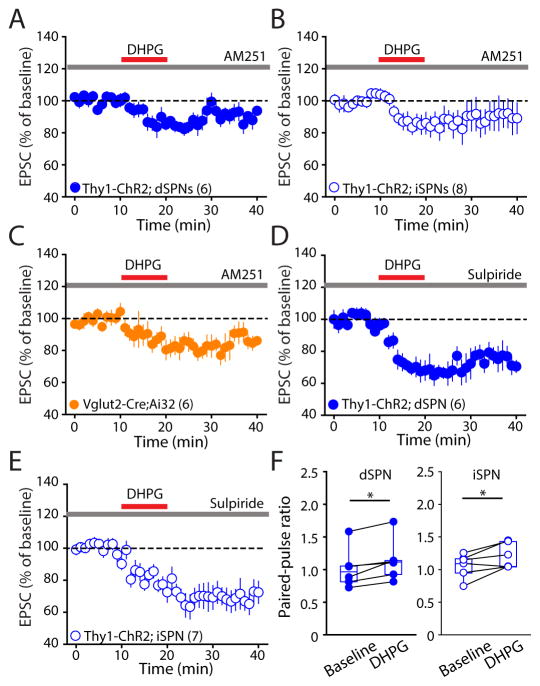
Changes in basal ganglia plasticity at the corticostriatal and thalamostriatal levels are required for motor learning. Endocannabinoid-dependent long-term depression (eCB-LTD) is known to be a dominant form of synaptic plasticity expressed at these glutamatergic inputs; however, whether eCB-LTD can be induced at all inputs on all striatal neurons is still debatable. Using region-specific Cre mouse lines combined with optogenetic techniques, we directly investigated and distinguished between corticostriatal and thalamostriatal projections. We found that eCB-LTD was successfully induced at corticostriatal synapses, independent of postsynaptic striatal spiny projection neuron (SPN) subtype. Conversely, eCB-LTD was only nominally present at thalamostriatal synapses. This dichotomy was attributable to the minimal expression of cannabinoid type 1 (CB1) receptors on thalamostriatal terminals. Furthermore, coactivation of dopamine receptors on SPNs during LTD induction re-established SPN-subtype-dependent eCB-LTD. Altogether, our findings lay the groundwork for understanding corticostriatal and thalamostriatal synaptic plasticity and for striatal eCB-LTD in motor learning.
运动学习需要皮质纹状体和丘脑纹状体水平的基底神经节可塑性发生变化。内源性大麻素依赖的长时程抑制(eCB-LTD)是这些谷氨酸能输入中表达的一种主要突触可塑性形式;然而,是否能在所有纹状体神经元的所有输入上诱导eCB-LTD仍存在争议。利用区域特异性Cre小鼠品系结合光遗传学技术,我们直接研究并区分了皮质纹状体和丘脑纹状体投射。我们发现,eCB-LTD在皮质纹状体突触处成功诱导,与突触后纹状体棘状投射神经元(SPN)亚型无关。相反,eCB-LTD仅在丘脑纹状体突触处名义上存在。这种二分法归因于丘脑纹状体终末上1型大麻素(CB1)受体的最小表达。此外,在LTD诱导期间SPN上多巴胺受体的共激活重新建立了SPN亚型依赖性eCB-LTD。总之,我们的研究结果为理解皮质纹状体和丘脑纹状体突触可塑性以及运动学习中的纹状体eCB-LTD奠定了基础。