Gilman Jodi M, Calderon Vanessa, Curran Max T, Evins A Eden
Center for Addiction Medicine, Massachusetts General Hospital, Department of Psychiatry, Harvard Medical School, USA.
Center for Addiction Medicine, Massachusetts General Hospital, Department of Psychiatry, Harvard Medical School, USA.
Drug Alcohol Depend. 2015 Feb 1;147:26-31. doi: 10.1016/j.drugalcdep.2014.12.020. Epub 2014 Dec 30.
Though substance use is often associated with elevated risk-taking in real-world scenarios, many risk-taking tasks in experimental psychology using financial gambles fail to find significant differences between individuals with substance use disorders and healthy controls. We assessed whether participants using marijuana would show a greater propensity for risk-taking in distinct domains including, but not limited to, financial risk-taking.
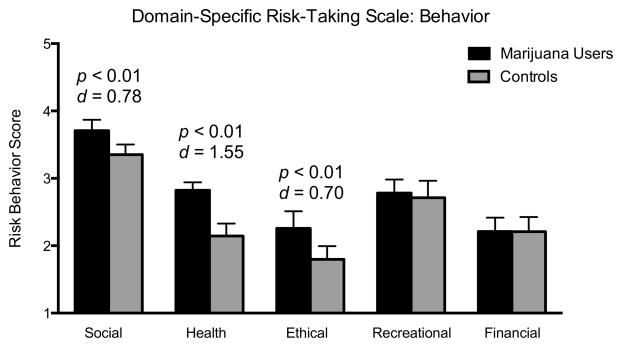
In the current study, we assessed risk-taking in young adult (age 18-25) regular marijuana users and in non-using control participants using a domain-specific risk-taking self-report scale (DOSPERT) encompassing five domains of risk-taking (social, financial, recreational, health/safety, and ethical). We also measured behavioral risk-taking using a laboratory monetary risk-taking task.
Marijuana users and controls reported significant differences on the social, health/safety, and ethical risk-taking scales, but no differences in the propensity to take recreational or financial risks. Complementing the self-report finding, there were no differences between marijuana users and controls in their performance on the laboratory risk-taking task.
These findings suggest that financial risk-taking may be less sensitive than other domains of risk-taking in assessing differences in risky behavior between those who use marijuana and those who do not. In order to more consistently determine whether increased risk-taking is a factor in substance use, it may be necessary to use both monetary risk-taking tasks and complementary assessments of non-monetary-based risk-taking measures.
尽管在现实场景中物质使用往往与冒险行为增加有关,但实验心理学中许多使用金钱赌博的冒险任务未能发现物质使用障碍患者与健康对照者之间存在显著差异。我们评估了使用大麻的参与者在包括但不限于金融冒险在内的不同领域是否会表现出更大的冒险倾向。
在本研究中,我们使用特定领域冒险自我报告量表(DOSPERT)评估了年轻成年人(18 - 25岁)中经常使用大麻的使用者和不使用大麻的对照参与者的冒险行为,该量表涵盖五个冒险领域(社交、金融、娱乐、健康/安全和道德)。我们还使用实验室金钱冒险任务测量了行为冒险。
大麻使用者和对照者在社交、健康/安全和道德冒险量表上报告了显著差异,但在娱乐或金融冒险倾向上没有差异。与自我报告结果相补充的是,大麻使用者和对照者在实验室冒险任务中的表现没有差异。
这些发现表明,在评估使用大麻者和不使用大麻者之间的冒险行为差异时,金融冒险可能比其他冒险领域更不敏感。为了更一致地确定冒险行为增加是否是物质使用的一个因素,可能有必要同时使用金钱冒险任务和基于非金钱的冒险措施的补充评估。