Ge Tian, Nichols Thomas E, Ghosh Debashis, Mormino Elizabeth C, Smoller Jordan W, Sabuncu Mert R
Athinoula A. Martinos Center for Biomedical Imaging, Massachusetts General Hospital / Harvard Medical School, Charlestown, MA 02129, USA.
Psychiatric and Neurodevelopmental Genetics Unit, Center for Human Genetic Research, Massachusetts General Hospital, Boston, MA 02114, USA.
Neuroimage. 2015 Apr 1;109:505-514. doi: 10.1016/j.neuroimage.2015.01.029. Epub 2015 Jan 16.
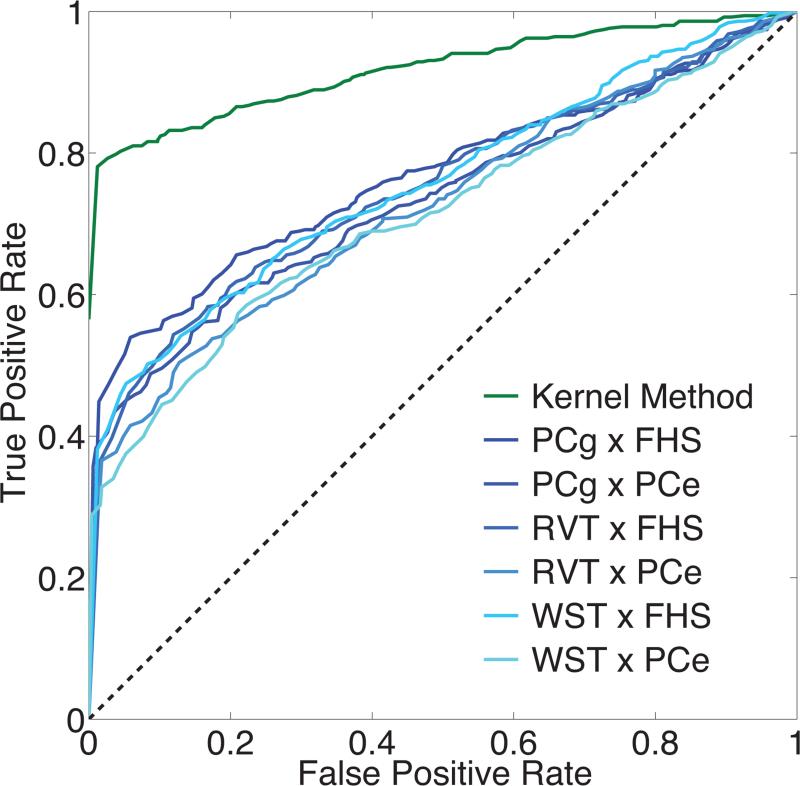
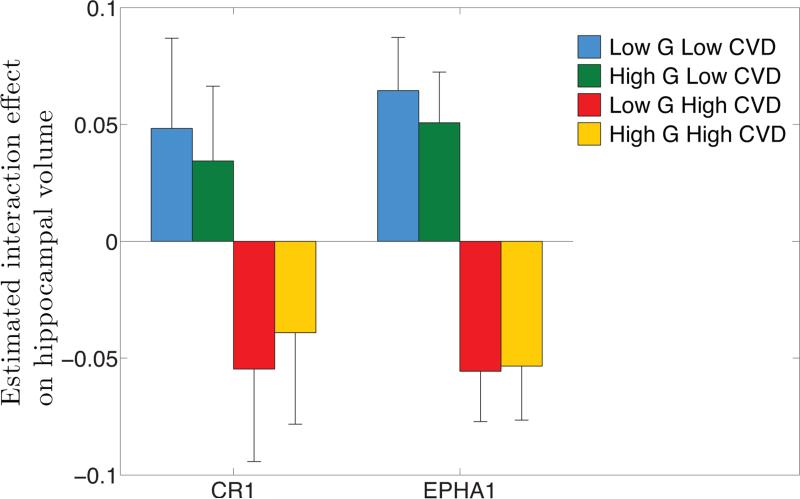
Measurements derived from neuroimaging data can serve as markers of disease and/or healthy development, are largely heritable, and have been increasingly utilized as (intermediate) phenotypes in genetic association studies. To date, imaging genetic studies have mostly focused on discovering isolated genetic effects, typically ignoring potential interactions with non-genetic variables such as disease risk factors, environmental exposures, and epigenetic markers. However, identifying significant interaction effects is critical for revealing the true relationship between genetic and phenotypic variables, and shedding light on disease mechanisms. In this paper, we present a general kernel machine based method for detecting effects of the interaction between multidimensional variable sets. This method can model the joint and epistatic effect of a collection of single nucleotide polymorphisms (SNPs), accommodate multiple factors that potentially moderate genetic influences, and test for nonlinear interactions between sets of variables in a flexible framework. As a demonstration of application, we applied the method to the data from the Alzheimer's Disease Neuroimaging Initiative (ADNI) to detect the effects of the interactions between candidate Alzheimer's disease (AD) risk genes and a collection of cardiovascular disease (CVD) risk factors, on hippocampal volume measurements derived from structural brain magnetic resonance imaging (MRI) scans. Our method identified that two genes, CR1 and EPHA1, demonstrate significant interactions with CVD risk factors on hippocampal volume, suggesting that CR1 and EPHA1 may play a role in influencing AD-related neurodegeneration in the presence of CVD risks.
从神经影像数据中得出的测量结果可作为疾病和/或健康发育的标志物,在很大程度上具有遗传性,并且在基因关联研究中越来越多地被用作(中间)表型。迄今为止,影像遗传学研究大多集中于发现孤立的基因效应,通常忽略了与非基因变量(如疾病风险因素、环境暴露和表观遗传标记)的潜在相互作用。然而,识别显著的相互作用效应对于揭示基因和表型变量之间的真实关系以及阐明疾病机制至关重要。在本文中,我们提出了一种基于通用核机器的方法,用于检测多维变量集之间相互作用的效应。该方法可以对单核苷酸多态性(SNP)集合的联合和上位效应进行建模,纳入多个可能调节基因影响的因素,并在一个灵活的框架中测试变量集之间的非线性相互作用。作为应用示例,我们将该方法应用于阿尔茨海默病神经影像倡议(ADNI)的数据,以检测候选阿尔茨海默病(AD)风险基因与心血管疾病(CVD)风险因素集合之间的相互作用对源自结构性脑磁共振成像(MRI)扫描的海马体积测量结果的影响。我们的方法确定,CR1和EPHA1这两个基因在海马体积上与CVD风险因素表现出显著的相互作用,表明在存在CVD风险的情况下,CR1和EPHA1可能在影响AD相关神经退行性变中发挥作用。