Fang Li-Qun, Goeijenbier Marco, Zuo Shu-Qing, Wang Li-Ping, Liang Song, Klein Sabra L, Li Xin-Lou, Liu Kun, Liang Lu, Gong Peng, Glass Gregory E, van Gorp Eric, Richardus Jan H, Ma Jia-Qi, Cao Wu-Chun, de Vlas Sake J
State Key Laboratory of Pathogen and Biosecurity, Beijing Institute of Microbiology and Epidemiology, Beijing 100071, China.
Department of Viroscience, Erasmus MC, University Medical Center Rotterdam, Rotterdam 3015CE, The Netherlands.
Viruses. 2015 Jan 20;7(1):333-51. doi: 10.3390/v7010333.
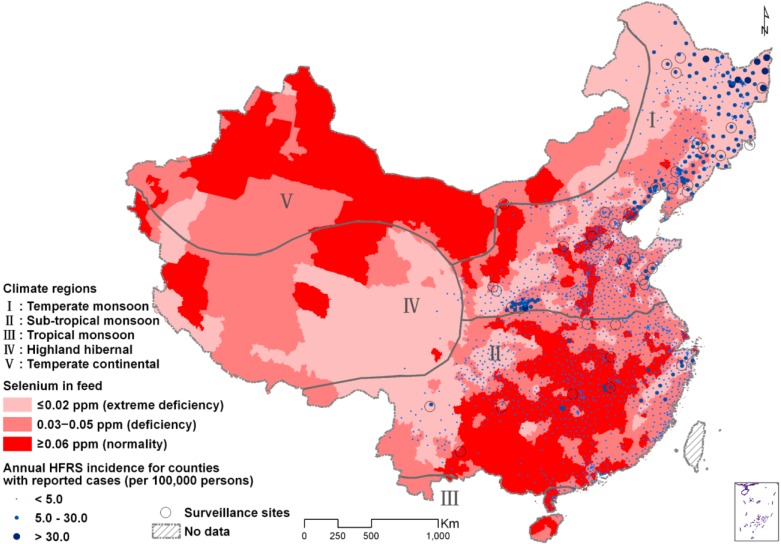
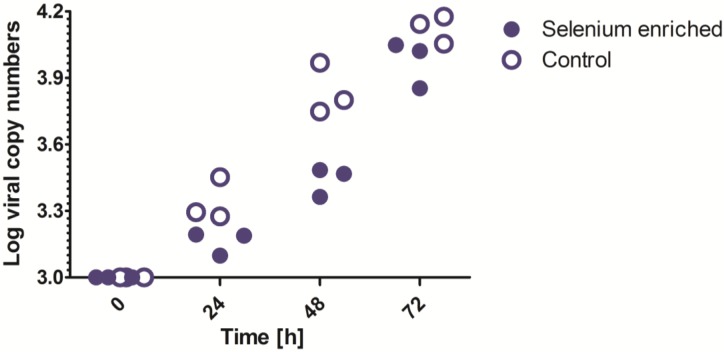
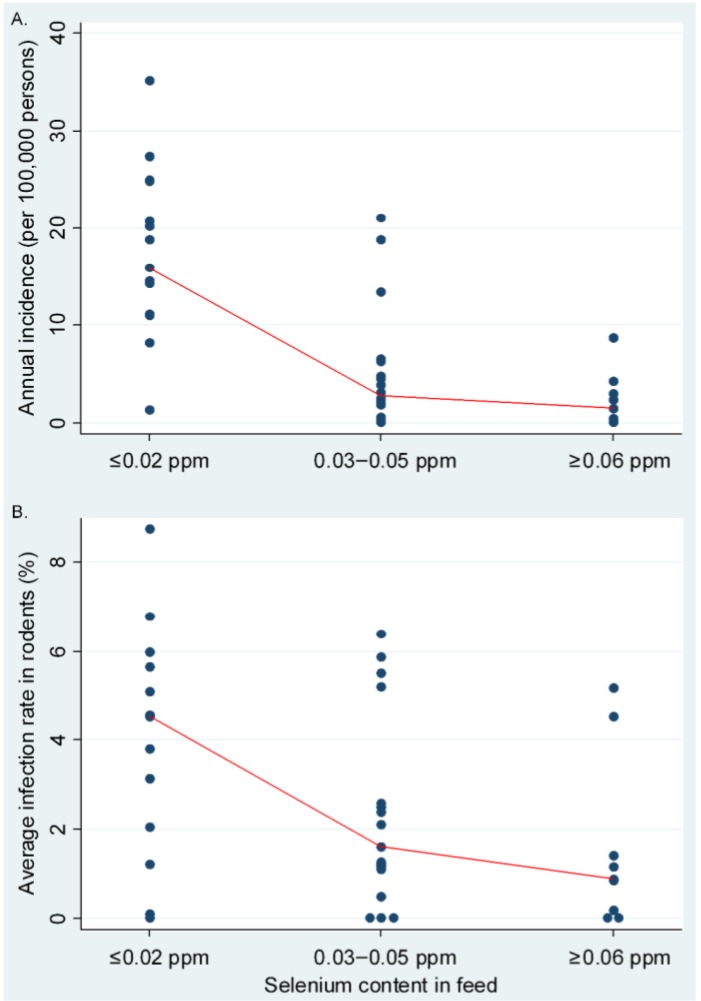
Hemorrhagic fever with renal syndrome (HFRS) caused by hantaviruses and transmitted by rodents is a significant public health problem in China, and occurs more frequently in selenium-deficient regions. To study the role of selenium concentration in HFRS incidence we used a multidisciplinary approach combining ecological analysis with preliminary experimental data. The incidence of HFRS in humans was about six times higher in severe selenium-deficient and double in moderate deficient areas compared to non-deficient areas. This association became statistically stronger after correction for other significant environment-related factors (low elevation, few grasslands, or an abundance of forests) and was independent of geographical scale by separate analyses for different climate regions. A case-control study of HFRS patients admitted to the hospital revealed increased activity and plasma levels of selenium binding proteins while selenium supplementation in vitro decreased viral replication in an endothelial cell model after infection with a low multiplicity of infection (MOI). Viral replication with a higher MOI was not affected by selenium supplementation. Our findings indicate that selenium deficiency may contribute to an increased prevalence of hantavirus infections in both humans and rodents. Future studies are needed to further examine the exact mechanism behind this observation before selenium supplementation in deficient areas could be implemented for HFRS prevention.
由汉坦病毒引起并通过啮齿动物传播的肾综合征出血热(HFRS)在中国是一个重大的公共卫生问题,且在缺硒地区更为频发。为研究硒浓度在HFRS发病中的作用,我们采用了多学科方法,将生态分析与初步实验数据相结合。与非缺硒地区相比,严重缺硒地区人类HFRS发病率约高六倍,中度缺硒地区则高两倍。在校正其他与环境相关的重要因素(低海拔、少草原或森林繁茂)后,这种关联在统计学上变得更强,并且通过对不同气候区域的单独分析,该关联与地理尺度无关。一项针对住院HFRS患者的病例对照研究显示,硒结合蛋白的活性和血浆水平升高,而在低感染复数(MOI)感染内皮细胞模型后,体外补充硒可降低病毒复制。高MOI的病毒复制不受补充硒的影响。我们的研究结果表明,缺硒可能导致人类和啮齿动物中汉坦病毒感染率增加。在缺硒地区实施补充硒以预防HFRS之前,需要进一步研究以明确这一观察结果背后的确切机制。