Braadland Peder Rustøen, Ramberg Håkon, Grytli Helene Hartvedt, Taskén Kristin Austlid
Department of Tumor Biology, Institute of Cancer Research, Division of Cancer Medicine, Transplantation and Surgery, Oslo University Hospital , Oslo , Norway.
Department of Tumor Biology, Institute of Cancer Research, Division of Cancer Medicine, Transplantation and Surgery, Oslo University Hospital , Oslo , Norway ; Institute of Clinical Medicine, University of Oslo , Oslo , Norway.
Front Oncol. 2015 Jan 12;4:375. doi: 10.3389/fonc.2014.00375. eCollection 2014.
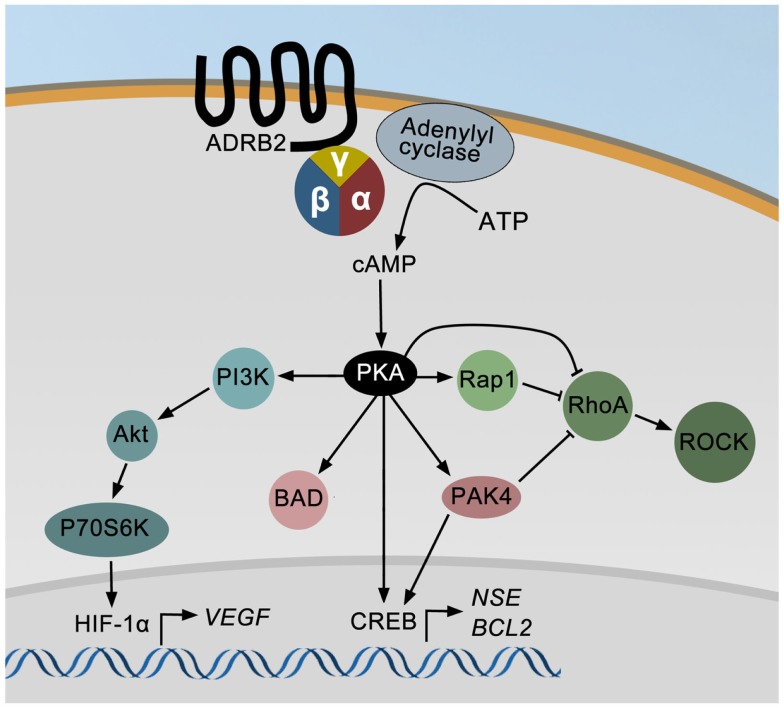
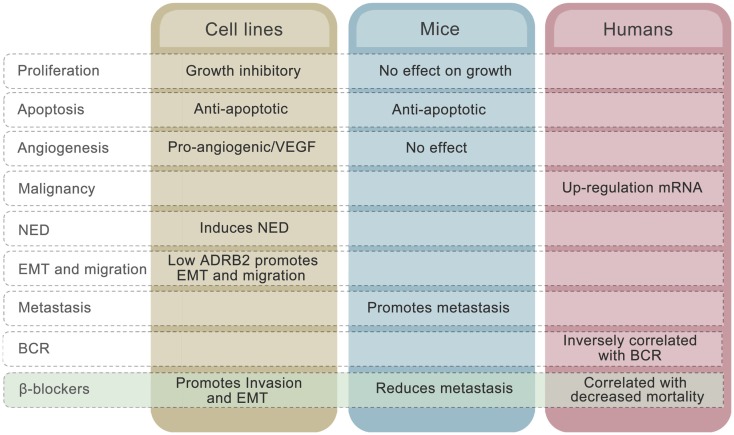
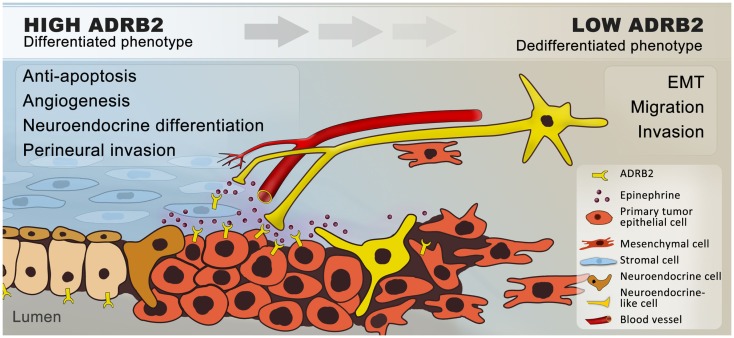
Enhanced sympathetic signaling, often associated with obesity and chronic stress, is increasingly acknowledged as a contributor to cancer aggressiveness. In prostate cancer, intact sympathetic nerves are critical for tumor formation, and sympathectomy induces apoptosis and blocks tumor growth. Perineural invasion, involving enrichment of intra-prostatic nerves, is frequently observed in prostate cancer and is associated with poor prognosis. β2-adrenergic receptor (ADRB2), the most abundant receptor for sympathetic signals in prostate luminal cells, has been shown to regulate trans-differentiation of cancer cells to neuroendocrine-like cells and to affect apoptosis, angiogenesis, epithelial-mesenchymal transition, migration, and metastasis. Epidemiologic studies have shown that use of β-blockers, inhibiting β-adrenergic receptor activity, is associated with reduced prostate cancer-specific mortality. In this review, we aim to present an overview on how β-adrenergic receptor and its downstream signaling cascade influence the development of aggressive prostate cancer, primarily through regulating neuroendocrine differentiation.
增强的交感神经信号传导通常与肥胖和慢性应激相关,越来越被认为是癌症侵袭性的一个促成因素。在前列腺癌中,完整的交感神经对肿瘤形成至关重要,而交感神经切除术可诱导细胞凋亡并阻断肿瘤生长。神经周围浸润,包括前列腺内神经的富集,在前列腺癌中经常观察到,并与不良预后相关。β2-肾上腺素能受体(ADRB2)是前列腺管腔细胞中最丰富的交感神经信号受体,已被证明可调节癌细胞向神经内分泌样细胞的转分化,并影响细胞凋亡、血管生成、上皮-间质转化、迁移和转移。流行病学研究表明,使用抑制β-肾上腺素能受体活性的β-阻滞剂与降低前列腺癌特异性死亡率相关。在这篇综述中,我们旨在概述β-肾上腺素能受体及其下游信号级联如何主要通过调节神经内分泌分化来影响侵袭性前列腺癌的发展。