Chajès Véronique, Biessy Carine, Ferrari Pietro, Romieu Isabelle, Freisling Heinz, Huybrechts Inge, Scalbert Augustin, Bueno de Mesquita Bas, Romaguera Dora, Gunter Marc J, Vineis Paolo, Hansen Camilla Plambeck, Jakobsen Marianne Uhre, Clavel-Chapelon Françoise, Fagherazzi Guy, Boutron-Ruault Marie-Christine, Katzke Verana, Neamat-Allah Jasmine, Boeing Heiner, Bachlechner Ursula, Trichopoulou Antonia, Naska Androniki, Orfanos Philippos, Pala Valeria, Masala Giovanna, Mattiello Amalia, Skeie Guri, Weiderpass Elisabete, Agudo Antonio, Huerta Jose Maria, Ardanaz Eva, Sánchez Maria Jose, Dorronsoro Miren, Quirós Jose Ramon, Johansson Ingegerd, Winkvist Anna, Sonested Emily, Key Tim, Khaw Kay-Tee, Wareham Nicolas J, Peeters Petra H M, Slimani Nadia
Nutrition and Metabolism Section, International Agency for Research on Cancer, Lyon, France.
Department of Epidemiology and Biostatistics, The School of Public Health, Imperial College London, London, United Kingdom; Department For Determinants of Chronic Diseases (DCD), National Institute for Public Health and the Environment (RIVM), Bilthoven, The Netherlands; Department of Gastroenterology and Hepatology, University Medical Centre, Utrecht, The Netherlands; Department of Social & Preventive Medicine, Faculty of Medicine, University of Malaya, Kuala Lumpur, Malaysia.
PLoS One. 2015 Feb 12;10(2):e0118206. doi: 10.1371/journal.pone.0118206. eCollection 2015.
Few epidemiological studies have examined the association between dietary trans fatty acids and weight gain, and the evidence remains inconsistent. The main objective of the study was to investigate the prospective association between biomarker of industrial trans fatty acids and change in weight within the large study European Prospective Investigation into Cancer and Nutrition (EPIC) cohort.
Baseline plasma fatty acid concentrations were determined in a representative EPIC sample from the 23 participating EPIC centers. A total of 1,945 individuals were followed for a median of 4.9 years to monitor weight change. The association between elaidic acid level and percent change of weight was investigated using a multinomial logistic regression model, adjusted by length of follow-up, age, energy, alcohol, smoking status, physical activity, and region.
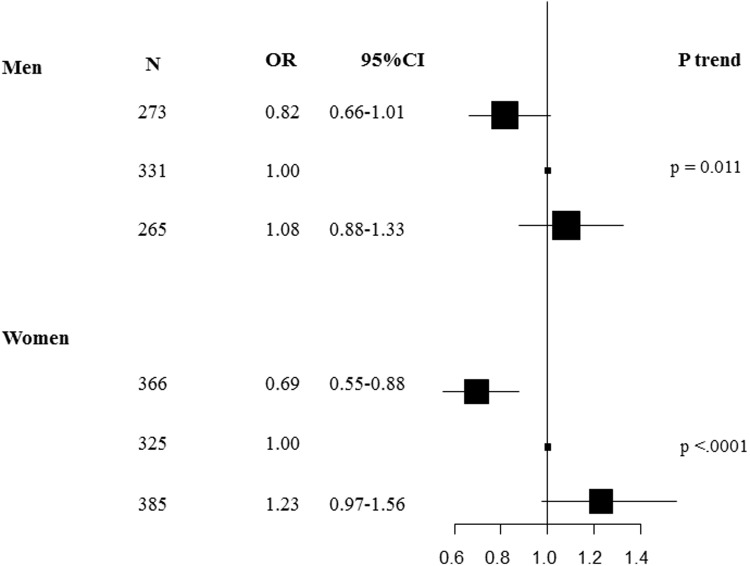
In women, doubling elaidic acid was associated with a decreased risk of weight loss (odds ratio (OR) = 0.69, 95% confidence interval (CI) = 0.55-0.88, p = 0.002) and a trend was observed with an increased risk of weight gain during the 5-year follow-up (OR = 1.23, 95% CI = 0.97-1.56, p = 0.082) (p-trend<.0001). In men, a trend was observed for doubling elaidic acid level and risk of weight loss (OR = 0.82, 95% CI = 0.66-1.01, p = 0.062) while no significant association was found with risk of weight gain during the 5-year follow-up (OR = 1.08, 95% CI = 0.88-1.33, p = 0.454). No association was found for saturated and cis-monounsaturated fatty acids.
These data suggest that a high intake of industrial trans fatty acids may decrease the risk of weight loss, particularly in women. Prevention of obesity should consider limiting the consumption of highly processed foods, the main source of industrially-produced trans fatty acids.
很少有流行病学研究探讨膳食反式脂肪酸与体重增加之间的关联,证据仍不一致。本研究的主要目的是在大型欧洲癌症与营养前瞻性调查(EPIC)队列中,调查工业反式脂肪酸生物标志物与体重变化之间的前瞻性关联。
在来自23个参与EPIC中心的代表性EPIC样本中测定基线血浆脂肪酸浓度。共对1945名个体进行了中位数为4.9年的随访,以监测体重变化。使用多项逻辑回归模型研究反油酸水平与体重变化百分比之间的关联,并根据随访时间、年龄、能量、酒精、吸烟状况、身体活动和地区进行调整。
在女性中,反油酸翻倍与体重减轻风险降低相关(比值比(OR)=0.69,95%置信区间(CI)=0.55-0.88,p=0.002),并且在5年随访期间观察到体重增加风险增加的趋势(OR=1.23,95%CI=0.97-1.56,p=0.082)(p趋势<0.0001)。在男性中,观察到反油酸水平翻倍与体重减轻风险的趋势(OR=0.82,95%CI=0.66-1.01,p=0.062),而在5年随访期间未发现与体重增加风险有显著关联(OR=1.08,95%CI=0.88-1.33,p=0.454)。未发现饱和脂肪酸和顺式单不饱和脂肪酸有相关性。
这些数据表明,高摄入工业反式脂肪酸可能会降低体重减轻的风险,尤其是在女性中。预防肥胖应考虑限制食用高加工食品,这是工业生产反式脂肪酸的主要来源。