Institute of Novel and Emerging Infectious Diseases, Friedrich-Loeffler-Institut, Federal Research Institute for Animal Health, Greifswald-Isle of Riems, Germany.
Faculty of Veterinary Medicine, Kafkas University, Department of Parasitology, Kars, Turkey.
PLoS Negl Trop Dis. 2015 Mar 5;9(3):e0003519. doi: 10.1371/journal.pntd.0003519. eCollection 2015 Mar.
There are only few assays available for the detection of Crimean-Congo Hemorrhagic Fever Virus (CCHFV)-specific antibodies in animals, and data about diagnostic sensitivity and specificity are incompletely documented for most of these tests. This is unfortunate since CCHFV antibodies in animals can be used as indicator for virus circulation in a geographic area and therewith potential risk of human exposure. This paper therefore reports on a novel ELISA for the detection of CCHFV-specific antibodies in cattle and on its application for testing ruminant sera from the Former Yugoslav Republic of Macedonia.
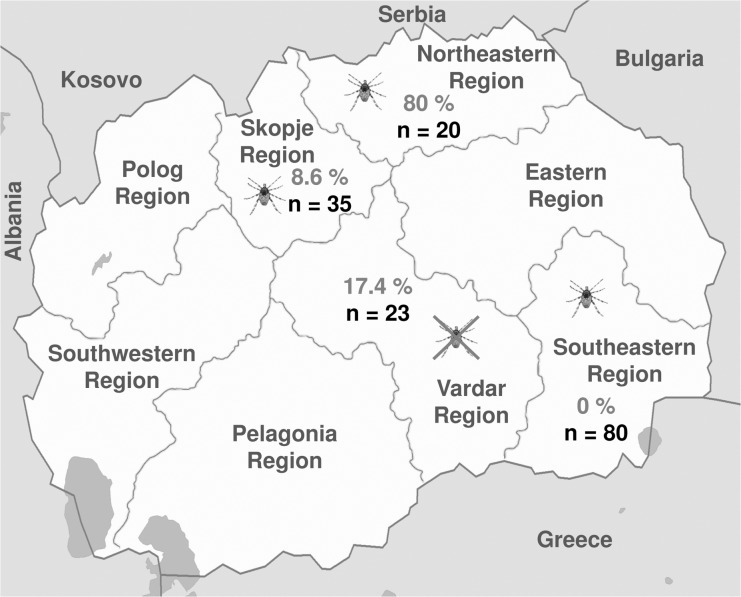
A highly sensitive and specific ELISA was developed to detect CCHFV-specific IgG antibodies in cattle. The assay was validated by using 503 negative serum samples from a country where CCHFV has never been detected until now, and by using 54 positive serum samples. The positive sera were verified by using two commercially available assays (for testing human serum) which we have adapted for use in animals. The sensitivity of the novel ELISA was 98% and its specificity 99%. The presence of Hyalomma ticks was demonstrated in the Former Yugoslav Republic of Macedonia and depending on the region antibody prevalence rates up to 80% were detected in the cattle population.
This article describes a fully validated, highly sensitive and specific ELISA for the detection of CCHFV-specific IgG antibodies in cattle. Using this assay, CCHFV-specific antibodies were detected for the first time in cattle in the Former Yugoslav Republic of Macedonia, giving evidence for an active circulation of this virus in the country. Supporting this conclusion, the occurrence of the main vector of CCHFV was demonstrated in the present work for the first time in Former Yugoslav Republic of Macedonia.
目前仅有少数几种检测方法可用于检测动物体内的克里米亚-刚果出血热病毒(CCHFV)特异性抗体,并且这些检测方法的大多数诊断敏感性和特异性数据都不完整。这很不幸,因为动物体内的 CCHFV 抗体可用作病毒在特定地理区域内传播的指标,并且可能存在人类暴露的潜在风险。因此,本文报告了一种用于检测牛体内 CCHFV 特异性抗体的新型 ELISA,并报告了其在测试前南斯拉夫的马其顿共和国反刍动物血清中的应用。
开发了一种高度敏感和特异性的 ELISA 来检测牛体内的 CCHFV 特异性 IgG 抗体。该检测方法通过使用来自一个迄今为止从未检测到 CCHFV 的国家的 503 份阴性血清样本进行了验证,并且使用了 54 份阳性血清样本进行了验证。阳性血清通过使用两种市售的检测试剂盒(用于检测人血清)进行了验证,我们已将其适应于动物使用。新型 ELISA 的敏感性为 98%,特异性为 99%。在前南斯拉夫的马其顿共和国,证明了有钝缘蜱的存在,并且根据该地区的不同,牛群中的抗体流行率高达 80%。
本文描述了一种完全验证的、高度敏感和特异性的 ELISA,用于检测牛体内的 CCHFV 特异性 IgG 抗体。使用该检测方法,首次在前南斯拉夫的马其顿共和国的牛体内检测到了 CCHFV 特异性抗体,证明了该病毒在该国的活跃传播。本研究首次证明了主要 CCHFV 传播媒介的存在,支持了这一结论。