El Baz Soraia, Baz Mohamed, Barakate Mustapha, Hassani Lahcen, El Gharmali Abdelhay, Imziln Boujamâa
Environmental Microbiology and Toxicology Unit, Laboratory of Biology and Biotechnology of Microorganisms (LBBM), Faculty of Sciences Semlalia, Cadi Ayyad University, P.O. Box 2390, 40000 Marrakech, Morocco.
Laboratory of Hydrobiology, Ecotoxicology and Assainissement (LHEA), Faculty of Sciences Semlalia, Cadi Ayyad University, P.O. Box 2390, 40000 Marrakech, Morocco.
ScientificWorldJournal. 2015;2015:761834. doi: 10.1155/2015/761834. Epub 2015 Feb 11.
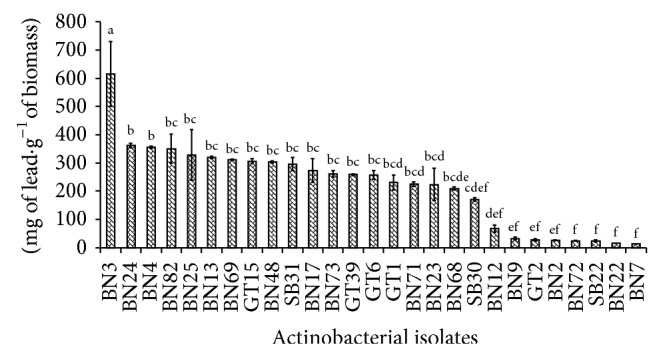
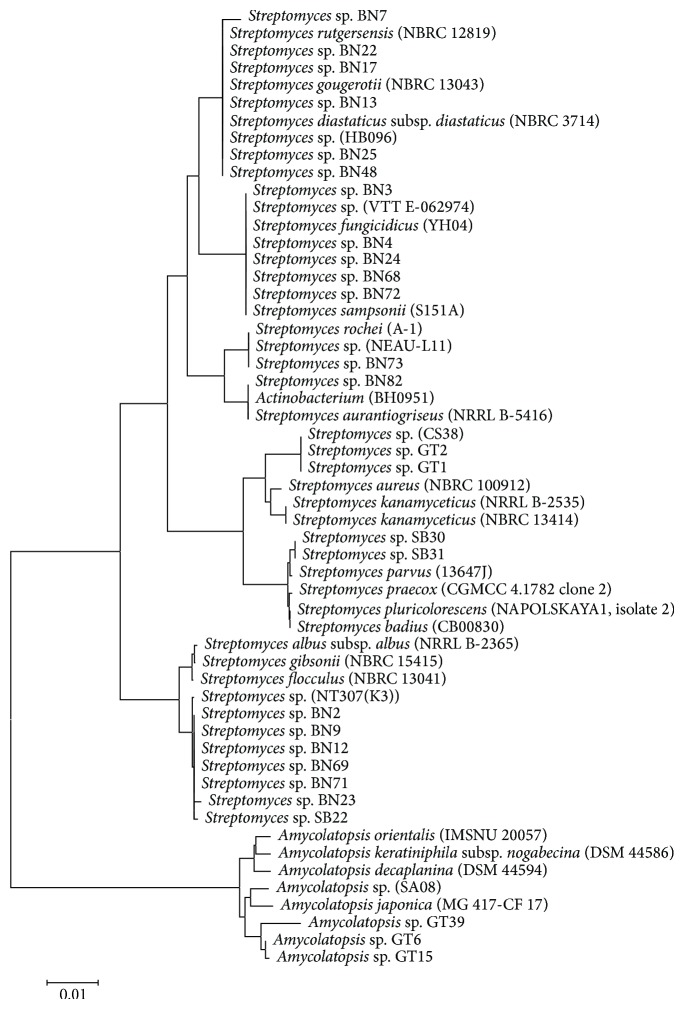
Accumulation of high concentrations of heavy metals in environments can cause many human health risks and serious ecological problems. Nowadays, bioremediation using microorganisms is receiving much attention due to their good performance. The aim of this work is to investigate heavy metals resistance and bioaccumulation potential of actinobacteria strains isolated from some abandoned mining areas. Analysis of mining residues revealed that high concentration of zinc "Zn" was recorded in Sidi Bouatman, Arbar, and Bir Nhass mining residues. The highest concentration of lead "Pb" was found in Sidi Bouatman. Copper "Cu," cadmium "Cd," and chromium "Cr" were found with moderate and low concentrations. The resistance of 59 isolated actinobacteria to the five heavy metals was also determined. Using molecular identification 16S rRNA, these 27 isolates were found to belong to Streptomyces and Amycolatopsis genera. The results showed different levels of heavy metal resistance; the minimum inhibitory concentration (MIC) recorded was 0.55 for Pb, 0.15 for Cr, and 0.10 mg·mL(-1) for both Zn and Cu. Chemical precipitation assay of heavy metals using hydrogen sulfide technic (H2S) revealed that only 27 isolates have a strong ability to accumulate Pb (up to 600 mg of Pb per g of biomass for Streptomyces sp. BN3).
环境中高浓度重金属的积累会引发诸多人类健康风险和严重的生态问题。如今,利用微生物进行生物修复因其良好的性能而备受关注。这项工作的目的是研究从一些废弃矿区分离出的放线菌菌株对重金属的抗性和生物积累潜力。对采矿残渣的分析表明,在西迪布阿特曼、阿尔巴尔和比尔尼亚斯的采矿残渣中记录到高浓度的锌(Zn)。在西迪布阿特曼发现了最高浓度的铅(Pb)。铜(Cu)、镉(Cd)和铬(Cr)的浓度为中度和低度。还测定了59株分离出的放线菌对这五种重金属的抗性。通过16S rRNA分子鉴定发现,这27株分离菌属于链霉菌属和拟无枝菌酸菌属。结果显示出不同水平的重金属抗性;记录到的最低抑菌浓度(MIC),铅为0.55,铬为0.15,锌和铜均为0.10毫克·毫升⁻¹。使用硫化氢技术(H₂S)对重金属进行化学沉淀分析表明,只有27株分离菌具有很强的积累铅的能力(链霉菌BN3每克生物量最多可积累600毫克铅)。