Koskiniemi Sanna, Garza-Sánchez Fernando, Edman Natasha, Chaudhuri Swarnava, Poole Stephen J, Manoil Colin, Hayes Christopher S, Low David A
Department of Molecular, Cellular and Developmental Biology, University of California Santa Barbara, Santa Barbara, California, United States of America.
Department of Genome Sciences, Box 355065, University of Washington, Seattle, Washington, United States of America.
PLoS One. 2015 Mar 18;10(3):e0120265. doi: 10.1371/journal.pone.0120265. eCollection 2015.
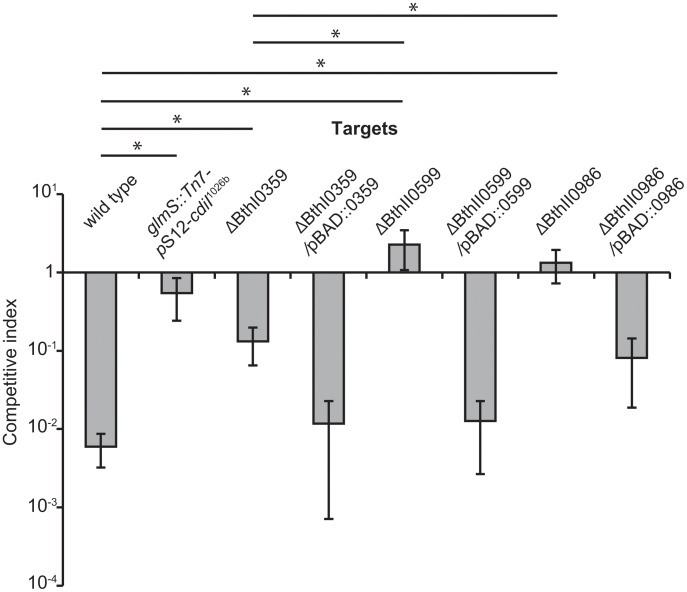
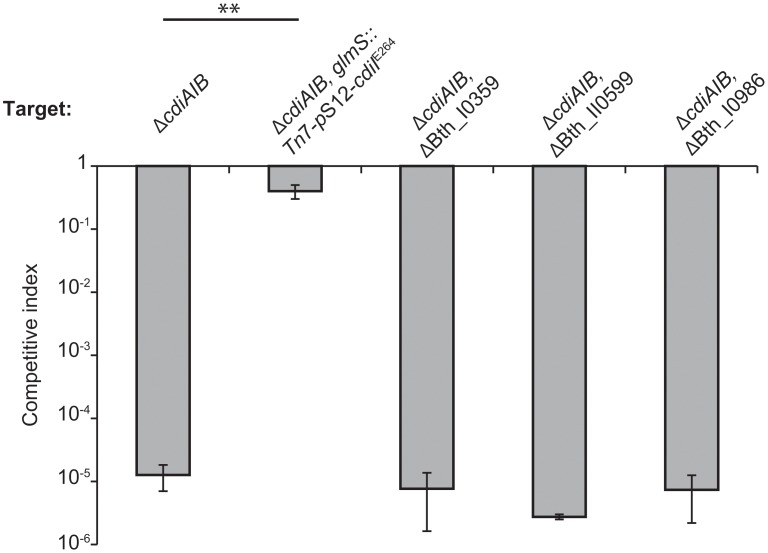
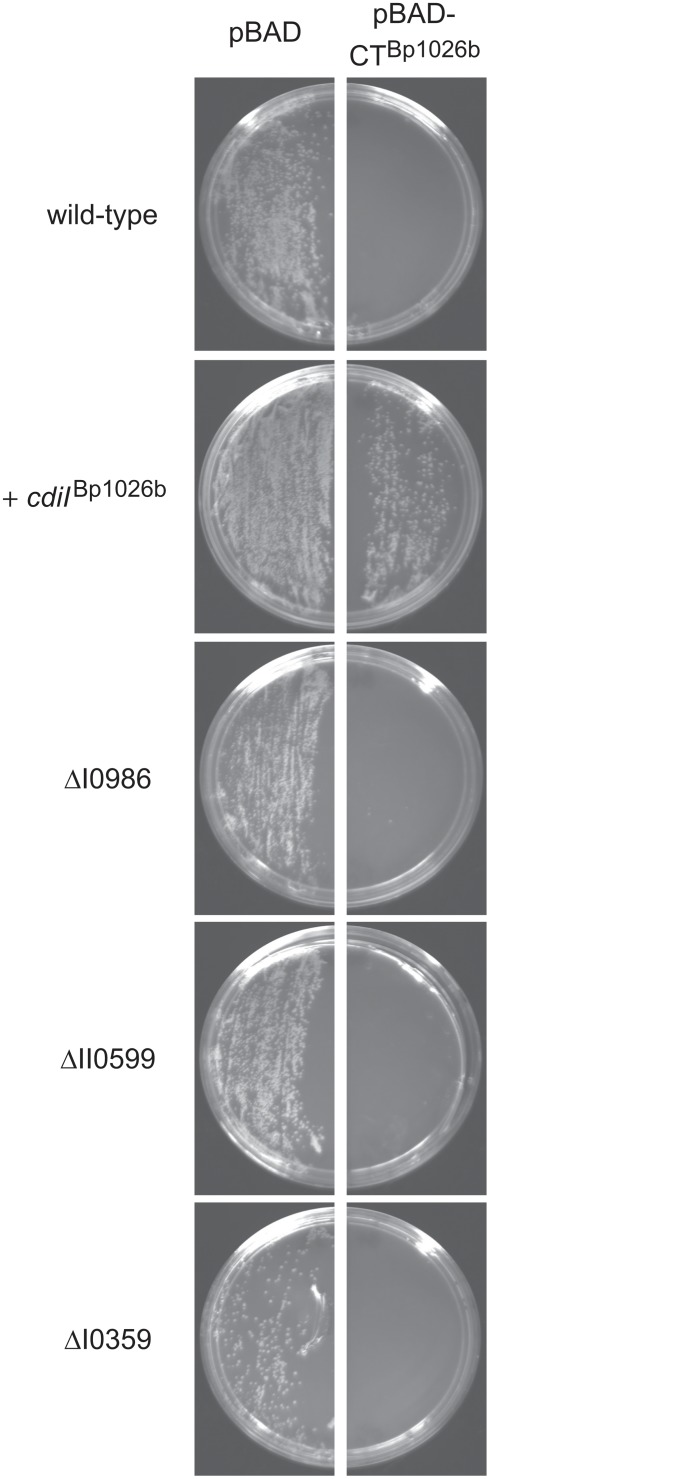
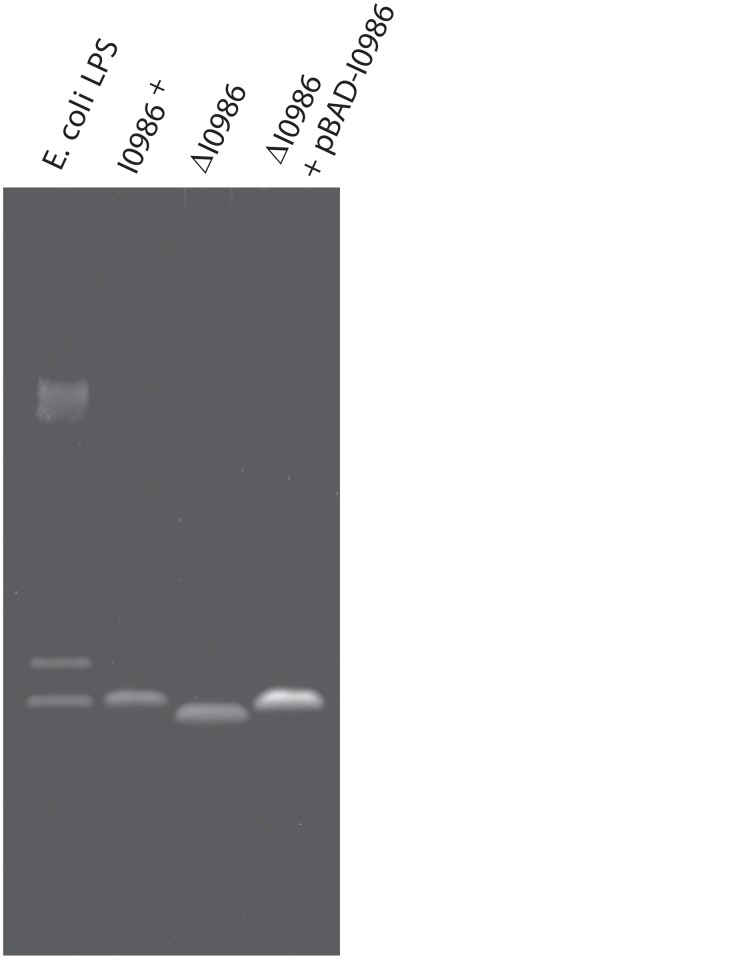
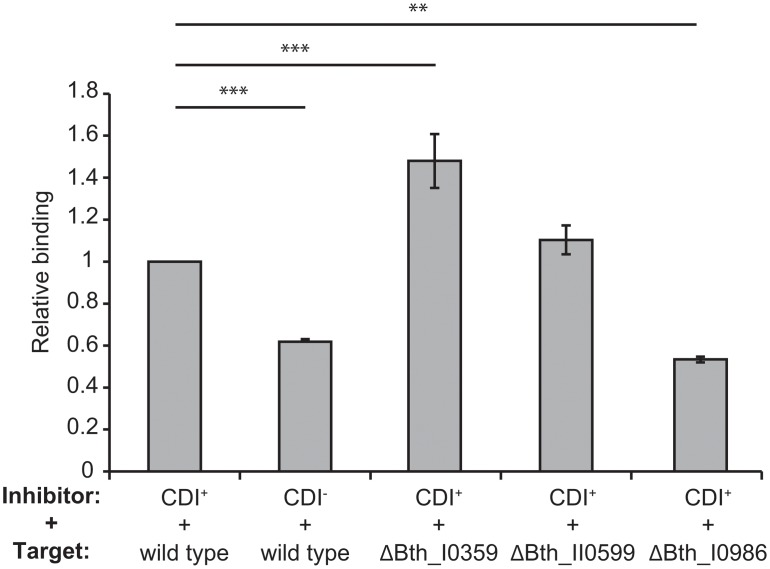
Contact-dependent growth inhibition (CDI) is a mode of inter-bacterial competition mediated by the CdiB/CdiA family of two-partner secretion systems. CdiA binds to receptors on susceptible target bacteria, then delivers a toxin domain derived from its C-terminus. Studies with Escherichia coli suggest the existence of multiple CDI growth-inhibition pathways, whereby different systems exploit distinct target-cell proteins to deliver and activate toxins. Here, we explore the CDI pathway in Burkholderia using the CDIIIBp1026b system encoded on chromosome II of Burkholderia pseudomallei 1026b as a model. We took a genetic approach and selected Burkholderia thailandensis E264 mutants that are resistant to growth inhibition by CDIIIBp1026b. We identified mutations in three genes, BTH_I0359, BTH_II0599, and BTH_I0986, each of which confers resistance to CDIIIBp1026b. BTH_I0359 encodes a small peptide of unknown function, whereas BTH_II0599 encodes a predicted inner membrane transport protein of the major facilitator superfamily. The inner membrane localization of BTH_II0599 suggests that it may facilitate translocation of CdiA-CTIIBp1026b toxin from the periplasm into the cytoplasm of target cells. BTH_I0986 encodes a putative transglycosylase involved in lipopolysaccharide (LPS) synthesis. ∆BTH_I0986 mutants have altered LPS structure and do not interact with CDI⁺ inhibitor cells to the same extent as BTH_I0986⁺ cells, suggesting that LPS could function as a receptor for CdiAIIBp1026b. Although ∆BTH_I0359, ∆BTH_II0599, and ∆BTH_I0986 mutations confer resistance to CDIIIBp1026b, they provide no protection against the CDIE264 system deployed by B. thailandensis E264. Together, these findings demonstrate that CDI growth-inhibition pathways are distinct and can differ significantly even between closely related species.
接触依赖性生长抑制(CDI)是一种由双组分分泌系统的CdiB/CdiA家族介导的细菌间竞争模式。CdiA与易感靶细菌上的受体结合,然后传递其C末端衍生的毒素结构域。对大肠杆菌的研究表明存在多种CDI生长抑制途径,不同的系统利用不同的靶细胞蛋白来传递和激活毒素。在这里,我们以编码在类鼻疽杆菌1026b染色体II上的CDIIIBp1026b系统为模型,探索类鼻疽杆菌中的CDI途径。我们采用遗传学方法,筛选出对CDIIIBp1026b生长抑制具有抗性的泰国伯克霍尔德菌E264突变体。我们在三个基因BTH_I0359、BTH_II0599和BTH_I0986中鉴定到突变,每个突变都赋予对CDIIIBp1026b的抗性。BTH_I0359编码一个功能未知的小肽,而BTH_II0599编码一个预测的主要易化子超家族的内膜转运蛋白。BTH_II0599的内膜定位表明它可能促进CdiA-CTIIBp1026b毒素从周质转运到靶细胞的细胞质中。BTH_I0986编码一种参与脂多糖(LPS)合成的推定转糖基酶。∆BTH_I0986突变体的LPS结构发生改变,并且与CDI⁺抑制细胞的相互作用程度不如BTH_I0986⁺细胞,这表明LPS可能作为CdiAIIBp1026b的受体。尽管∆BTH_I0359、∆BTH_II0599和∆BTH_I0986突变赋予对CDIIIBp1026b的抗性,但它们不能保护细胞免受泰国伯克霍尔德菌E264所部署的CDIE264系统的影响。总之,这些发现表明CDI生长抑制途径是不同的,甚至在密切相关的物种之间也可能有显著差异。